What Is a Desk Fee in Real Estate? A Clear Guide

What is a desk fee in real estate?
A desk fee is a fixed monthly charge that a real estate brokerage collects from each agent for the right to operate under the brokerage’s license, brand, and infrastructure. You pay it whether you close ten deals that month or zero. That flat, predictable nature is exactly what makes it different from a commission split, which rises and falls with your sales volume.
Brokerages use desk fees to maintain steady cash flow regardless of how the housing market is performing. From the broker’s side, it eliminates the financial risk of carrying agents who go months between closings. From your side, it means your biggest fixed cost is locked in before you write a single offer.
- Desk fees grant access to the brokerage’s license, branding, office space, and operational support
- The fee applies every month, regardless of how many deals you close
- Some brokerages charge desk fees alongside a commission split; others use desk fees as the sole revenue model
- Typical monthly desk fees run $200–$600, though high-service brokerages can charge more
- The fee gives the broker stable income and gives you a clear, predictable business expense to plan around
What do desk fees actually cover?
Most desk fees bundle several resources into one monthly charge, but the exact contents vary by brokerage. At a minimum, you can usually expect access to a physical workspace and the brokerage’s licensing umbrella. Beyond that, coverage gets more specific to each firm.
Common inclusions are:
- Office space and a physical desk for client meetings and daily work
- Telephone and internet access within the brokerage’s office
- Administrative support, such as transaction coordinators or front-desk staff
- Marketing materials, including branded templates, yard signs, and listing collateral
- Office supplies like printers, copiers, and paper
Here is where agents get caught off guard. Desk fees often coexist with a separate layer of shared brokerage expenses, such as MLS membership fees, technology subscriptions, and advertising costs. These may or may not be bundled into your desk fee. Franchise royalties, CRM platforms, and transaction management software are frequently billed as separate line items on top of the base desk fee. Reading your agreement carefully before signing tells you exactly which bucket each cost falls into.
How much do desk fees cost, and what else will you pay?
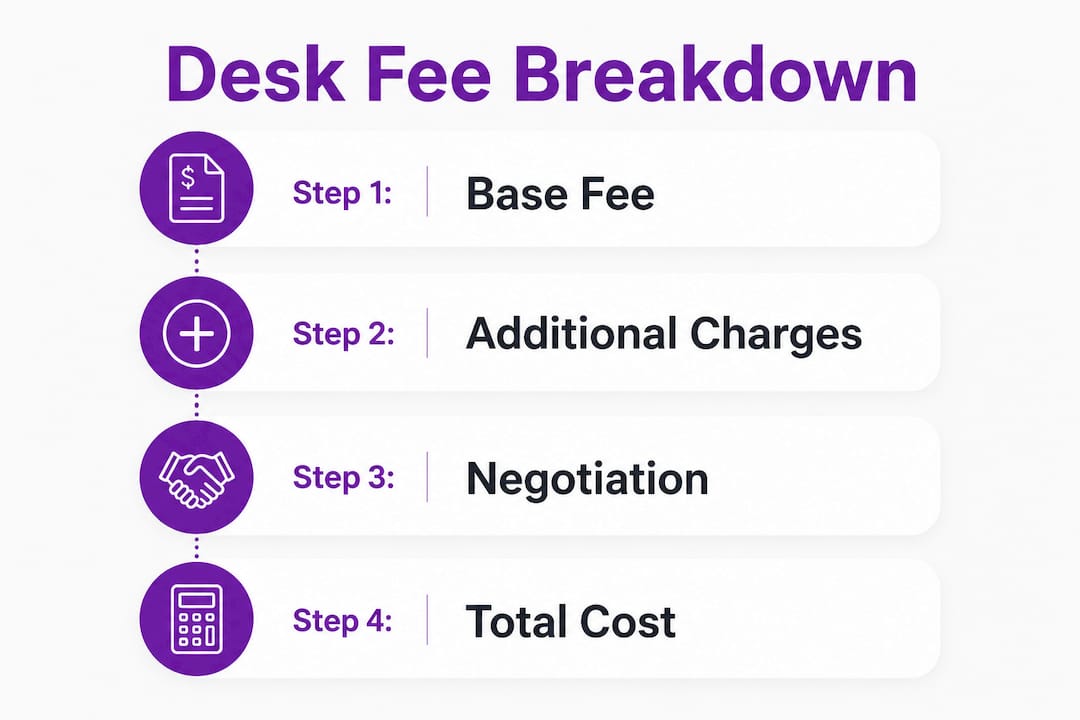
The base desk fee is rarely the only number that matters. Traditional brokerages layer several recurring charges on top of it, and the cumulative total can be much higher than the headline figure suggests.

| Fee category | Typical range | Notes |
|---|---|---|
| Base desk fee | $200–$600/month | — |
| Technology and CRM fees | $50–$500/month | Transaction management, CRM platforms |
| Franchise royalties | 4–6% per transaction | Applies at each closing |
| Coaching and training | Varies | Often an upsell, not always disclosed upfront |
Additional recurring costs agents frequently encounter include:
- Transaction fees, charged per closing on top of any split or desk fee
- Advertising and lead generation fees, sometimes mandatory through the brokerage’s platform
- Errors and omissions (E&O) insurance, either billed monthly or deducted per transaction
- Signage and lockbox fees, which most brokerages do not include in the base desk fee
Desk fees are also negotiable in many cases. Top-producing agents and those who work primarily remotely often negotiate reduced rates or full waivers, since the brokerage’s cost to serve them is lower. If you’re bringing consistent volume, it’s worth asking.
Pro Tip: Add up every recurring charge before comparing brokerages, not just the desk fee or the split percentage. Technology and CRM fees can add up to $6,000 per year on their own, which changes the math significantly.
How desk fees affect your commissions and earnings
The core trade-off in real estate brokerage fees is straightforward: pay a higher desk fee and keep more of your commission, or pay a lower desk fee and give the brokerage a cut of every closing. Neither model is universally better. The right answer depends on how much you sell.
In a 100% commission model, the desk fee is the brokerage’s entire revenue from you. You keep the full commission on every deal, but the monthly fee is your fixed overhead regardless of production. In a traditional split model, the desk fee is lower or nonexistent, but the brokerage takes 20%–40% of each commission check.
The math is simpler than it looks. Multiply your expected annual commission income by the split percentage, then compare that number to twelve months of the higher desk fee. Whichever total is lower is the better deal for your production level. Agents should compare expected annual commission against both models before signing with any brokerage.
One thing new agents consistently get wrong: assuming that zero or low desk fees means lower costs. Higher commission splits often reduce net income more than flat desk fees do for productive agents. A 30% split on $200,000 in annual commissions costs $60,000. A moderate fixed monthly desk fee costs a significant annual amount. The desk fee model wins by a wide margin at that production level.
Pros and cons of the desk fee model from an agent’s perspective:
- Pro: Predictable monthly cost makes budgeting straightforward
- Pro: You keep 100% (or close to it) of every commission check
- Pro: High producers save significantly compared to percentage splits
- Con: Fixed cost continues even in slow months with no closings
- Con: New agents with low volume may struggle to cover the fee before income arrives
- Con: Physical office fees can drain capital that could fund marketing or lead generation
Pro Tip: Treat your brokerage fee structure as a business decision, not a loyalty choice. Run the numbers at your current production level and at your target production level. The model that costs less at your goal volume is the one worth choosing.
Contractual and compliance considerations for desk fees
Desk fees must be spelled out explicitly in your Independent Contractor Agreement (ICA) with the brokerage. A vague contract that references “desk fees” without specifying the amount, billing cycle, and what is included creates room for disputes that are difficult to resolve later.
State regulatory guidance is clear on how these fees are treated for tax purposes. According to the Washington Department of Revenue, desk fees count as brokerage gross income regardless of whether they are deducted from a broker’s commission or billed separately. That classification has direct implications for how brokerages report income and how agents document their expenses.
Detailed fee documentation and clear Independent Contractor Agreements help avoid tax compliance problems and contractual conflicts later on.
Key compliance practices every agent should follow:
- Get itemized receipts for every desk fee payment. Clear, itemized records help you reconcile business expenses for tax deductions and prevent problems during tax season.
- Verify your 1099 accuracy. Since desk fees are part of brokerage gross income, they affect how your earnings are reported. Keeping your own records lets you catch discrepancies before they become IRS issues.
- Confirm the ICA covers fee changes. Some brokerages reserve the right to raise desk fees with minimal notice. Your contract should specify how and when fees can change.
- Understand what triggers additional charges. Some agreements include escalation clauses tied to production thresholds or office usage.
Tracking commission payments and fee deductions with a documented paper trail protects you at tax time and in any contract dispute. Platforms that automate this process reduce the risk of errors on both sides of the broker-agent relationship.
How to evaluate your total brokerage costs before you sign
Desk fees are one line item in a longer list of brokerage costs. Agents who focus only on the split percentage or the desk fee headline number often underestimate their actual annual brokerage expenses by a wide margin.
A complete cost picture includes:
- Commission split percentage applied to every closing
- Monthly desk fee, annualized
- Technology and CRM subscriptions, whether bundled or separate
- Franchise royalties, if the brokerage is part of a franchise network
- Transaction fees charged per closing
- Coaching or training program fees, especially if mandatory
- E&O insurance contributions
- Marketing and advertising fees required by the brokerage
To project your annual cost, add up every fixed monthly fee, multiply by twelve, then add the variable costs based on your expected number of closings. Run that calculation at your current production level and at the level you plan to reach in two to three years. A brokerage that looks affordable today may cost significantly more as your volume grows, especially if franchise royalties and transaction fees scale with each deal.
Pro Tip: Ask any brokerage to provide a complete written fee schedule before you sign. If they hesitate or say fees are “determined later,” that is a red flag. Transparent brokerages list every charge upfront, including caps on annual fees where they apply.
Agents who pay for physical office access they rarely use are redirecting funds away from paid advertising and lead generation, the activities that actually drive income. If you work primarily from home or in the field, a brokerage with lower or no desk fees and a reasonable split may preserve more capital for growth.
Brokerpay helps brokerages track, document, and process agent splits, desk fees, and co-op commissions in one place, keeping every payment RESPA-compliant and eliminating the informal payment workarounds that create federal liability. If your brokerage is still managing fee payments manually, the compliance risk is real and the fix is straightforward.

Ready to see how compliant commission and fee tracking works in practice? Explore Brokerpay to learn how brokerages handle desk fees, splits, and co-op payments without the liability of informal workarounds.
Key Takeaways
Desk fees are a fixed, predictable brokerage cost that can save high-producing agents significant money compared to percentage-based commission splits, but only when you account for every additional charge in the agreement.
| Point | Details |
|---|---|
| Desk fee definition | A fixed monthly charge for brokerage license access, office space, and operational support, paid regardless of sales volume. |
| Typical cost range | Base desk fees typically range from $200 to $600 per month, amounting to $2,400–$7,200 annually, before accounting for supplementary fees. |
| Commission model trade-off | Compare your split percentage times expected annual commissions against twelve months of desk fees to find the lower-cost model. |
| Hidden additional costs | Additional fees such as technology, CRM subscriptions, franchise royalties per transaction, and coaching fees can meaningfully increase total brokerage expenses. |
| Compliance requirement | Desk fees count as brokerage gross income; keep itemized payment records for accurate tax reporting and 1099 reconciliation. |