Real Estate Third-Party Fee Arrangements: 2026 Guide

Third-party fee arrangements in real estate are defined as payments made to service providers outside the primary agent-client relationship, covering everything from title companies and lenders to administrative processors and referral networks. These fee structures shape how agents and brokers earn, how clients pay, and whether a brokerage stays on the right side of federal law. The 2024 NAR settlement changed how buyer-agent compensation is negotiated, making it more urgent than ever to understand the types of real estate third-party fee arrangements your brokerage uses. RESPA governs most of these arrangements at the federal level, and the penalties for noncompliance are serious. This guide breaks down every major fee category, the legal rules that govern them, and how to negotiate them effectively in 2026.
1. What are the main types of real estate third-party fee arrangements?
The primary categories of third-party fee arrangements in real estate are percentage-based commissions, flat fees, retainer fees, and hybrid models. Each one carries different risk profiles, income predictability, and compliance requirements.
Percentage-based commissions are the traditional model. Total commissions typically range from 4% to 6% of the sale price, with the national average sitting at 5.46% as of 2026. That percentage gets split between the listing agent and the buyer’s agent, then further divided between each agent and their brokerage.

Flat fees are common in discount and limited-service brokerage models. Flat-fee MLS packages range from a few hundred dollars for basic listing entry to several thousand dollars for full-service support. The appeal is cost predictability. The trade-off is that agents receive no percentage upside on higher-priced transactions.
Retainer fees apply most often in property management or ongoing advisory relationships. A property manager might charge a monthly retainer covering routine maintenance coordination, tenant communication, and financial reporting. These fees work well when the scope of service is recurring and well-defined.
Hybrid models combine a percentage commission with flat service fees or retainers. Brokerage compensation models now include split-plus-cap, split-no-cap, salary-plus-bonus, flat-fee desk costs, and revenue-share programs. Hybrid structures are increasingly common because they let brokerages attract agents with lower splits while recovering costs through flat administrative charges.
Pro Tip: Before signing any brokerage agreement, ask for a full fee schedule in writing. Verbal descriptions of “low splits” often omit desk fees, transaction fees, and administrative charges that add up fast.
2. How do regulatory rules like RESPA influence third-party fee arrangements?
RESPA, the Real Estate Settlement Procedures Act, is the federal law that governs most third-party fee arrangements in residential real estate transactions. Its core prohibition is simple: no one in a real estate transaction may pay or receive a fee, kickback, or thing of value in exchange for a referral of settlement services.
The practical implication is that referral fees from third-party providers are illegal unless the agent performs bona fide services for which the payment reflects fair market value. “Bona fide” means real, documented work. Signing a referral agreement and collecting a check for sending a client to a title company is a federal violation, regardless of what the agreement calls the payment.
RESPA bars volume-based and transaction-contingent payments from third-party providers to real estate agents. Any payment tied to the number of closings or the size of a transaction is presumed to be an illegal kickback, not a legitimate service fee. The law requires that fees reflect the actual market value of services rendered, independently of transaction outcomes.
Desk rentals and marketing service agreements face the same scrutiny. A title company paying a brokerage for “desk space” at above-market rates, contingent on the brokerage steering clients their way, is a kickback dressed up as a lease. Regulators look at whether the fee is flat-rate, at fair market value, and independent of transaction volume.
The 2024 NAR settlement added another layer. Buyer-agent compensation can no longer be advertised on MLS systems and must be negotiated in a written agreement before home tours begin. This means the informal, assumed compensation structures that once governed buyer-side fees are gone. Every arrangement now requires documentation.
Enforced use of preferred vendors tied to undisclosed referral payments creates federal liability. Brokerages must provide clients with Affiliated Business Arrangement disclosure forms and preserve the client’s right to choose any qualified provider.
3. What commission split models and administrative fees do brokers use?
Commission split models define how gross commission income divides between an agent and the brokerage. The structure an agent chooses directly determines their net earnings per transaction and their total annual income.
The most common models are:
- Split-plus-cap: The agent pays the brokerage a percentage of each commission until hitting an annual cap, after which the agent keeps 100%. This rewards high-volume producers.
- Split-no-cap: The brokerage takes a percentage of every transaction with no ceiling. Predictable for the brokerage, potentially costly for top producers.
- Salary-plus-bonus: Less common in traditional sales roles, more typical in corporate or institutional real estate. Provides income stability but limits upside.
- Revenue-share programs: Agents earn a portion of the commissions generated by agents they recruit. This model functions as a long-term income layer on top of direct sales earnings.
- Flat-fee desk costs: The agent pays a fixed monthly fee to the brokerage and keeps all commissions. Works well for experienced, high-volume agents who need minimal brokerage support.
Beyond splits, brokerages charge administrative fees ranging from $295 to $625 per transaction. These cover document storage, file management, and transaction processing. The range reflects geographic variation and the scope of services included.
| Fee type | Typical range | What it covers |
|---|---|---|
| Administrative fee | $295–$625 per transaction | Document storage, file management, processing |
| Flat-fee desk cost | Varies by market | Monthly brokerage access, no commission split |
| Transaction coordination fee | $200–$500 per transaction | Coordination of closing documents and timelines |
| Flat-fee MLS listing | $300–$3,000+ | MLS entry, ranging from basic to full-service |
Administrative and broker service fees must be applied consistently across all agents to avoid discrimination claims. A brokerage that charges some agents $295 and others $625 for identical services, without a documented rationale, creates legal exposure.
Pro Tip: Track every fee category in a dedicated system. Agents who rely on memory or spreadsheets to reconcile splits and admin charges routinely underreport income or miss deductible expenses at tax time. Accurate commission tracking prevents both problems.
4. How should real estate professionals evaluate and negotiate third-party fee arrangements?
Evaluating a fee arrangement starts with confirming that the payment reflects fair market value for a real service. That single test eliminates most RESPA risk and most bad deals.
-
Verify bona fide services. Before accepting any payment from a third-party provider, document exactly what service you are providing. Legal experts emphasize that documenting “services rendered” is the primary defense against kickback allegations. A written service agreement with deliverables and a market-rate fee schedule is the minimum standard.
-
Benchmark the fee against market rates. A title company paying $500 per month for desk space in a market where comparable office space rents for $200 is a red flag. Pull comparable lease rates before signing any marketing service agreement or desk rental.
-
Negotiate buyer-agent compensation in writing. Since the 2024 NAR settlement, buyer-agent fees must be negotiated independently and documented before any home tour. Use this as an opportunity to articulate your value clearly. Agents who can explain their fee in terms of specific services command better compensation.
-
Evaluate payment processor fee structures carefully. Interchange-plus pricing models are generally preferable to flat-rate fees for high-volume brokerages. The cheapest advertised rate often hides markup that costs more overtime. Review the full fee schedule, including monthly minimums, chargeback fees, and batch processing costs. Understanding commission payment alternatives helps brokerages choose partners that match their transaction volume and margin requirements.
-
Disclose all affiliated arrangements to clients. Provide Affiliated Business Arrangement disclosure forms whenever you recommend a provider in which you or your brokerage has a financial interest. Client choice is a legal right, not a courtesy.
Pro Tip: When reviewing a brokerage contract, ask specifically whether administrative fees are charged per transaction or per year. Some brokerages charge both, and the combined cost can exceed what a higher-split arrangement would cost.
5. What situational factors determine the best fee arrangement for your brokerage?
The right fee structure depends on your brokerage model, your agents’ production levels, and your local market conditions. No single arrangement fits every context.
- Flat fees work best for discount and limited-service brokerages. When the service scope is standardized and the client expects to handle more of the transaction independently, a flat fee creates clear expectations and predictable revenue.
- Percentage-based commissions suit full-service traditional brokerages. Agents in these models provide end-to-end support, and the percentage structure aligns agent income with transaction value. Higher-priced markets naturally reward this model.
- Retainers fit property management and advisory relationships. When the service is ongoing rather than transaction-based, a monthly retainer reflects the actual work pattern. It also stabilizes brokerage cash flow between transaction cycles.
- Hybrid models serve mid-size brokerages competing on both price and service. A lower percentage split combined with a flat administrative fee lets the brokerage attract cost-conscious agents while covering operational costs.
- Market conditions shift the calculus. In a slow market, agents may resist high desk fees because their transaction volume drops. In a hot market, split-plus-cap models become more attractive because agents hit their cap faster and keep more of their earnings.
Transparency is the constant across all models. Inconsistent fee application risks discrimination allegations, and undisclosed affiliated arrangements risk federal penalties. Whatever structure you choose, document it, apply it consistently, and disclose it fully.
Compliant co-op payment workflows show how brokerages can structure third-party fee arrangements across different transaction types while maintaining RESPA compliance and clear audit trails.
Key Takeaways
The most effective approach to real estate third-party fee arrangements is to match the fee model to your brokerage’s service scope, document every payment against a bona fide service, and disclose all affiliated arrangements to clients before they commit.
| Point | Details |
|---|---|
| Fee model selection | Match percentage, flat, retainer, or hybrid models to your brokerage’s actual service scope. |
| RESPA compliance | Every third-party payment must reflect fair market value for a documented, real service. |
| Post-2024 negotiation | Buyer-agent compensation requires a written agreement before home tours under NAR settlement rules. |
| Admin fee consistency | Apply administrative fees ($295–$625) uniformly across agents to avoid discrimination claims. |
| Payment processor evaluation | Interchange-plus pricing typically costs less than flat-rate fees for high-volume brokerages. |
What I’ve learned about fee arrangements that most agents find out too late
The biggest mistake I see agents make is treating the brokerage fee schedule as a fixed fact rather than a negotiable contract. Every line item, from the split percentage to the transaction fee to the desk cost, was set by someone, and it can be changed by someone. Agents who never ask rarely get better terms.
The 2024 NAR settlement accelerated something that was already happening: the end of assumed compensation. Buyers now expect to discuss agent fees directly, and agents who cannot articulate their value in plain language lose those conversations. The agents thriving in 2026 are the ones who reframed this as an opportunity. When you can explain exactly what you do and why it is worth a specific fee, you close more buyer agreements and at better rates.
The RESPA piece keeps me cautious in a way that I think more brokers should be. The line between a legitimate marketing service agreement and an illegal kickback is thinner than most people realize. I have seen arrangements that looked fine on paper collapse under scrutiny because the fee was tied, even loosely, to transaction volume. Flat-rate, documented, and market-value-tested is the only safe standard.
Technology has made the documentation side far more manageable. Platforms like Brokerpay remove the temptation to run splits through Venmo or Zelle, which creates federal liability the moment a payment looks like an undocumented referral fee. Automated workflows also generate the paper trail that protects you if a RESPA question ever comes up.
— Wes
How Brokerpay keeps your fee arrangements compliant and documented
Managing multiple fee types across dozens of agents is where informal systems break down. Spreadsheets miss splits. Venmo payments lack documentation. Zelle transfers create federal liability when they look like undisclosed referral payments.
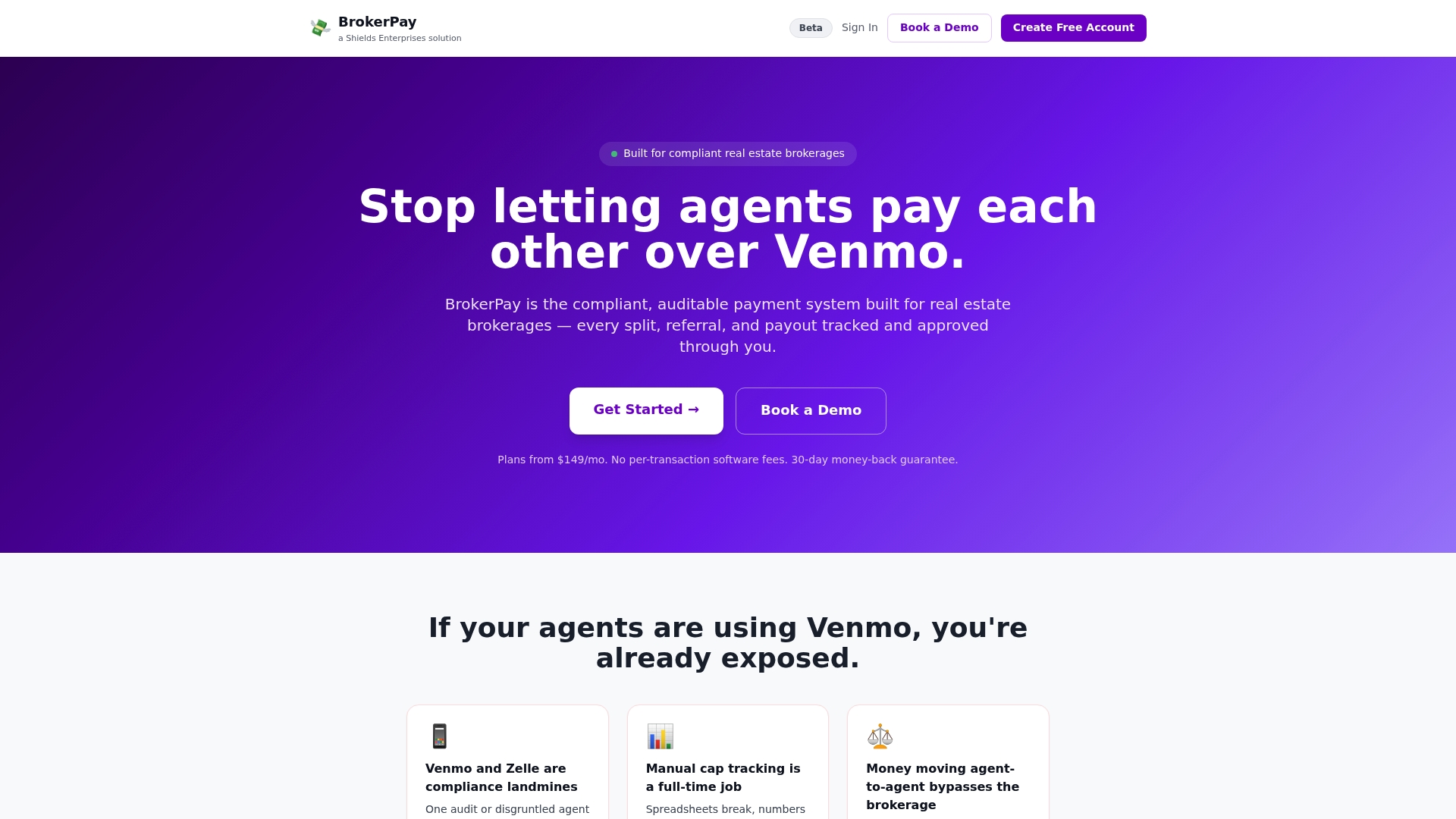
Brokerpay is a compliant commission payment platform built for real estate brokerages. It tracks agent splits, referral fees, and co-op commissions in one place, generating the documentation that RESPA compliance requires. Every payment runs through a documented workflow, eliminating the informal workarounds that expose brokerages to federal penalties. Brokerages using Brokerpay also get faster agent payouts and a clear audit trail for every transaction fee. Stop paying agents over Venmo and replace informal transfers with a system built for the compliance standards your brokerage actually faces.
FAQ
What are the main types of real estate third-party fee arrangements?
The main types are percentage-based commissions, flat fees, retainer fees, and hybrid models combining two or more structures. Each type suits different brokerage models and service scopes.
Are referral fees from third-party providers legal under RESPA?
Referral fees are legal only when the agent performs bona fide services at fair market value. RESPA prohibits payments made solely for referring clients to settlement service providers.
How did the 2024 NAR settlement change fee arrangements?
Buyer-agent compensation can no longer be advertised on MLS systems and must be negotiated in a written agreement before home tours begin. This makes every buyer-side fee arrangement a direct negotiation between agent and client.
What is a typical administrative fee in real estate transactions?
Administrative fees typically range from $295 to $625 per transaction, covering document storage, file management, and processing services. These fees must be applied consistently across all agents to avoid discrimination claims.
How should brokers evaluate third-party payment processor fees?
Brokers should compare interchange-plus pricing against flat-rate models, since cheaper upfront fees often hide markups that cost more at higher transaction volumes. Request a full fee schedule including monthly minimums and chargeback costs before committing.