How to Reduce Commission Payment Errors for Brokers

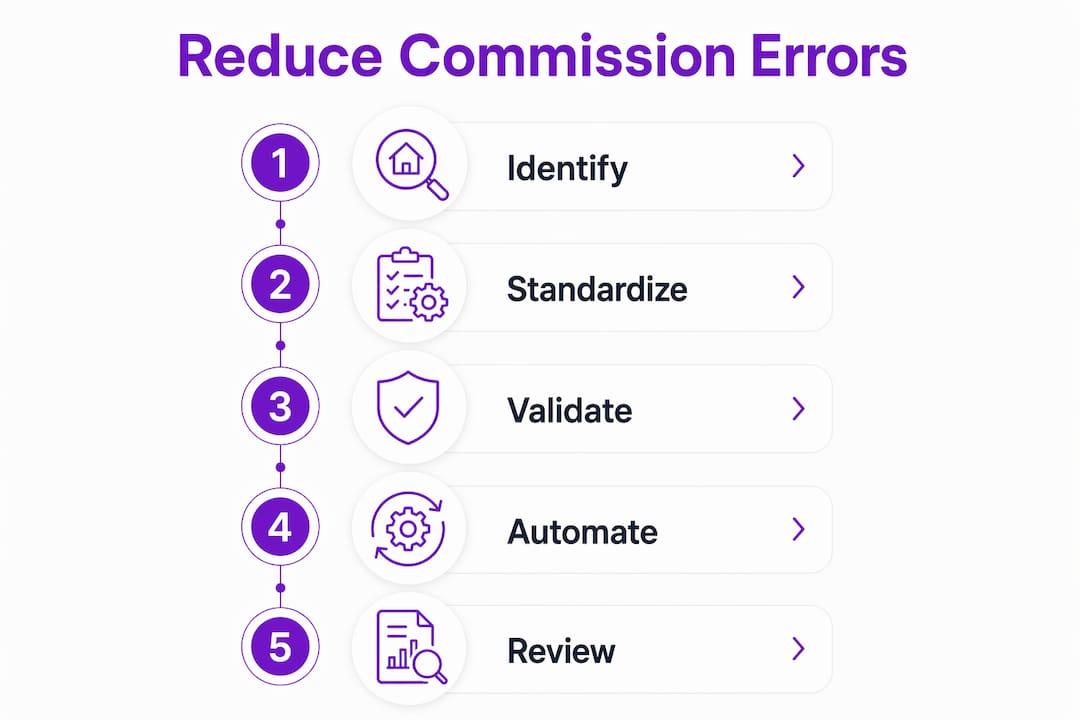
Commission payment errors are defined as any miscalculation, omission, or processing mistake that causes an agent to receive an incorrect payout. For independent real estate brokers and agency owners, these errors carry consequences far beyond a corrected check. 42% of sales professionals have left a position due to compensation disputes. That number signals a direct threat to agent retention, brokerage reputation, and RESPA compliance. The best practices for commission payments all point to the same root cause: errors rarely start in the math. They start in ambiguous plans, dirty CRM data, and manual processes that were never built to scale.
What causes commission payment errors in real estate brokerages?
Most commission errors originate upstream from ambiguous plans and poor data, not from calculation math itself. Understanding the root causes is the first step toward fixing them permanently.
The most common sources of payment mistakes in real estate brokerages include:
- Ambiguous commission plan language. When a plan document uses vague terms like “primary agent” or “deal closer” without precise definitions, two people will read it two different ways. Disputes follow.
- Manual spreadsheet management. Over 70% of companies still rely on spreadsheets for commission tracking. Spreadsheets break with version conflicts, formula overwrites, and human entry mistakes.
- Gaps between plan documents and system configurations. A broker may update a split percentage in writing but forget to update the calculation logic in their system. The two drift apart, and agents get paid on the wrong rate.
- CRM data quality problems. Missing contract dates, incorrect deal values, or unassigned agent fields all feed bad inputs into commission calculations. Garbage in, garbage out.
- Manual data transfers between systems. Manual data transfers between CRM, commission tools, and payroll are a leading cause of payroll errors. Each handoff is a chance for a number to get dropped or mistyped.
- Uncoordinated mid-period plan changes. Changing a commission rate or split structure mid-month without a clear effective date creates retroactive confusion that takes hours to untangle.
Each of these issues adds admin burden and erodes agent trust. Fixing them requires a structured approach, not just more careful spreadsheet work.
How to standardize commission plan documents to prevent disputes

A commission plan document is the single source of truth for every payout calculation. When that document is vague or outdated, every downstream process inherits the ambiguity.
A well-built plan document defines every crediting rule with precision. It specifies who owns a deal when two agents collaborate, how splits are calculated when a referral is involved, and exactly when payment is triggered relative to closing. “Upon closing” is not precise enough. “Within five business days of the recorded deed date” is. The difference between those two phrases is the difference between a smooth payout and a dispute.
Version control matters as much as content. Every plan revision should carry a date, a version number, and a clear effective date. Agents should receive the updated document with enough lead time to ask questions before the new rules take effect. A plan that surprises agents at payout time is a plan that generates disputes.
Pro Tip: Build a one-page summary of your commission plan that agents can reference quickly. The full document handles edge cases; the summary handles daily questions. Both should be stored in the same place and updated together.
Avoid rolling out plan changes mid-period unless absolutely necessary. When a mid-period change is unavoidable, document the exact effective date and communicate it in writing to every affected agent before the period closes.
What does “contract-grade” CRM data mean for commission accuracy?
CRM data hygiene is the critical prerequisite for any commission calculation accuracy. “Contract-grade” data means every deal record contains the mandatory fields required to calculate a commission without manual lookups or assumptions.
The minimum required fields for contract-grade CRM records in a real estate brokerage include:
- Contract start and end dates. These determine which commission period a deal falls into. A missing close date means the deal either gets missed or assigned to the wrong period.
- Final deal value. The commission base must reflect the actual contract price, not the listing price or an estimated figure.
- Product or transaction type. Residential, commercial, referral, and co-op transactions often carry different commission rates. The system needs to know which rules apply.
- Agent assignment and split structure. Every deal record should name the primary agent, any co-agents, and the agreed split percentages. These should be structured fields, not free-text notes.
- Timestamp for any post-close changes. If a deal value is corrected after closing, the CRM should log who changed it, when, and why.
Validation rules prevent bad data from entering the system in the first place. Configure your CRM to block deal closure without mandatory fields completed. That friction at entry saves hours of correction later.
Pro Tip: Audit your CRM records for the prior three months and count how many deals are missing at least one of the five fields above. That number tells you exactly how much commission calculation risk you are carrying right now.
How does automation reduce manual errors in commission calculations?
Automation removes the human steps that introduce errors. When a commission platform connects directly to your CRM and payroll system, deal data flows through without manual re-entry. That eliminates the transcription mistakes that manual data transfers consistently produce.
The most valuable automation feature for brokers is the pre-flight review. A pre-flight process runs automated checks on every commission statement before it reaches an agent. It flags anomalies like a payout that is more than 30% above or below an agent’s recent average, a deal that appears twice, or a split that does not add up to 100%. Pre-flight automated review reduces formal dispute volume by 40%–60%. Catching an error before the statement goes out costs nothing. Correcting it after an agent calls costs time, trust, and sometimes legal exposure.
Automation also produces audit trails automatically. Every calculation step is logged, timestamped, and retrievable. When an agent questions a payout, you can show them exactly how the number was reached without rebuilding the calculation from scratch.
Key benefits of moving from spreadsheets to a dedicated commission platform:
- Consistent rule application. The same split logic applies to every deal, every period, without formula drift.
- CRM and payroll integration. Deal data syncs directly; no manual export or import required.
- Structured dispute workflows. Agents submit questions through a defined channel, and every response is documented.
- Scalability. Adding agents or new commission structures does not require rebuilding a spreadsheet from scratch.
Brokerpay is built specifically for real estate brokerages. It tracks agent splits, referral fees, and co-op commissions while keeping transactions RESPA-compliant and eliminating the Venmo and Zelle workarounds that create federal liability. Switching from manual to automated payouts is the single highest-impact change most independent brokers can make to minimize commission discrepancies.
How should brokers handle reconciliation, payroll locking, and disputes?
Reconciliation before payroll submission is the last line of defense against payment mistakes. A structured reconciliation process catches errors that automation and pre-flight checks missed.
- Match deal records to commission statements. Every deal that closed in the period should appear on exactly one statement. Any deal that appears twice or not at all needs immediate investigation.
- Verify split totals. Every transaction involving multiple agents should show splits that sum to 100%. A split that totals 95% or 105% signals a configuration error.
- Compare period totals to prior periods. A significant jump or drop in total commission expense warrants a line-by-line review before submission.
- Lock the payroll period. Once reconciliation is complete and payroll is submitted, lock the period to prevent retroactive recalculation. Recalculating prior periods after CRM changes creates audit risk and erodes agent trust.
- Handle retroactive adjustments in the current period. When a correction is necessary, apply it as a clearly labeled line item in the next open period rather than reopening a closed one.
Sending draft commission statements 5–7 days before finalization catches most errors early. Agents review their own numbers and flag discrepancies before payroll runs. This shifts error detection to the people with the most context about their own deals.
A clear SLA for dispute resolution reduces agent anxiety and improves relations, even when the financial outcome does not change. Agents who know a dispute will be reviewed and answered within three business days behave differently than agents who feel ignored. The process itself builds trust.
Transparent commission calculations that show agents deal-level breakdowns let them self-audit their statements. That reduces the volume of questions that reach your finance team and replaces suspicion with confidence.
Key Takeaways
Reducing commission payment errors requires clean data, clear documentation, and automated processes working together at every stage of the payment cycle.
| Point | Details |
|---|---|
| Errors start upstream | Most commission mistakes come from ambiguous plans and bad CRM data, not calculation math. |
| Contract-grade CRM data | Every deal record needs close date, deal value, transaction type, agent assignment, and change timestamps. |
| Pre-flight automation cuts disputes | Automated anomaly checks before statements go out reduce formal disputes by 40%–60%. |
| Lock payroll periods | Closing prior periods prevents retroactive recalculation that creates audit risk and agent distrust. |
| Transparency builds trust | Showing agents deal-level breakdowns lets them self-audit and reduces finance team workload. |
The part most brokers skip
Wes here. After working with independent brokers on commission payment processes, the pattern I see most often is this: brokers invest in fixing the calculation and ignore everything around it. They get the math right and still have agents calling every month to dispute their statements.
The reason is almost always transparency, not accuracy. An agent who cannot see how their number was reached will assume it is wrong. That assumption generates disputes even when the payout is correct. The fix is not more explanation in the moment. It is a system that shows the work automatically, every time, before the agent has to ask.
The second thing I have learned is that annual plan reviews are not optional. Commission rules that made sense when you had eight agents stop working when you have twenty-two. Quotas that fit the market in one year create systematic underpayment or overpayment the next. Annual audits of commission plans help adjust quotas and rules before they generate errors at scale. Most brokers treat the plan as permanent until something breaks. The brokers with the fewest disputes treat it as a living document.
Automation does not replace judgment. It protects you from the errors that happen when judgment is tired, rushed, or working from a spreadsheet with seventeen tabs.
— Wes
How Brokerpay helps brokers eliminate payment errors
Real estate brokerages that process agent splits, referral fees, and co-op commissions manually carry significant compliance and accuracy risk. Brokerpay is built to remove that risk.
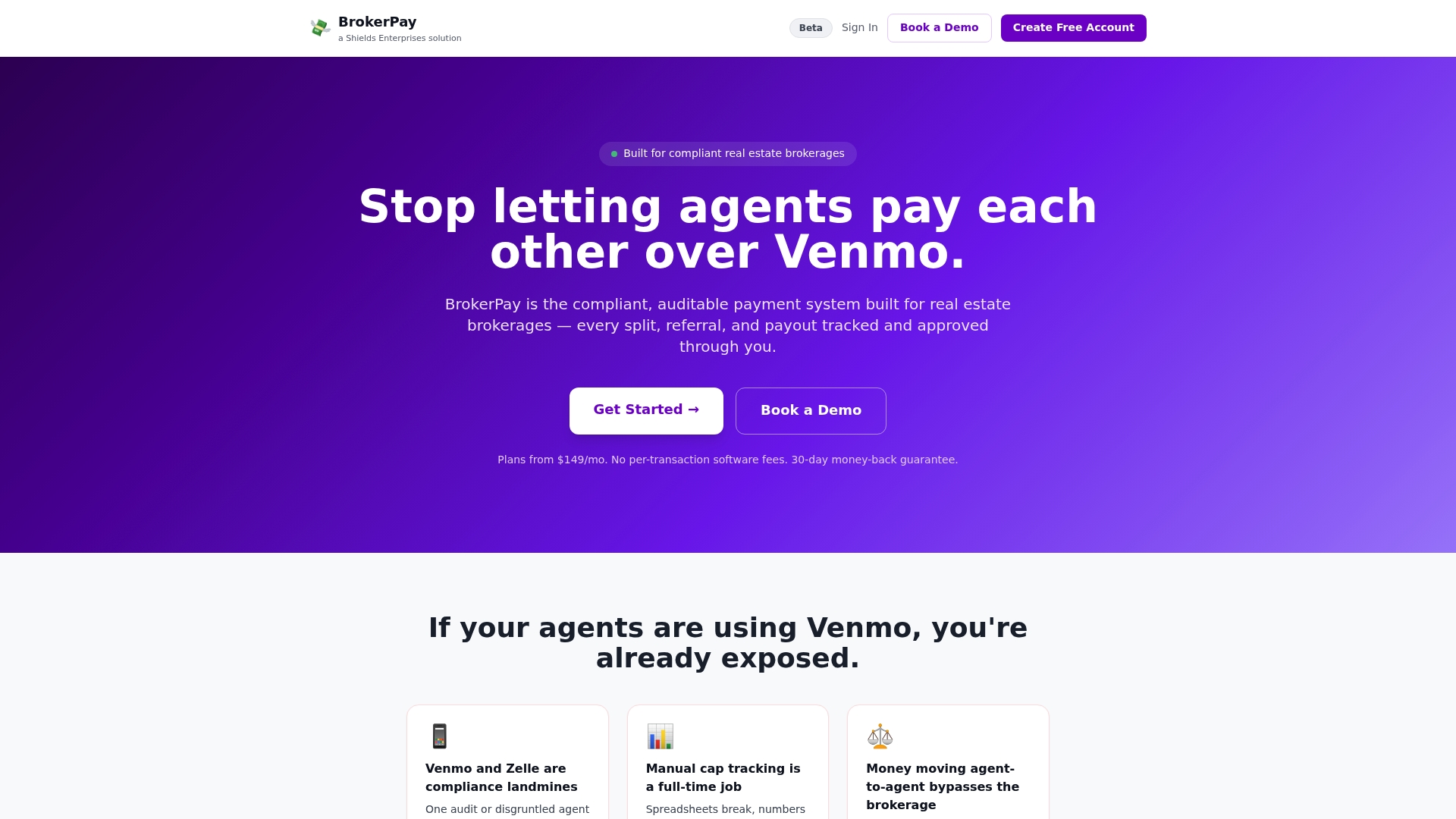
Brokerpay automates the full commission payment workflow, from deal sync to agent payout, with full RESPA-compliant documentation at every step. It replaces Venmo and Zelle workarounds with a structured, auditable payment process. Brokers get deal-level transparency, automated split calculations, and a dispute workflow that keeps agents informed without burying your team in calls. If you are ready to stop payment mistakes before they reach your agents, Brokerpay gives you the infrastructure to do it. You can also learn how commission tracking prevents tax issues for agents as part of a complete compliance approach.
FAQ
What are the most common commission payment errors in real estate?
The most common errors are incorrect split calculations, missing or wrong deal values in the CRM, and ambiguous plan language that different agents interpret differently. Manual data transfers between systems are also a leading cause of payroll discrepancies.
How do I fix a commission error after payroll has been submitted?
Apply the correction as a clearly labeled adjustment line item in the next open payroll period. Never reopen a locked period, as retroactive recalculation creates audit risk and undermines agent trust.
How does automation reduce commission payment mistakes?
Automated platforms sync deal data directly from the CRM, apply commission rules consistently, and run pre-flight anomaly checks before statements reach agents. This process reduces formal dispute volume by 40%–60% compared to manual spreadsheet methods.
What is a pre-flight commission review?
A pre-flight review is an automated check that runs on every commission statement before it is published. It flags anomalies such as payouts that deviate significantly from an agent’s recent average, duplicate deals, or splits that do not total correctly.
How early should agents receive draft commission statements?
Agents should receive draft statements 5–7 days before the final payroll run. That window gives them enough time to review deal-level details and flag errors before the payment is processed.