How Closing Disbursements Work for Real Estate Pros

Closing disbursements are the financial transactions that officially distribute funds to all parties at the end of a real estate deal, following the terms of the settlement statement. Every broker and agent needs to understand the closing disbursement process because errors at this stage can delay funding, trigger legal disputes, or leave clients blind sided by unexpected costs. The Closing Disclosure and the settlement statement serve as the legal blueprints for every dollar that moves. Knowing who gets paid, when, and why is not optional knowledge for real estate professionals. It is the foundation of a clean close.
How closing disbursements work: the core process
Closing disbursements are the final step in a real estate transaction, not just a formality after signing. The process begins when all funds, including the buyer’s down payment, loan proceeds, and any seller credits, arrive in an escrow or title company account. The escrow officer then verifies that every condition in the purchase agreement and loan documents is fully satisfied before a single dollar moves. Disbursement release is legally contingent on deed recording with the county recorder’s office. That single fact surprises many agents who assume the closing meeting is the finish line.
The standard industry term for this process is “escrow disbursement,” though real estate professionals commonly use “closing disbursements” to describe the same event. Both terms refer to the coordinated release of funds from escrow to sellers, lenders, agents, government agencies, and other parties listed on the settlement statement.
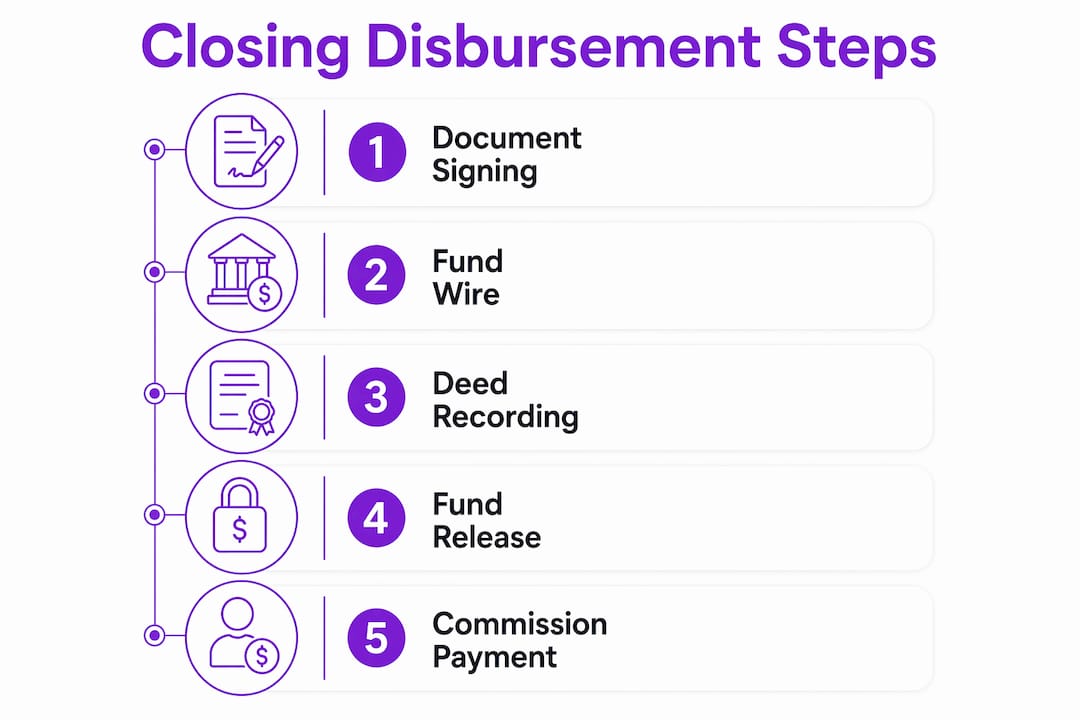
The step-by-step disbursement sequence
- Funds received into escrow. The buyer’s lender wires loan proceeds, and the buyer deposits any remaining cash to close. The escrow officer confirms all funds are “good,” meaning cleared and verified.
- Conditions verified. The escrow officer checks that all contractual and lender conditions are met: title is clear, insurance is bound, and all required documents are signed.
- Settlement statement finalized. The final Closing Disclosure is prepared and reviewed by all parties. Every credit, debit, and proration is confirmed line by line.
- Deed recorded. The deed is submitted to the county recorder’s office. Recording the deed is the legal trigger that authorizes the escrow officer to release funds.
- Funds disbursed. Wire transfers go out to the seller, lender payoffs are processed, agent commissions are released, and third-party fees are paid.
Full disbursement typically takes 1–2 business days after signing, though same-day wire transfers are possible when documentation is complete and submitted before bank cutoff times. County recorder delays and bank processing windows are the two most common reasons funds arrive later than expected.
Pro Tip: Wire funds to escrow early, before the closing date. Last-minute wires that miss bank cutoff times push disbursement to the next business day, which frustrates sellers and can trigger contract penalties.

What costs are involved and who pays what?
Closing disbursements cover a wide range of expenses, and the allocation between buyer and seller depends on the purchase contract, local custom, and lender requirements. Agents who understand these categories can set accurate expectations and prevent last-minute surprises at the closing table.
Common disbursement cost categories include:
- Lender fees. Origination charges, underwriting fees, and prepaid interest paid by the buyer at closing.
- Title and escrow fees. Title search, title insurance premiums, and escrow service charges. These are often split between buyer and seller, though local custom varies by state.
- Recording fees. Government charges to record the deed and any new mortgage. These are typically the buyer’s responsibility.
- Transfer taxes. State or county taxes on the transfer of property. Responsibility varies by jurisdiction.
- Agent commissions. Paid from seller proceeds, split between listing and buyer’s agent per the listing agreement.
- Prorations. Property taxes, HOA dues, and prepaid utilities are divided based on the closing date. The seller pays through the day of closing; the buyer takes over from that point forward.
- Payoff amounts. The seller’s existing mortgage balance, including any prepayment penalties, is paid directly from sale proceeds.
The Closing Disclosure is the authoritative document for every credit, debit, and payment flow. Agents should walk clients through it line by line before the closing date, not the morning of.
Non-refundable disbursements deserve special attention. Certain costs incurred upfront, such as property searches and anti-money laundering checks, must be reimbursed regardless of whether the transaction closes. If a deal falls apart after these costs are ordered, the party who authorized them is still responsible for payment. This is a critical point to communicate to clients early in the transaction.
Pro Tip: Prepare a simple one-page cost summary for your clients before the Closing Disclosure arrives. When clients see the numbers for the first time at the table, they panic. A preview eliminates that reaction entirely.
Who manages closing disbursements and what are their responsibilities?
The escrow or title company acts as the neutral third party responsible for holding and distributing funds. The escrow officer does not represent the buyer or the seller. Their job is to follow the written escrow instructions exactly as agreed by all principals.
Key responsibilities of the escrow officer include:
- Verifying that all escrow conditions are fully satisfied before releasing any funds.
- Preparing the final closing disbursement statement and reconciling all credits and debits.
- Coordinating wire transfers and check payments to all parties listed on the settlement statement.
- Communicating with the county recorder’s office to confirm deed recording before disbursement.
One legal safeguard that every agent should know: escrow agents cannot unilaterally change disbursement terms without joint written instructions from all principals. If a buyer and seller agree to modify how costs are split after escrow opens, both parties must provide written authorization. Verbal agreements do not move money.
Lenders also play a direct role. They fund the loan proceeds into escrow and may have specific conditions that must be confirmed before they authorize the wire. Agents and brokers support the process by keeping clients informed, ensuring documents are signed on time, and responding quickly to escrow inquiries. Delays caused by missing signatures or unanswered questions from the escrow officer are almost always avoidable with proactive communication.
What are the common challenges in closing disbursements?
The disbursement process has several predictable failure points. Knowing them in advance lets you prevent them rather than manage them after the fact.
Missing or incomplete documentation is the leading cause of disbursement delays. A single unsigned addendum or a missing lender condition can halt the entire process. Agents should confirm with escrow that all documents are in order at least 48 hours before the scheduled closing.
Wire transfer cutoffs create hard deadlines that many clients do not anticipate. Most banks process outgoing wires only until 2:00 PM or 3:00 PM local time. A wire submitted after cutoff does not move until the next business day. Funds for disbursements must be liquid and available well in advance to prevent this delay.
Wire fraud is a real and growing threat in real estate transactions. Always verify wire instructions directly with the escrow officer by phone before sending any funds. Never rely solely on emailed wire instructions, as fraudulent instructions are a common attack vector.
County recorder delays are outside everyone’s control but can be anticipated. Some counties process recordings same-day; others take 24–48 hours. Closing is not complete until the deed is recorded and funds are disbursed, regardless of what time the signing meeting ends. Agents who communicate this to clients prevent the frustrated phone calls that follow a signing day with no wire in the seller’s account.
Non-refundable costs on failed deals catch clients off guard. When a transaction collapses after certain third-party services are ordered, those fees are still owed. Setting this expectation early protects your professional relationship and avoids disputes.
Pro Tip: Build a closing checklist that includes a wire verification call, a document confirmation with escrow, and a recorder timeline check. Run it 48 hours before every closing. It takes 15 minutes and prevents the majority of last-minute delays.
Key Takeaways
The closing disbursement process is complete only after deed recording triggers fund release, not when documents are signed.
| Point | Details |
|---|---|
| Deed recording triggers disbursement | Funds cannot be legally released until the county recorder confirms the deed transfer. |
| Timeline is 1–2 business days | Same-day wires are possible, but bank cutoffs and recorder delays often push funds to the next day. |
| Non-refundable costs survive failed deals | Property searches and compliance checks must be paid even if the transaction does not close. |
| Escrow officers require written authorization | Any change to disbursement terms after escrow opens requires joint written instructions from all principals. |
| Agents prevent delays through preparation | Confirming documents and wire instructions 48 hours before closing eliminates the most common failure points. |
The part of closing that agents consistently underestimate
After years of watching real estate transactions close, the pattern I see most often is this: agents treat the signing meeting as the finish line, and then scramble to explain to their clients why the seller’s wire has not arrived by dinner. The signing is not the close. Disbursement completion depends on county recorder efficiency and banking processes that no one in the room controls.
The fix is not complicated. It is communication, delivered early and repeated. Tell your seller on day one that they will not see funds the moment they sign. Tell them the recorder may take a full business day. Tell them the wire has a cutoff time. When clients already know this, they are not calling you in a panic at 5:00 PM on closing day.
The other thing I see agents get wrong is conflating disbursements with their own commission. Disbursements are treated separately from professional fees in the settlement statement. Your commission is a line item, but the disbursement process governs all the other payments too. Agents who understand the full picture can answer client questions with authority instead of deflecting to the escrow officer for every detail.
The professionals who build the strongest client reputations are the ones who own the entire closing process in their client’s mind, not just the part where they hand over the keys.
— Wes
How Brokerpay fits into the disbursement picture
Managing commission payments after closing should not involve Venmo, Zelle, or a spreadsheet. Those workarounds create federal liability under RESPA and leave brokerages with no audit trail.

Brokerpay is a compliant commission payment platform built specifically for real estate brokerages. It tracks agent splits, referral fees, and co-op commissions, and processes every payment with full documentation. Brokers get a clear record of every disbursement, and agents get paid accurately and on time. If your brokerage is still handling post-closing commission payments manually, Brokerpay replaces that process with one that holds up to scrutiny. You can also read more about commission tracking and tax compliance to understand why documentation at the disbursement stage matters beyond just getting paid.
FAQ
What triggers the release of closing disbursement funds?
Recording the deed with the county recorder’s office is the legal trigger for fund release. Escrow officers cannot disburse funds until title transfer is officially confirmed.
How long does the closing disbursement process take?
Disbursement typically takes 1–2 business days after signing. Same-day wire transfers are possible when all documentation is in order and funds are submitted before bank cutoff times.
Are any closing disbursement costs non-refundable if a deal falls through?
Yes. Costs like property searches and compliance checks are often non-refundable once ordered, even if the transaction does not close. Clients should understand this risk before those services are initiated.
Can escrow officers change disbursement terms on their own?
No. Escrow agents cannot unilaterally modify disbursement terms. Any change requires joint written instructions from all principals involved in the transaction.
What is the difference between a closing disbursement and an agent commission?
Agent commissions are a line item within the broader disbursement process. The disbursement process covers all fund distributions listed on the settlement statement, including lender payoffs, taxes, title fees, and commissions.