Why Manual Commission Tracking Fails Real Estate Brokers

Manual commission tracking is defined as the practice of calculating, recording, and distributing agent commission payouts using spreadsheets, email chains, and paper records without automated controls. It fails because error rates reach 3%–8% of total payouts, and over 80% of complex spreadsheets contain material errors. For real estate brokerages managing agent splits, referral fees, and co-op commissions, those error rates translate directly into overpayments, underpayments, and agent disputes. The issues with manual commission tracking go beyond simple math mistakes. They include hidden operational costs, compliance exposure, and the kind of trust erosion that drives good agents to competing brokerages.
Why manual commission tracking fails: errors, risks, and silent failures
Manual commission tracking produces two categories of errors: the ones you catch and the ones you never do. Payout calculation errors range from 3% to 8% of total incentive payouts in manual environments. That range sounds manageable until you apply it to a brokerage closing $10 million in commissions annually. At 5%, that is $500,000 in miscalculated payouts per year.
The more dangerous problem is silent failure. Spreadsheets produce plausible but wrong calculations that go undetected without an independent audit or an agent complaint. A broken formula that rounds incorrectly, a mislinked cell that pulls last month’s split rate, a tab that was copied but never updated. Each error looks correct on screen. None of them trigger an alert.
Common errors in commission tracking through manual methods include:
- Formula errors: A single broken cell reference corrupts every calculation that depends on it.
- Data entry mistakes: Agents’ names misspelled across tabs prevent accurate matching and reconciliation.
- Version control failures: Multiple brokers editing different copies of the same file create conflicting payout records.
- Missing transactions: Deals closed near month-end get logged in the wrong period, skewing totals.
- Copy-paste drift: Rates from prior commission plans get carried forward into new periods unintentionally.
Key-person dependency compounds every one of these risks. When only one person understands how the spreadsheet is structured, that knowledge leaves with them on vacation, during illness, or when they resign. The brokerage is left with a file no one can safely edit.
Pro Tip: Ask yourself whether any agent could independently verify their commission calculation using the records your brokerage provides. If the answer is no, trust is already eroding.

How manual tracking drains operational capacity
Manual commission workflows consume 3%–5% of sales operations capacity monthly. For a brokerage with a full-time operations manager, that is roughly two to three days every month spent on commission administration alone. That time does not include fixing disputes after the fact.
The operational drag follows a predictable pattern:
- Data extraction: Transaction data lives in the MLS, the CRM, and email. Someone manually pulls it into a spreadsheet each cycle.
- Reconciliation: Splits, referral deductions, and franchise fees must be cross-checked line by line against closing documents.
- Formula troubleshooting: When totals do not match, staff spend hours tracing the error through nested formulas.
- Dispute resolution: Agents who question their payout require a manual review of the original records, which may no longer exist in a clear form.
- Reprocessing: Corrected payouts require a second round of approvals, documentation, and disbursement.
Companies spending five or more days monthly on manual commission processing face measurably higher operational risk and reduced strategic capacity. That time is not recoverable. Every hour an operations manager spends reconciling spreadsheets is an hour not spent on agent onboarding, compliance review, or growth planning.
Manual reconciliation diverts high-value staff from analysis to data cleaning. This is the hidden cost that never appears on a budget line. The misconception that manual tracking saves money ignores administrative labor, penalties, and lost opportunities that routinely exceed the cost of a software subscription.
Pro Tip: Track the actual hours your team spends on commission work each month, including dispute resolution and corrections. Most brokers are surprised the number exceeds 20 hours.
How lack of scalability and governance breaks manual systems
Manual commission tracking does not degrade gradually. It breaks at a threshold. Spreadsheets strain and fail reliably for teams exceeding approximately 75 active representatives. Below that number, a skilled administrator can hold the system together through personal knowledge and discipline. Above it, the complexity of overlapping plans, tiered splits, and referral arrangements overwhelms any spreadsheet structure.
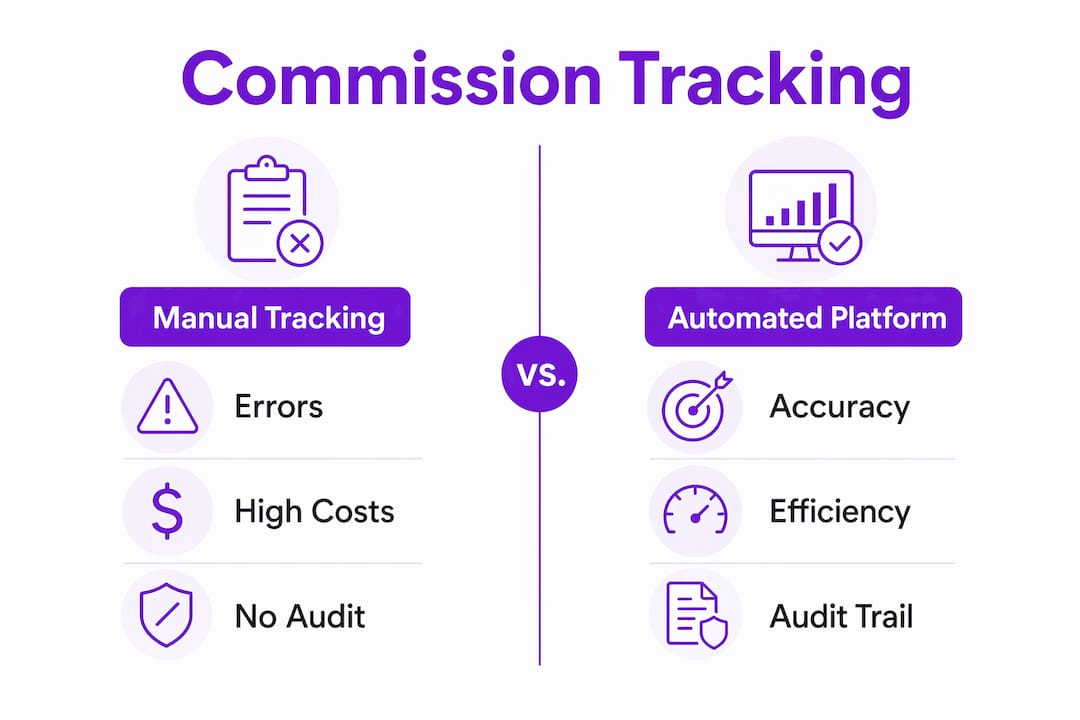
Governance is the deeper problem. Manual tracking lacks audit trails, version control, and transparent approval workflows. This creates real compliance exposure. Under RESPA, real estate brokerages must document how co-op commissions and referral fees are calculated and paid. A spreadsheet with no change history and no approval log cannot satisfy that requirement. Brokerages relying on compliant co-op payment workflows need documentation that manual files simply cannot produce.
Changing a commission plan in a manual system is also costly and risky. A new split structure requires updating formulas across every active agent tab, testing for errors, and communicating changes without a formal version snapshot. One missed cell and the old plan continues paying out under the new plan’s name.
| Feature | Manual spreadsheet | Automated platform |
|---|---|---|
| Audit trail | None | Immutable log of every change |
| Version control | Manual file saves only | Automatic snapshots with timestamps |
| Approval workflow | Email chains | Built-in approval routing |
| Sensitive data security | Scattered across files and inboxes | Centralized, access-controlled |
| Scalability | Breaks near 75 reps | Scales to hundreds of agents |
| Plan change management | Manual formula edits | Rule-based updates applied instantly |
Sensitive payment data scattered across spreadsheets and email threads creates security risk beyond compliance. Agent Social Security numbers, bank details, and payout histories stored in shared drives or email attachments are a data breach waiting to happen.
What impact does manual tracking have on agent trust and retention?
Agent trust is the most underestimated casualty of manual commission tracking problems. Commission disputes stem from trust erosion caused by opaque, delayed commission statements. When an agent cannot see how their split was calculated, they assume the worst. That assumption is not irrational. It is the predictable result of a system with no transparency.
The downstream effects on brokerage operations are significant:
- Shadow accounting: Agents who distrust the official numbers keep their own records. When those records conflict with the brokerage’s, a dispute is inevitable.
- Productivity loss: An agent spending time auditing their own commissions is not prospecting, showing homes, or closing deals.
- Recruiting damage: Word travels fast in local real estate markets. A reputation for slow or inaccurate commission payments makes recruiting harder and retention worse.
- Morale decline: Repeated payment errors signal to agents that the brokerage does not value their work, regardless of intent.
- Turnover cost: Replacing a producing agent costs far more than fixing the commission system that drove them away.
The financial stakes are real. A brokerage losing two or three mid-level producers per year to commission frustration loses not just their splits but their referral networks, their market relationships, and the training investment the brokerage made in them. Accurate, transparent commission tracking is not an administrative nicety. It is a retention tool.
When should a brokerage switch from manual to automated commission tracking?
The right time to switch is before the system breaks, not after. Automated commission tracking pays for itself within the first year and yields substantial savings by year three. The break-even point arrives faster than most brokers expect because automation eliminates costs that never appeared on the manual system’s budget.
The case for switching rests on concrete operational and financial advantages:
- Error elimination: Automated calculations apply the correct split rate to every transaction without formula drift or copy-paste errors.
- Audit readiness: Every payout carries a complete, timestamped record of how it was calculated and who approved it.
- Real-time visibility: Agents see their commission status without calling the office, which reduces inbound questions and dispute volume.
- Plan flexibility: New commission structures apply instantly across all active agents without manual formula edits.
- Compliance protection: Platforms built for real estate brokerages handle RESPA-compliant documentation automatically, eliminating the Venmo and Zelle workarounds that create federal liability.
The switch from manual to automated payouts also removes key-person dependency. When commission logic lives in a platform rather than one person’s spreadsheet, the brokerage is not vulnerable to staff turnover.
Pro Tip: If your brokerage is growing past 20 agents or adding a second office, automate now. The cost of fixing a broken manual system mid-growth is always higher than the cost of preventing it.
Key Takeaways
Manual commission tracking fails because it combines high error rates, hidden operational costs, zero auditability, and the kind of opacity that destroys agent trust before a brokerage realizes the damage is done.
| Point | Details |
|---|---|
| Error rates are material | Payout errors of 3%–8% compound into significant financial losses at brokerage scale. |
| Silent failures are the real risk | Spreadsheet errors often go undetected until an agent dispute or external audit surfaces them. |
| Operational cost is hidden | Manual processing consumes 3%–5% of operations capacity monthly, diverting staff from growth work. |
| Governance gaps create liability | No audit trails or approval logs expose brokerages to RESPA compliance risk. |
| Automation pays for itself | Automated platforms typically break even within year one and protect agent trust through transparency. |
The uncomfortable truth about manual commission tracking in real estate
I have seen brokerages run on spreadsheets for years and genuinely believe the system works. It does, until it does not. The failure is rarely dramatic. It is usually a quiet accumulation of small errors, a few agent complaints, one operations manager who is the only person who understands the file, and a compliance question no one can answer cleanly.
What strikes me most is how brokers underestimate the trust dimension. Commission accuracy is not just a financial issue. It is the signal agents use to judge whether the brokerage respects their work. A delayed or wrong payment communicates something, even when the intent is good. And in a market where agents have real choices about where to hang their license, that signal matters.
The audit trail problem is the one I would push hardest on. Brokers often think of audits as something that happens to other people. But a RESPA inquiry, a departing agent’s dispute, or a state licensing board review can all demand documentation that a spreadsheet simply cannot produce. The absence of defensible records is not a minor gap. It is a liability.
My advice to any brokerage leader evaluating their commission process: do not ask whether the current system is working. Ask whether it can prove it is working. If the answer requires opening a spreadsheet and explaining a formula to a regulator, the answer is no.
— Wes
How Brokerpay handles what manual tracking cannot
Real estate brokerages dealing with the challenges described above need more than a better spreadsheet. They need a system built for the specific compliance and operational demands of commission management.
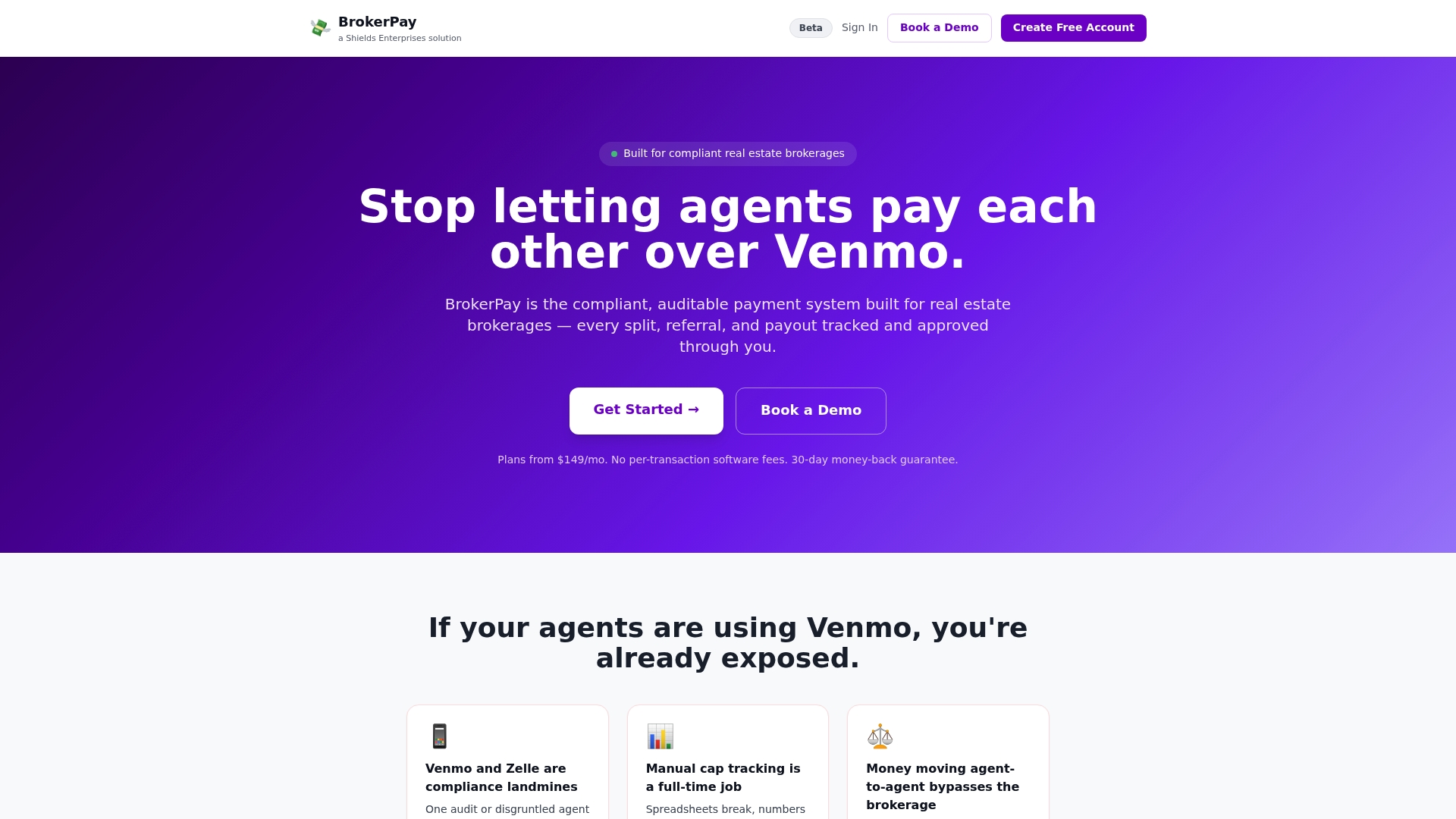
Brokerpay is a compliant commission payment platform that tracks, documents, and processes agent splits, referral fees, and co-op commissions with a complete audit trail on every transaction. It eliminates the Venmo and Zelle workarounds that create federal liability, and it gives agents real-time visibility into their payouts without a single phone call to the office. Brokerages using Brokerpay replace fragile spreadsheet logic with rule-based calculations that apply correctly every time. If your brokerage is ready to move past the risks of manual tracking, see how Brokerpay works and what it takes to get started.
FAQ
What is the main reason manual commission tracking fails?
Manual commission tracking fails because it produces calculation errors at rates of 3%–8% of total payouts and lacks the audit trails needed to detect or defend those errors. Silent spreadsheet failures are the most dangerous because they go unnoticed until an agent dispute or audit surfaces them.
How many agents does it take for manual tracking to break down?
Manual commission spreadsheets typically fail reliably for teams exceeding approximately 75 active representatives. Below that threshold, a skilled administrator can manage the complexity, but growth beyond it overwhelms any manual system.
What compliance risks does manual commission tracking create?
Manual tracking creates RESPA compliance exposure because it produces no immutable audit logs, version history, or documented approval workflows. Brokerages cannot defend payout calculations to a regulator or licensing board without those records.
How much time does manual commission processing actually take?
Manual commission processing consumes 3%–5% of sales operations capacity monthly, which translates to multiple full working days per cycle. Companies spending five or more days per month on this work face measurably higher operational risk.
Does switching to automated commission tracking save money?
Automated commission tracking typically pays for itself within the first year by eliminating overpayments, reducing administrative labor, and avoiding dispute costs. The hidden costs of manual tracking, including penalties and lost opportunities, routinely exceed the cost of a software platform.