How to Pay Multiple Agents in One Transaction

Batch payment for real estate agents is defined as a single disbursement that splits one gross commission into multiple simultaneous payouts, each landing in the correct recipient’s account before the transaction closes on the ledger. Real estate brokerages that need to pay multiple agents in one transaction face a specific compliance problem: every split, referral fee, and co-op commission must be documented, capped, and traceable under RESPA. The Batch Payments for Agents (BPA) 1.0 specification and AP2-style mandate frameworks give brokerages the technical and legal scaffolding to do this correctly. Brokerpay is built on exactly these principles, automating multi-agent payouts while keeping every dollar auditable.
What do you need to pay multiple agents in one transaction?
The core requirement is a payment gateway that supports batch disbursement, not just sequential individual transfers. Standard wire or ACH setups process one recipient at a time. Batch payment gateways group all recipients into a single call, reducing both processing time and network fees.
Three infrastructure layers make this work:
- Batch payment gateway. The gateway accepts a recipient list, validates each entry against an allowlist, and submits one transaction to the network. Batch payments can reach over 200 recipients in a single on-chain transaction. That scale is not possible with manual ACH runs.
- Protocol layer (X402 or AP2). X402 is an HTTP-based API protocol built for high-frequency micro-payments. AP2 extends existing card rail infrastructure with credentialed authorization. MindStudio experts note that choosing between these two depends on whether your brokerage prioritizes developer-facing APIs or card network compatibility.
- Compliance controls. Spend caps, recipient allowlists, and approval gating must be configured before any funds move. These are not optional features. They are the governance layer that separates a compliant batch payout from a liability.
| Requirement | Purpose |
|---|---|
| Recipient allowlist | Blocks unauthorized payees before submission |
| Spend cap per mandate | Limits maximum disbursement per authorization window |
| Atomic transaction protocol | Guarantees all-or-nothing settlement |
| Tamper-evident audit log | Supports RESPA reconciliation and tax documentation |
| Human approval gate | Required for high-value disbursements per Stripe guidance |
Pro Tip: Set your spend cap at 110% of the expected gross commission. This gives you a small buffer for last-minute adjustments without opening the mandate to runaway disbursements.
Understanding the real estate payment gateway layer is the fastest way to evaluate whether your current setup can handle batch payouts or needs replacement.
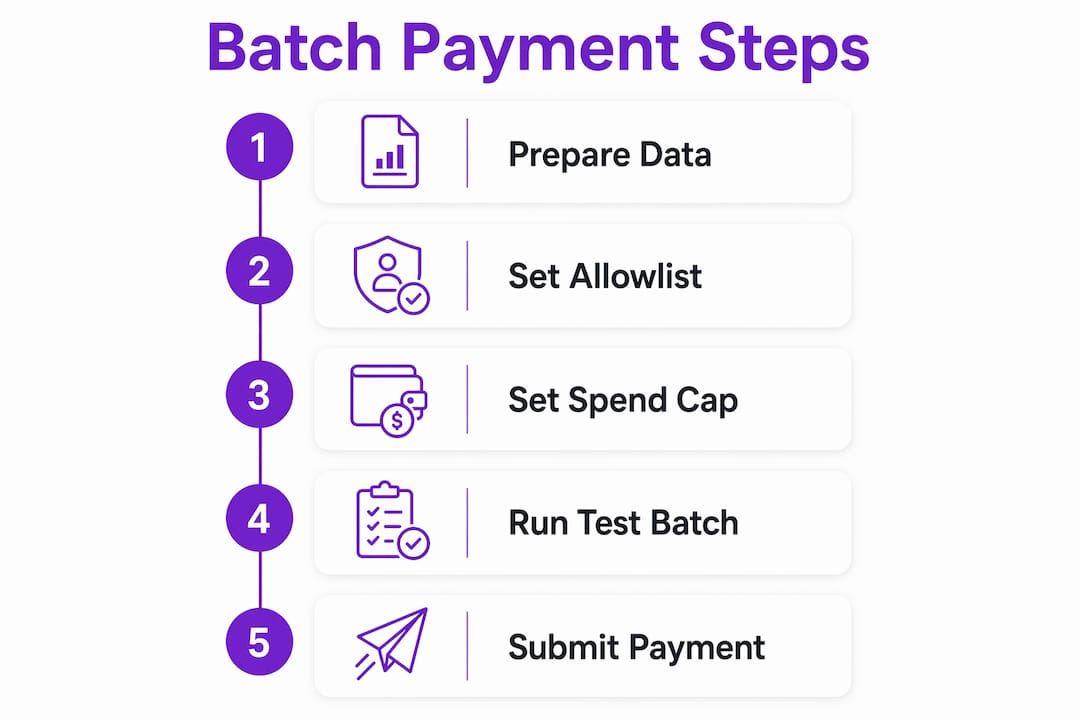
How to execute a single transaction payment to multiple agents
A clean batch payout follows six steps. Skipping any one of them creates reconciliation problems or compliance gaps.
-
Build the recipient list. Collect each agent’s wallet address or bank routing details, their agreed split percentage, and their authorization status. Verify every entry against your brokerage’s approved payee list. A single bad address in a batch of 20 can trigger a full transaction revert under atomic protocols.
-
Define the mandate. Create an AP2-style mandate that specifies the total disbursement ceiling, the expiry window (90 days is the standard), and the list of approved recipients. AP2-style mandates require hard spending caps and 90-day expiry windows. This structure prevents unauthorized disbursements after a deal closes.
-
Initiate the batch call. Submit the recipient list and amounts through your gateway’s API. The gateway builds an unsigned transaction and routes it for authorization. Batch payment systems are non-custodial, meaning the facilitator builds the unsigned transaction and the authorized wallet signs it. This eliminates custody risk and prevents forged requests.
-
Route for human approval. For any transaction above your brokerage’s defined threshold, require a human signature before submission. Stripe recommends a human-in-the-loop process for high-value transactions even when using autonomous digital wallets. Real estate commissions almost always qualify as high-value.
-
Submit and confirm atomicity. Once signed, the gateway submits the batch. The BPA 1.0 specification finalizes atomic transactions by default, meaning all payments succeed or the entire transaction reverts. No agent receives a partial payment while another goes unpaid.
-
Audit the settlement. Pull the per-recipient status report immediately after confirmation. Log transaction hashes, amounts, timestamps, and recipient identifiers in your brokerage’s records. This log is your RESPA documentation.
Pro Tip: Run a test batch with $1 amounts to every recipient before submitting the live transaction. This confirms routing details and allowlist entries without risking the full commission.
Brokerages switching from manual processes to this workflow see the biggest gains in closing-day speed. The switch from manual to automated payouts eliminates the back-and-forth of individual wire confirmations that can delay agent disbursements by hours.

How do you stay compliant when paying multiple agents at once?
Compliance in batch agent payments rests on four controls. Each one addresses a specific failure mode that creates legal exposure for the brokerage.
- Fail-closed authorization. The system must reject any payment attempt that lacks a valid mandate, a confirmed recipient allowlist entry, and a spend cap check. Successful batch payment protocols implement fail-closed governance checks before any funds move. A system that defaults to “allow” when a check is inconclusive is a liability, not a tool.
- Tamper-evident audit trails. Every disbursement must generate a log entry that cannot be edited after the fact. AP2 mandates provide tamper-evident audit logs that support institutional reconciliation. For RESPA purposes, this log is the proof that each payment was authorized, capped, and directed to the correct party.
- Spend cap enforcement. Each mandate must carry a hard ceiling. If the batch total exceeds the cap, the transaction must fail, not prompt for override. Overrides introduce discretion into a process that regulators expect to be deterministic.
- Human oversight on high-value disbursements. Automation handles the mechanics, but a licensed broker or compliance officer must approve any batch above the brokerage’s defined threshold.
“Human oversight remains the gold standard for ensuring compliance in real estate transactions, even when leveraging automated, blockchain-based payment systems.” — Stripe, Empowering Agents with Digital Wallet Payments
Accurate payment records also protect agents at tax time. Commission tracking prevents tax issues by creating a clear paper trail for every split, referral, and co-op payment across the year.
What goes wrong when paying multiple agents in one transaction?
Most batch payment failures fall into four categories. Knowing them in advance lets you build the right checks before submission.
- Partial failure without atomicity. If your gateway does not enforce atomic settlement, a network interruption can pay some agents and skip others. The BPA 1.0 atomic transaction standard prevents this by reverting the entire batch on any failure. Always confirm your gateway supports atomicity before going live.
- Exceeding batch size limits. Larger batches must be chunked to avoid hitting block gas or size limits. Chunking batches avoids failed transactions that waste fees without delivering funds. A batch of 250 agents may need to be split into two calls of 125 each, depending on the network.
- Dirty recipient data. A single mistyped wallet address or expired bank routing number fails silently in some systems and loudly in others. Run a data validation pass on every recipient list before submission. Cross-reference against your brokerage’s verified payee database, not just the deal file.
- Missing idempotency keys. When a batch partially fails and you retry, a system without idempotent retry logic can pay some agents twice. Idempotent retry mechanisms ensure retries only execute for failed recipients, not the entire batch. Confirm your gateway supports per-recipient status tracking, not just transaction-level hashes.
Pro Tip: Keep a “failed recipient” queue separate from your main batch log. When a retry runs, it pulls only from that queue. This prevents duplicate payments and keeps your reconciliation clean.
Reviewing compliant co-op payment workflows from real brokerage examples shows exactly how these failure modes appear in practice and how experienced brokerages handle them.
Key Takeaways
The most reliable way to pay multiple agents in one transaction is to use an atomic batch payment protocol with fail-closed governance, human approval gates, and tamper-evident audit logs baked in from the start.
| Point | Details |
|---|---|
| Use atomic protocols | BPA 1.0 guarantees all agents are paid or none are, preventing partial payment states. |
| Set AP2-style mandates | Hard spend caps and 90-day expiry windows protect against unauthorized disbursements. |
| Require human approval | A licensed broker must sign off on high-value batches before submission. |
| Chunk large batches | Split batches exceeding network size limits to avoid full transaction failures and wasted fees. |
| Audit every settlement | Per-recipient status logs are your RESPA documentation and your tax defense. |
The industry is moving faster than most brokerages realize
I have watched real estate payment workflows evolve from paper checks to ACH to, now, atomic on-chain batch settlements. The speed of that shift surprises brokerages that assume their current process is “good enough.” It is not, and the gap is widening.
The detail that most brokerages miss is the difference between a system that can batch payments and one that enforces atomicity. I have seen brokerages run batch ACH files that pay 18 of 20 agents and then spend three days untangling who got paid and who did not. That is not a batch payment. That is a sequential payment with a spreadsheet attached.
Mastercard’s Agent Pay for Machines initiative signals where the industry is heading: credentialed, programmatic settlements with verifiable intent. Real estate brokerages that build atomic, mandate-governed batch payment workflows now will not need to retrofit compliance controls later when regulators catch up to the technology.
My advice is to treat the governance layer as the product, not the payment itself. The payment is a commodity. The audit trail, the spend cap, the human approval gate: those are what protect your license.
— Wes
Brokerpay handles multi-agent payouts so you don’t have to
Real estate brokerages that process agent splits, referral fees, and co-op commissions manually are carrying unnecessary compliance risk. Venmo and Zelle create federal liability. Manual ACH runs create reconciliation gaps. Neither produces the audit trail RESPA requires.

Brokerpay automates the entire batch payment workflow for real estate brokerages. It tracks every split, documents every disbursement, and processes payments in a single compliant transaction. Every payout is capped, logged, and tied to the deal record. Visit Brokerpay to see how brokerages are replacing manual payment workarounds with a purpose-built, RESPA-compliant system.
FAQ
What is a batch payment for real estate agents?
A batch payment is a single transaction that disburses funds to multiple agents simultaneously. Each recipient receives their correct split, referral fee, or co-op commission in one atomic settlement.
How does atomicity protect brokerages in multi-agent payouts?
Atomic settlement means all agents are paid or none are. The BPA 1.0 specification enforces this by reverting the entire transaction if any single payment fails, eliminating partial payment states.
What is an AP2-style mandate in agent payment systems?
An AP2 mandate is a pre-authorized payment instruction with a hard spend cap and a defined expiry window, typically 90 days. It gives brokerages governance control over automated disbursements without requiring manual approval on every transaction.
How do I avoid paying an agent twice during a retry?
Use a gateway that supports idempotent retries with per-recipient status tracking. Idempotent retry mechanisms only re-execute payments for failed recipients, not the full batch.
Is Brokerpay RESPA-compliant for multi-agent commission payments?
Brokerpay is built specifically for RESPA compliance. It tracks, documents, and processes agent splits and co-op commissions with tamper-evident audit logs, eliminating the liability created by informal payment tools.