Real Estate Brokerage Payment Policy Explained

A real estate brokerage payment policy is a formal document that defines how commissions are calculated, split, timed, and paid to agents within a brokerage. Every brokerage operating in the United States needs one. Without a written policy, commission disputes multiply, regulatory audits become dangerous, and agents lose trust in the brokerage’s financial management. The 2024 NAR settlement added new urgency to this requirement by decoupling buyer-agent compensation from MLS listings, forcing brokerages to rethink how they document and process every payment. This guide breaks down what a compliant, effective commission payment policy looks like in practice.
What is a real estate brokerage payment policy?
A real estate brokerage payment policy is the governing document for all agent compensation decisions inside a brokerage. Industry professionals also call this an “office policy manual” or “compensation policy,” and state regulators often require it by law. The policy covers commission calculation methods, agent-to-broker split ratios, fee deductions, payment timing, and compliance procedures.
The policy serves two audiences at once. Agents need it to understand exactly when and how they will be paid. Regulators need it to verify that the brokerage handles commission funds lawfully. State commissions require an Office Policy Manual detailing commission calculation, payments, and deductions to ensure transparency and compliance. That requirement makes the policy a legal document, not just an internal guideline.

A well-written policy also prevents the most common source of brokerage disputes: misunderstandings about money. When the split percentage, the deduction schedule, and the payment timeline are all written down and signed, agents cannot claim they were surprised by a deduction, and brokers cannot be accused of arbitrary decisions.
How are commissions structured and split in real estate brokerages?
The national average total commission is approximately 5.70%, with listing agents averaging about 2.88% and buyer agents averaging about 2.82%. Rates vary by market, ranging from 4.50% to 6.20%. That variability means a brokerage payment policy must define how the brokerage handles both ends of the transaction, not just the listing side.
Common agent-to-broker split models
Compensation models are structural frameworks, including splits, flat fees, and tiers, that determine agent incentives and brokerage profitability. They are typically reset annually. The three most common structures are:
| Split model | How it works | Best for |
|---|---|---|
| Traditional percentage split | Broker takes a fixed percentage (e.g., 30%) of every commission | New agents, high-support brokerages |
| Cap model | Agent pays a capped annual fee, then keeps 100% after the cap | High-volume producers |
| Flat fee per transaction | Agent pays a fixed dollar amount per closed deal | Experienced agents with low overhead needs |
The 70/30 split is the most widely recognized starting point in traditional brokerages. The agent keeps 70% and the broker retains 30% to cover overhead, training, and compliance costs. Cap models, popularized by national franchise brokerages, let top producers keep more of their income once they hit an annual ceiling.
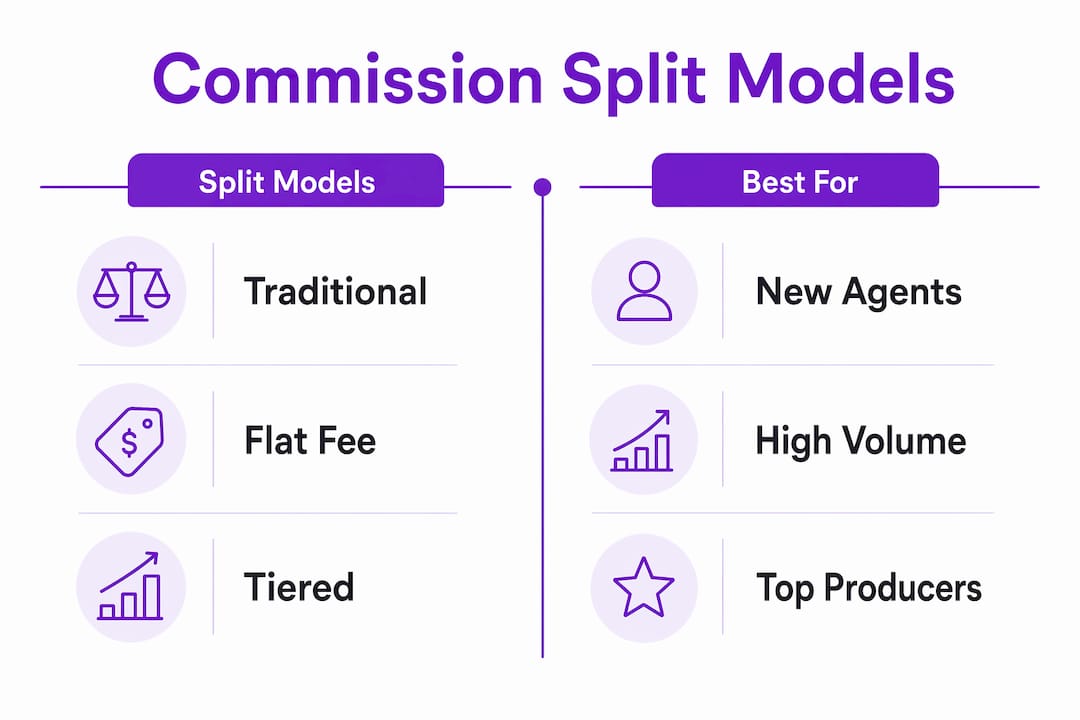
Flat fees work differently. The agent pays a set amount per transaction regardless of the sale price. A $500 flat fee on a $1,000,000 sale is a very different cost structure than a 30% split on the same deal. Your payment policy must specify which model applies to which agent tier and what happens when an agent moves between tiers mid-year.
Pro Tip: Review your split model every january before the new production year begins. Agents who hit cap in the prior year will expect their reset date to be clearly documented in the policy.
How have recent regulatory changes affected brokerage payment policies?
The NAR settlement, finalized in august 2024, is the most significant structural change to real estate compensation in decades. Post-August 2024, buyer-agent compensation requires written agreements negotiated independently, and offers of compensation can no longer appear on MLS listings. That single change rewrites the payment policy requirements for every brokerage in the country.
The practical effects on brokerage payment policies include:
- Written buyer representation agreements. Buyer compensation agreements must be in writing before services begin. Failure to document properly risks losing commissions entirely under the decoupled buyer-side payment structure.
- Separate commission negotiation. Buyer-agent fees are now negotiated directly with buyers, not bundled into the seller’s concession by default. Your policy must address how agents document and collect these fees.
- RESPA compliance documentation. Using commission funds for personal expenses or paying unlicensed parties is prohibited. Strict documentation of the commission flow from escrow to agent is required to avoid RESPA violations.
- State-level office policy manuals. Many states now mandate that brokerages maintain updated written policies covering all payment methodologies and deductions. Colorado’s Division of Real Estate is one example of a state regulator that enforces this requirement directly.
The RESPA risk is the one most brokerages underestimate. A brokerage that routes commission funds through a personal account, or pays a referral fee to an unlicensed party without documentation, faces federal liability. The paper trail from escrow to trust account to agent disbursement must be complete and auditable.
Pro Tip: Conduct an internal audit of your commission disbursement records every six months. If you cannot produce a clean paper trail from escrow receipt to agent payment for every closed transaction, your policy has a compliance gap.
What operational practices ensure timely and compliant commission payments?
The payment process after closing follows a defined sequence, and your policy must describe each step. Here is how a compliant commission payment workflow operates:
- Closing and fund receipt. The settlement company or title company releases commission funds to the brokerage’s trust account. Funds do not go directly to agents.
- Accounting reconciliation. The brokerage accounting team verifies the commission amount against the transaction file, confirms split calculations, and checks for any deductions such as desk fees or E&O insurance contributions.
- Compliance review. The managing broker or compliance officer confirms that all required agreements, including buyer representation agreements and co-op documentation, are on file.
- Agent disbursement. Agents are typically paid within 1–3 business days after closing once brokerage accounting reconciles commissions and receives funds from settlement trust accounts.
- Record retention. The brokerage retains documentation of the full disbursement chain for regulatory audit purposes.
Payment timing can be delayed until deed recording or lender fund confirmation, creating friction between agent expectations and regulatory requirements. Agents often expect payment on the day of closing. The policy must set clear expectations that payment follows reconciliation, not the closing table.
The most common operational failure is the informal workaround. Agents request immediate payment, and a well-meaning broker sends funds via Venmo or Zelle. That workaround creates federal liability because it bypasses the trust account requirement and leaves no auditable record. A real estate payment gateway solves this by processing disbursements through a compliant channel with automatic documentation.
Pro Tip: Automate your payout workflow. Switching from manual to automated payouts eliminates the reconciliation errors that cause delayed payments and the informal workarounds that create compliance risk.
How to create and implement an effective brokerage payment policy?
A payment policy document needs specific sections to be both legally defensible and operationally useful. Vague policies create the same disputes as no policy at all.
Core sections every policy must include:
- Commission calculation method. Define the gross commission income, how it is split between listing and buyer sides, and how the agent’s share is calculated before deductions.
- Split schedule. Document the exact percentage or flat fee for each agent tier, including cap thresholds and reset dates.
- Deduction schedule. List every authorized deduction: desk fees, E&O insurance, marketing fund contributions, and referral fees. Agents must sign acknowledgment of this schedule.
- Payment timeline. State the number of business days after closing that agents can expect payment, and identify the conditions that can extend that timeline.
- Compliance requirements. Reference the specific agreements agents must submit before a commission is released, including buyer representation agreements and co-op documentation.
- Dispute resolution process. Define how commission disputes are escalated and resolved, including the timeline for resolution.
Aligning the policy with state legal requirements is not optional. Colorado, California, and other states with active real estate divisions publish specific requirements for office policy manuals. Review your state regulator’s current guidelines every time you update the policy.
Training matters as much as the document itself. A policy that agents have never read does not prevent disputes. Hold a policy review session at the start of each production year, distribute a signed acknowledgment form, and update agents in writing whenever the policy changes. Commission tracking also supports agents at tax time by giving them a clean record of every payment received throughout the year.
Key Takeaways
A compliant real estate brokerage payment policy is the single most effective tool for preventing commission disputes, passing regulatory audits, and maintaining agent trust.
| Point | Details |
|---|---|
| Define the policy formally | A written office policy manual is a legal requirement in many states and the foundation of all commission compliance. |
| Document every split model | Specify percentage splits, cap thresholds, flat fees, and annual reset dates so agents have no ambiguity about their compensation. |
| Address post-2024 NAR changes | Written buyer representation agreements are now mandatory before services begin; your policy must reflect this requirement. |
| Enforce a compliant payment timeline | Agents are typically paid within 1–3 business days post-closing; the policy must set this expectation and explain what can delay it. |
| Audit your disbursement records | A clean paper trail from escrow to agent disbursement is the only defense against RESPA violations and state regulatory scrutiny. |
What I’ve learned from watching brokerages get this wrong
Most brokerages I have seen run into trouble not because they lack a payment policy, but because their policy is three years out of date and nobody has read it since it was written. The 2024 NAR settlement exposed this gap in a very public way. Brokerages that had never formalized their buyer-agent compensation process suddenly found themselves without the written agreements they needed to collect fees.
The other pattern I keep seeing is the trust account workaround. A top producer closes a deal on a Friday afternoon and wants their check before the weekend. The broker, not wanting to lose the agent’s goodwill, sends the funds directly from a personal or operating account. That decision, made in good faith, is a RESPA violation. The solution is not a stricter policy document. The solution is a payment system that makes the compliant path faster than the workaround.
Compensation models also need more attention than most brokerages give them. A compensation plan shapes agent motivation and brokerage profitability in ways that go far beyond the split percentage. Brokerages that review and update their models annually retain agents better and attract higher producers. Those that set a split in 2019 and never revisited it are losing agents to brokerages that have.
The future of brokerage payment policy is documentation at scale. As buyer-agent compensation becomes fully decoupled and state regulators increase audit frequency, the brokerages that survive and grow will be the ones with clean, auditable records for every transaction. That requires both a strong written policy and the technology to enforce it automatically.
— Wes
How Brokerpay keeps your commission payments compliant
Running a brokerage means managing dozens of moving parts at every closing. Commission splits, referral fees, co-op payments, and buyer-agent agreements all need to be tracked, documented, and processed correctly.
Brokerpay is built specifically for this. The platform tracks and processes agent splits and co-op commissions with a full audit trail on every transaction, keeping your brokerage RESPA-compliant and eliminating the Venmo and Zelle workarounds that create federal liability. Brokerages using Brokerpay get faster disbursements, fewer reconciliation errors, and documentation that holds up under regulatory review. See how it works and stop letting informal payment habits put your license at risk.
FAQ
What is a real estate brokerage payment policy?
A real estate brokerage payment policy is a formal document that defines how commissions are calculated, split between broker and agent, and paid after closing. It also covers fee deductions, payment timelines, and compliance requirements.
How long does a broker have to pay an agent after closing?
Agents are typically paid within 1–3 business days after closing once the brokerage reconciles the commission and receives funds from the settlement trust account. State laws or lender requirements can extend this timeline.
What did the 2024 NAR settlement change about commission payments?
The NAR settlement, finalized in august 2024, requires that buyer-agent compensation be negotiated in writing before services begin and prohibits commission offers from appearing on MLS listings. Brokerages must now document buyer representation agreements before releasing buyer-side commissions.
What is a RESPA violation in real estate commission payments?
A RESPA violation occurs when commission funds are misused, such as paying unlicensed parties or routing funds outside of the required trust account process. Brokerages must maintain a documented disbursement chain from escrow to agent to avoid federal penalties.
What should a brokerage office policy manual include?
A brokerage office policy manual must include commission calculation methods, agent split schedules, authorized deductions, payment timelines, required compliance agreements, and a dispute resolution process. Many state regulators require this document to be maintained and updated regularly.