Payment Platforms’ Role in Broker Compliance Programs

Payment platforms are the primary infrastructure that enforces regulatory compliance in broker operations, embedding AML/KYC controls, generating audit trails, and automating transaction reconciliation. The role of payment platforms in broker compliance programs goes far beyond processing deposits. These systems determine whether a brokerage can prove, at any moment, that every dollar moved through its accounts is traceable, verified, and documented. For real estate brokers and compliance officers, that proof is not optional. RESPA, SEC Rule 15c3-1, and FATF standards all demand it. Platforms like Brokerpay exist precisely because manual workarounds, such as Venmo or Zelle, cannot produce that proof.
What regulatory requirements do broker compliance programs demand from payment systems?
Broker compliance programs set a high bar for payment systems. Regulators do not accept partial records or delayed reporting. Every payment system a brokerage uses must meet specific, documented standards.
The core requirements break down into three pillars:
- 100% deposit traceability. Regulated brokers must integrate KYC/AML at or before the first deposit, with every transaction linked to a verified client account. No anonymous or unverified funding is permitted.
- Annual independent AML testing. Broker-dealer compliance programs require annual independent testing of AML controls, supported by persistent audit trails that payment platforms must generate and retain.
- Risk-based customer due diligence. Payment systems must apply risk scoring to each client and transaction, flagging elevated-risk profiles for enhanced review before funds move.
- Capital maintenance triggers. SEC Rule 15c3-1 mandates daily early-warning triggers for minimum net capital. Payment platforms feed the real-time transaction data that makes those triggers possible.
- Sanctions and PEP screening. Every deposit must clear sanctions lists and politically exposed person (PEP) databases at the point of funding, not after the fact.
Regulatory fines for failures in these areas reach six figures. That number reflects the cost of a single audit failure, not a pattern of violations. Payment systems that cannot produce clean, timestamped records of every transaction put the entire brokerage license at risk.
The practical implication is clear. A brokerage cannot bolt compliance onto its payment process after the fact. The payment platform must be the compliance mechanism, not a separate system that compliance officers check manually.
How do payment platforms embed AML and KYC controls within broker operations?
Payment platforms embed compliance controls at four specific points in the transaction lifecycle. Each point closes a gap that manual processes leave open.
- Client onboarding and identity verification. Before a client funds an account, the platform runs identity checks against government databases, sanctions lists, and PEP registries. This happens automatically, not as a separate step that a compliance officer initiates.
- Deposit-time risk scoring. Every incoming deposit receives a real-time risk score tied to the client’s profile, funding history, and transaction pattern. Integrating payment data with CRM and trading systems reduces false positives and closes the audit gaps that siloed systems create.
- Third-party deposit blocking. Compliant platforms block deposits from accounts that do not match the verified client identity. This single control eliminates one of the most common money-laundering vectors in brokerage operations.
- Suspicious pattern detection. The platform monitors transaction sequences, flagging structuring attempts, rapid deposit-withdrawal cycles, and funding from high-risk jurisdictions. Alerts route to compliance officers with full transaction context attached.
Pro Tip: Set your platform’s third-party deposit block as a default-on control, not an optional setting. Turning it off requires a documented compliance exception. That paper trail protects you during audits.
The technical architecture matters here. Embedding AML/KYC in funding workflows prevents compliance breakdowns that occur when controls sit outside the payment process. A platform that screens clients at onboarding but does not re-screen at each deposit creates a gap. Regulators find those gaps. The correct design screens at every funding event, not just the first one.

Real estate brokerages face a specific version of this problem. Agent splits, referral fees, and co-op commissions all move money between parties. Each transfer is a potential compliance event. A real estate payment gateway built for brokerage operations handles these transfers within a documented, auditable workflow rather than routing them through personal payment apps.
What are the compliance benefits of multi-PSP routing for brokers?
Multi-PSP routing is the practice of connecting a brokerage to multiple payment service providers through a single orchestration layer. The compliance benefits are significant and often underestimated.
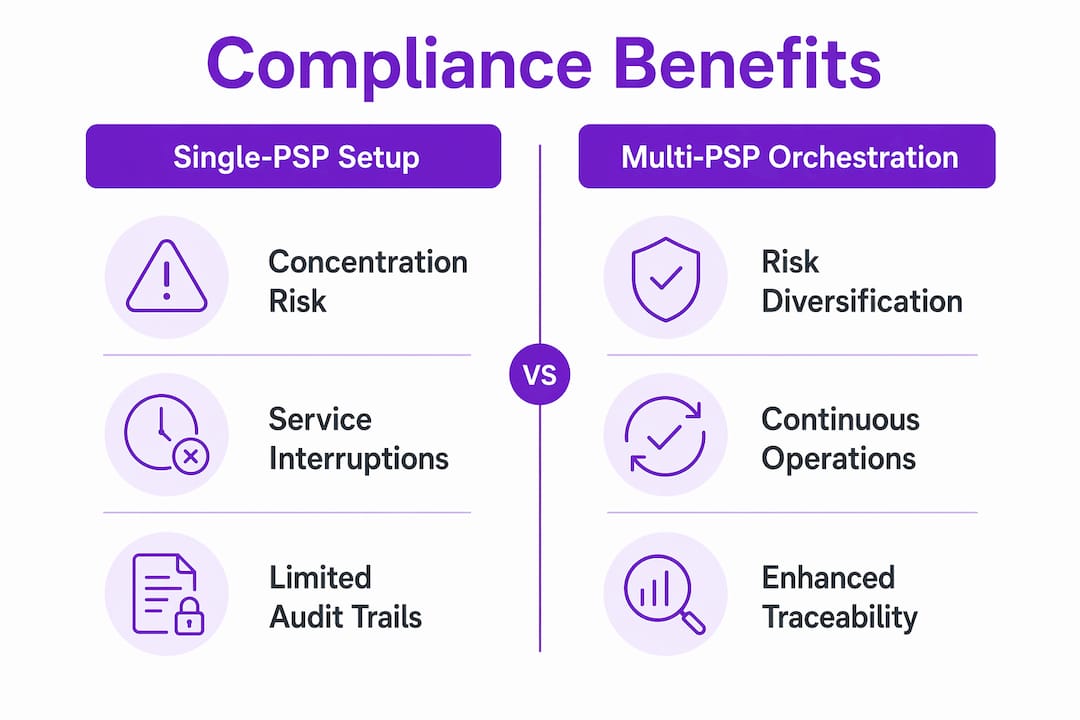
A single-provider setup creates concentration risk. If that provider freezes the account, the brokerage loses the ability to process deposits and withdrawals. That operational failure becomes a compliance failure when clients cannot access funds and regulators ask why. Multi-PSP routing prevents single-provider risk concentration and the service freezes that follow.
The orchestration layer does more than route transactions. It tags each transaction with the regulatory data required for that specific payment type, jurisdiction, and client risk profile. It normalizes data across providers so that reconciliation produces a single, consistent audit record rather than fragmented reports from five different dashboards. Fragmented dashboards cause data gaps that lead directly to audit failures.
Correct provider classification matters as much as routing logic. Using non-forex-specific merchant IDs leads to compliance failures and account freezes. Brokers must confirm that each PSP in their stack carries the correct MCC classification for their transaction types. An orchestration layer that routes compliant transaction types to correctly classified providers closes this risk.
The table below shows how routing architecture affects compliance outcomes across key risk categories.
| Risk category | Single-PSP setup | Multi-PSP orchestration |
|---|---|---|
| Service continuity | Single point of failure | Automatic failover preserves operations |
| Audit data consistency | Fragmented across provider reports | Normalized into one reconciliation record |
| Transaction tagging | Provider-dependent, often incomplete | Orchestration layer enforces consistent tagging |
| Regulatory data propagation | Manual export and mapping required | Automated across all connected providers |
| Fund commingling risk | Higher without routing controls | Reduced by type-specific routing rules |
How do payment platforms support affiliate commission management within compliance frameworks?
Affiliate and introducing broker (IB) commission management is one of the most overlooked compliance gaps in brokerage operations. The problem is structural. Commissions flow from client deposits, but many brokerages track deposits and commissions in separate systems. That separation creates reconciliation gaps that regulators treat as red flags.
A compliant payment platform closes this gap by linking every deposit to both the client record and the affiliate attribution data at the moment of funding. Brokers must treat IB-acquired clients with the same KYC/AML rigor as direct clients, and that means the affiliate attribution data must sit inside the compliance audit trail, not in a separate spreadsheet.
The practical workflow looks like this:
- The client funds an account. The platform records the deposit, the verified client identity, and the referring affiliate ID simultaneously.
- The platform calculates the commission based on the verified deposit amount, not a manually entered figure.
- The commission payout generates its own audit record, linked to the original deposit transaction.
- Any dispute about commission amounts has a complete, timestamped evidence chain available immediately.
Accurate commission tracking also prevents tax compliance failures for agents and brokers alike. When commission records are tied to verified transactions, tax reporting draws from a single source of truth rather than reconciled estimates.
Pro Tip: Require your payment platform to generate a commission audit report that links each payout to its originating deposit transaction ID. If your platform cannot produce that report on demand, your affiliate compliance program has a documentation gap.
Switching from manual to automated payouts eliminates the calculation errors and timing delays that create disputes between brokers and affiliates. Automation also removes the human decision point where errors, and potential manipulation, occur most often.
Key Takeaways
Payment platforms are not optional compliance tools. They are the infrastructure that makes broker compliance programs auditable, defensible, and scalable.
| Point | Details |
|---|---|
| Deposit-time KYC is mandatory | AML/KYC controls must trigger at every funding event, not just at client onboarding. |
| Audit trails require automation | Manual reconciliation fails as transaction volume grows; automated platforms generate persistent, linkable records. |
| Multi-PSP routing reduces compliance risk | Orchestration normalizes data across providers and prevents fund commingling and account freezes. |
| Affiliate commissions need compliance linkage | Every commission payout must trace back to a verified deposit with a documented audit chain. |
| Platform classification matters | Incorrect MCC classification leads to account freezes and regulatory penalties regardless of other controls. |
What I’ve learned from watching brokerages get compliance wrong
The most common mistake I see is treating payment infrastructure as an IT decision rather than a compliance decision. A brokerage selects a payment provider based on processing fees and integration speed, then hands the compliance officer a system that was never designed to produce audit trails. Six months later, an examiner asks for a transaction-level report linking deposits to client records and commissions. The compliance officer cannot produce it.
The second mistake is assuming that compliance controls in one system compensate for gaps in another. A brokerage might run excellent KYC at onboarding but use a personal payment app to distribute agent splits. That split payment is now outside the compliance record entirely. Regulators do not accept “we checked the client at onboarding” as a defense for an undocumented outbound payment.
The brokerages that handle this well share one characteristic. They selected their payment platform before they designed their compliance program, not after. The platform’s data architecture determined what the compliance program could document and prove. That sequence matters more than any individual control.
Compliant co-op payment workflows are not complicated to implement when the payment platform is built for them. The complexity comes from retrofitting compliance onto a system that was never designed to support it.
— Was
How Brokerpay handles compliance-ready payment workflows
Real estate brokerages face a specific compliance problem. Agent splits, referral fees, and co-op commissions move money between multiple parties on every transaction. Each transfer needs documentation. Brokerpay is built to handle exactly that.
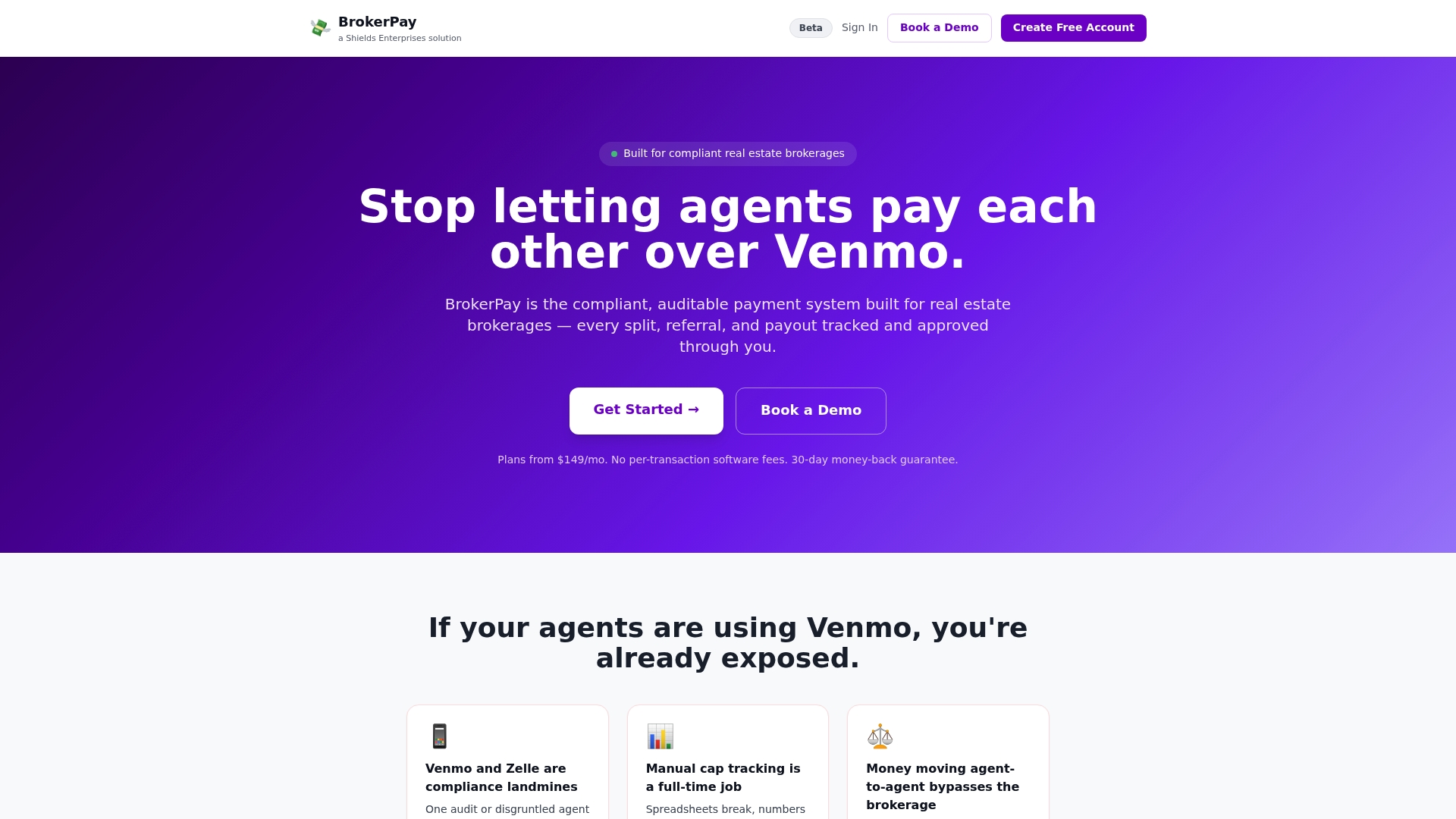
Brokerpay tracks, documents, and processes every agent split, referral fee, and co-op commission within a single auditable workflow. It keeps brokerages RESPA-compliant and eliminates the Venmo and Zelle workarounds that create federal liability. Every payout links back to the originating transaction, so your audit trail is complete by default, not assembled after the fact. See how Brokerpay works and replace your manual payment process with one that compliance officers can defend on demand.
FAQ
What is the role of payment platforms in broker compliance programs?
Payment platforms enforce AML/KYC controls at the point of funding, generate audit trails, and automate reconciliation across client deposits, commissions, and outbound payments. They are the primary mechanism through which brokerages meet regulatory documentation requirements.
Why can’t brokers use Venmo or Zelle for agent payments?
Personal payment apps do not generate the audit trails or compliance documentation that RESPA and SEC regulations require. Using them for agent splits or referral fees creates undocumented transactions that expose the brokerage to federal liability.
What does deposit-time KYC mean for real estate brokers?
Deposit-time KYC means that identity verification and sanctions screening run automatically each time a client or counterparty funds a transaction, not just at account opening. This control ensures every dollar entering the brokerage is linked to a verified identity.
How does multi-PSP routing improve compliance resilience?
Multi-PSP routing connects a brokerage to several payment providers through one orchestration layer, preventing single-provider failures and normalizing transaction data into a consistent audit record across all providers.
What compliance risk does affiliate commission tracking address?
Unlinked affiliate commissions create reconciliation gaps that regulators treat as potential money-laundering indicators. Linking each commission payout to its originating verified deposit closes that gap and produces a defensible audit chain.