How to Manage Referral Fee Paperwork in 2026

Referral fee paperwork management is the process of collecting, executing, and retaining the signed agreements, tax forms, and closing documents that govern every real estate referral transaction. Without a structured system, brokerages face IRS backup withholding liability, RESPA violations, and payment disputes that can unwind a closed deal. The 25% national average referral fee makes these transactions financially significant enough to demand the same documentation rigor as a primary commission. This guide gives real estate professionals a clear, compliant workflow for every stage of referral fee documentation.
What documents do you need to manage referral fee paperwork?
Three documents form the core of every compliant referral transaction: the signed referral fee agreement, the W-9 tax form, and the closing statement. Each one serves a distinct legal purpose, and missing any one of them creates a gap that auditors and regulators will find.
The referral fee agreement is the contract that defines the relationship. It must specify the fee amount or percentage, the payment trigger, the duration of the referral, and a tail period clause. A tail period clause protects your commission on transactions that close months after the original referral, which happens more often than agents expect in slow markets.

The W-9 form is not optional paperwork. Failure to collect a W-9 before payment exposes the paying brokerage to backup withholding liabilities under IRS rules. Collect it at the time the referral agreement is signed, not at closing.
The closing statement ties the referral fee to a specific transaction. It confirms the sale price, the commission amount, and the disbursement date. Without it, you cannot reconcile what was paid against what was agreed.
- Signed referral fee agreement with fee amount, payment trigger, duration, and tail period
- W-9 form collected before any payment is issued
- Closing statement or settlement sheet confirming disbursement
- Commission reconciliation showing the split calculation
- Correspondence log documenting referral acceptance and client introduction
Retain all of these documents for a minimum of seven years. That retention window covers the IRS audit lookback period and most state regulatory review timelines.
Pro Tip: Create a single folder per referral transaction labeled with a unique referral ID. Store the agreement, W-9, closing statement, and any email correspondence together. If an audit arrives two years later, you will have everything in one place.
How do you set up a compliant referral fee agreement process?
A compliant referral fee process starts before the referring agent ever introduces the client. Signed agreements before client contact prevent attribution disputes and protect both parties if the deal falls through or the client switches agents.
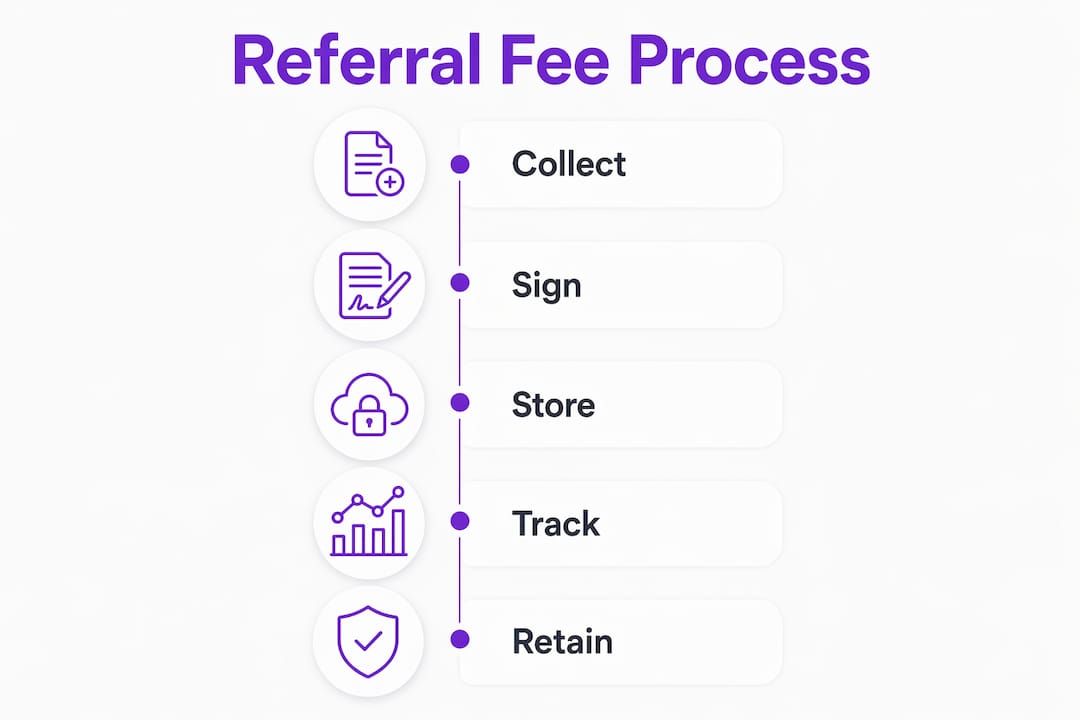
The workflow below covers every stage from referral submission to final payout.
- Receive the referral. Confirm the referral in writing via email or a referral submission form. Document the date, the referring agent’s brokerage, and the client’s name.
- Execute the agreement. Both brokerages sign the referral fee agreement before any client introduction occurs. Use eSignature tools to speed up execution and create a time-stamped record.
- Collect the W-9. Request the referring brokerage’s W-9 at the same time as the agreement. Do not wait until closing.
- Introduce the client. Only after the agreement is signed does the receiving agent make contact with the referred client.
- Track the transaction. Link the referral ID to the active transaction in your CRM. Update the record at each milestone: contract accepted, inspection complete, clear to close.
- Confirm the payment trigger. Most agreements set the trigger as funds disbursed at closing, not contract execution. Confirm this language before the deal closes.
- Apply the hold period. A 30–60 day hold period before releasing the referral fee reduces losses from chargebacks, cancellations, or post-closing disputes. This is standard practice for brokerages processing high referral volume.
- Issue payment and tax forms. Route payment through the licensed brokerage, not to an individual agent. Issue Form 1099-NEC if the annual total exceeds $600.
Pro Tip: Set your payment trigger language to “commission received by brokerage” rather than “transaction closed.” Closing and disbursement do not always happen on the same day, and vague trigger language is the most common source of referral fee disputes.
Payments typically occur 30–45 days after closing. Setting that expectation in the agreement prevents the referring agent from following up prematurely and reduces friction in the relationship.
What tax and regulatory rules apply to referral fee management?
Tax compliance is the area where referral fee management most often breaks down. The rules are clear, but the execution requires discipline at every transaction.
The IRS requires brokerages to issue Form 1099-NEC when referral fee payments to a single recipient exceed $600 in a calendar year. That threshold is reached quickly in active markets where a single referral fee can run several thousand dollars.
- 1099-NEC threshold: Any recipient receiving more than $600 in referral fees in a calendar year requires a 1099-NEC by January 31 of the following year.
- Backup withholding: Without a valid W-9 on file, the paying brokerage must withhold 24% of the payment and remit it to the IRS. That cost comes out of the brokerage’s pocket if the form was never collected.
- Licensing requirement: Referral fees must be paid only to licensed brokerages, not to individual agents. Paying an unlicensed individual directly violates state real estate licensing laws and RESPA. Review your state’s rules on commission payment alternatives before structuring any payout.
- Record retention: Keep signed agreements, W-9 forms, and closing statements for seven or more years to defend against IRS and state regulatory audits.
- Year-end reconciliation: Run a full audit of all referral payments in december before year-end close. Identify any missing W-9 forms and resolve them before January 31 filing deadlines.
Treating W-9 collection as a closing task rather than an agreement task is the single most expensive paperwork mistake a brokerage can make. Backup withholding liability at 24% on a $10,000 referral fee costs the brokerage $2,400 that it cannot recover from the referring party after the fact.
Organized commission tracking is the most reliable way to stay ahead of these obligations. Brokerages that track referral fees in a dedicated system catch missing forms before they become tax liabilities.
What tools help with tracking referral fees and reducing paperwork errors?
Technology does not replace the need for correct documentation. It does make correct documentation far easier to execute consistently across dozens of transactions.
The most effective approach links each referral to a unique ID that connects all related documents in one place. Successful referral programs manage documentation as a system, tying referral IDs to signed agreements, W-9 forms, and closing statements for audit readiness. That structure turns a pile of disconnected files into a searchable, auditable record.
| Tool category | Primary function | Compliance benefit |
|---|---|---|
| CRM with referral tracking | Links agreements, W-9s, and closing docs to a unique referral ID | Single source of truth for each transaction |
| eSignature platforms | Executes agreements with time-stamped records | Proves agreement was signed before client contact |
| Automated payout systems | Calculates splits and routes payments to licensed brokerages | Reduces manual errors and licensing violations |
| Digital document storage | Centralizes all referral paperwork in one searchable location | Supports 7-year retention requirement |
| Tax form automation | Generates and files 1099-NEC forms based on payment data | Eliminates year-end manual reconciliation |
Automation software handles the calculation and batch payment functions that create the most errors in manual workflows. When a brokerage processes 50 referral transactions in a quarter, manual spreadsheet tracking produces inconsistencies that compound at tax time.
- Use eSignature tools to execute agreements the same day a referral is accepted.
- Set automated reminders for W-9 collection tied to the agreement execution date.
- Configure your CRM to flag transactions where the hold period has not yet elapsed.
- Run monthly payment reports to catch any referral fees approaching the $600 IRS threshold.
- Integrate your automated payout process with your accounting system to eliminate duplicate data entry.
A transparent ledger that both the paying and receiving brokerage can reference reduces the most common source of referral disputes: disagreement over what was paid and when.
Key Takeaways
Compliant referral fee management requires a signed agreement, a W-9 collected before payment, and a closing statement retained for at least seven years.
| Point | Details |
|---|---|
| Execute agreements first | Sign the referral fee agreement before any client introduction to prevent attribution disputes. |
| Collect W-9 at signing | Waiting until closing to collect a W-9 creates backup withholding liability at 24% of the payment. |
| Apply a hold period | A 30–60 day hold before payout protects the brokerage from chargebacks and post-closing cancellations. |
| File 1099-NEC above $600 | Any referral recipient receiving more than $600 annually requires a 1099-NEC by January 31. |
| Retain records for 7+ years | Keep all referral paperwork for seven or more years to satisfy IRS and state audit requirements. |
The paperwork problem nobody talks about
The most common referral fee mistake I see is not a missing form. It is a verbal agreement that everyone assumed would be formalized later. Two agents agree on a referral over the phone, the client closes six months later, and suddenly there is a dispute over whether the fee was 20% or 25%, or whether it applies at all because no one signed anything.
The second most common mistake is treating W-9 collection as someone else’s job. The paying brokerage carries the backup withholding liability. That means the paying brokerage owns the W-9 collection process, full stop. Delegating it to the referring agent and hoping they remember is not a system. It is a liability waiting to surface at year-end.
What actually works is treating referral fee documentation the same way a title company treats a closing package. Every document has a checklist item. Nothing moves forward until the checklist is complete. That level of discipline feels excessive until the first time an auditor asks for records on a transaction from four years ago.
Technology makes this easier than it has ever been. Brokerages that connect their CRM to an automated payout system and eSignature workflow close the gaps that manual processes leave open. The brokerages still using spreadsheets and Venmo are not saving time. They are accumulating federal liability one transaction at a time.
Set clear timeline expectations in every agreement. State the payment trigger, the hold period, and the expected disbursement date in plain language. Referring agents who know exactly when to expect payment do not follow up every week, and that alone reduces the administrative burden significantly.
— Wes
How Brokerpay handles referral fee compliance for brokerages
Real estate brokerages that process referral fees at volume need more than a spreadsheet. They need a system that connects documentation, payment routing, and tax reporting in one place.
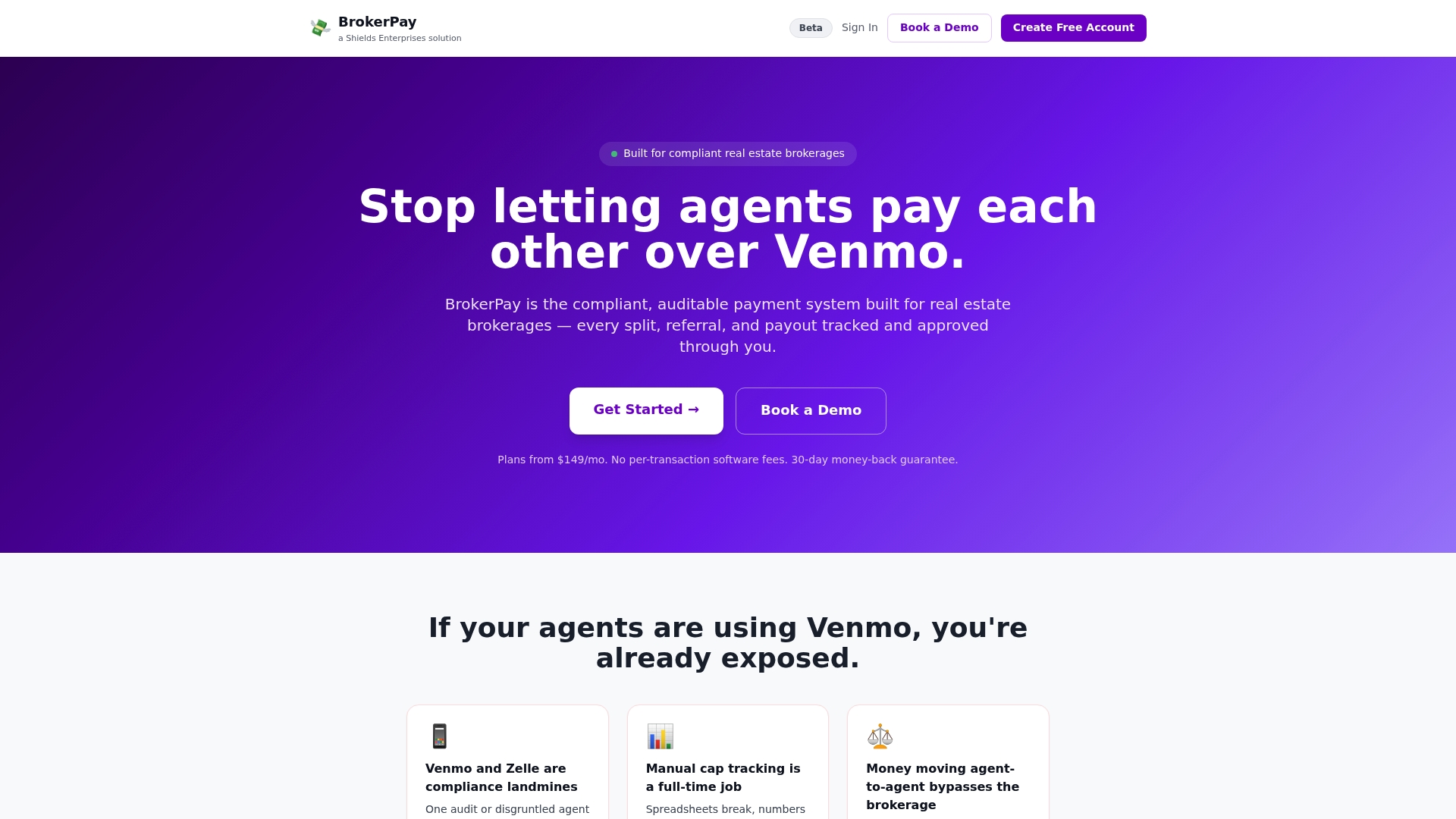
Brokerpay is a compliant commission payment platform built for exactly this workflow. It tracks referral agreements, processes agent splits, and routes co-op commissions through licensed brokerages, keeping transactions RESPA-compliant and eliminating the Venmo and Zelle workarounds that create federal liability. Brokerpay generates the audit trail that regulators expect, from signed agreement to final disbursement, without requiring manual reconciliation at year-end. Brokerages that stop paying agents informally and move to a documented payment system reduce their compliance risk on every single transaction. If your brokerage is ready to replace manual referral fee tracking with a system that handles documentation, payments, and tax reporting together, Brokerpay is built for that.
FAQ
What is a referral fee agreement in real estate?
A referral fee agreement is a signed contract between two licensed brokerages that specifies the fee amount, payment trigger, duration, and tail period for a referred client transaction. It must be executed before the referring agent introduces the client to the receiving agent.
When must a 1099-NEC be issued for referral fees?
The paying brokerage must issue Form 1099-NEC when total referral fee payments to a single recipient exceed $600 in a calendar year, with the form due by January 31 of the following year.
Can referral fees be paid directly to an individual agent?
No. Referral fees must be paid to a licensed brokerage, not to an individual agent. Paying an unlicensed individual directly violates state real estate licensing laws and RESPA regulations.
How long should referral fee records be kept?
Retain signed agreements, W-9 forms, and closing statements for a minimum of seven years to satisfy IRS audit requirements and state regulatory review timelines.
What happens if a brokerage does not collect a W-9 before paying a referral fee?
Without a valid W-9 on file, the paying brokerage is required to withhold 24% of the payment as backup withholding and remit it to the IRS. That cost cannot be recovered from the referring party after the fact.