Referral Fee Disclosure Requirements: A 2026 Agent Guide

A referral fee disclosure requirement is a legal or ethical obligation that compels real estate professionals to inform their clients about any referral fees or compensation they receive in connection with a transaction. These requirements exist at the federal level under RESPA, at the state level through licensing statutes, and within professional codes like the NAR Code of Ethics. The rules are not uniform. What California mandates, Illinois does not require. Understanding where your obligations begin and end is not optional. It is the difference between a clean transaction file and a federal liability.
What is a referral fee disclosure requirement in real estate?
A referral fee is a payment one licensed broker makes to another in exchange for sending a client their way. These fees typically range from 25% to 35% of the earned commission. They are legal under federal law when paid between licensed brokers, but the question of whether you must disclose them to your client is where the rules get complicated.
The term “referral fee disclosure requirement” is the plain-language description of what the industry formally addresses through RESPA, state agency statutes, and fiduciary duty rules. These are not interchangeable frameworks. Each one applies in different circumstances and carries different consequences for non-compliance. Knowing which framework governs your specific transaction is the first step toward real compliance.

Disclosure requirements for fees exist as a layer of compliance that sits above the question of whether a referral fee is legal at all. A fee can be perfectly legal and still trigger a disclosure obligation. That distinction matters more than most agents realize.
What does RESPA require for referral fee disclosures?
RESPA, the Real Estate Settlement Procedures Act, is the primary federal law governing referral fees in real estate transactions. It draws a clear line between two types of referrals, and the disclosure rules differ sharply between them.
Broker-to-broker referrals involve one licensed agent sending a buyer or seller to another licensed agent. RESPA permits these fees between licensed brokers without a federal disclosure mandate to the client. The fee is legal as long as it corresponds to an actual referral service. RESPA Section 8 prohibits kickbacks and fee splitting for settlement services where no real service was rendered.
Affiliated Business Arrangements (AfBAs) are a different matter entirely. When a brokerage has an ownership interest in a settlement service provider, such as a title company or mortgage lender, and refers clients to that provider, RESPA requires a written AfBA disclosure. The key requirements are:
- The disclosure must be a separate document, not buried in a contract
- It must explain the nature of the business relationship and the estimated charges
- It must be given at or before the time of the referral
- Records must be kept for not less than 5 years
Verbal disclosures do not satisfy RESPA’s AfBA requirements. The written document is not a formality. It is the compliance record that protects your brokerage if a consumer complaint or HUD audit arises. Brokerages that skip this step because they assume a conversation is enough are creating federal liability with every referral.
How do state laws affect referral fee disclosure rules?
State law is where the real variation lives. There is no universal federal rule requiring agents to disclose broker-to-broker referral fees to clients, but several states have filled that gap with their own statutes.
California sits at one end of the spectrum. California agents must disclose all compensation and fees received from a transaction, including referral fees. The state’s agency disclosure laws treat referral payments as material information that clients have a right to know. Illinois sits at the other end. Illinois does not require disclosure of broker-to-broker referral fees to clients, though professional ethics still apply.
The table below shows how disclosure obligations vary across key states:
| State | Disclosure required to client? | Key rule or statute |
|---|---|---|
| California | Yes | All compensation must be disclosed |
| Illinois | No | Broker-to-broker fees exempt from client disclosure |
| North Carolina | Conditional | Disclosure required when fee creates conflict of interest |
| Texas | Yes | Agency disclosure laws require full compensation transparency |
| Florida | Yes | Fiduciary duty statutes require disclosure of material facts |
Timing matters as much as content. Most state rules require disclosure before the client makes a decision based on the referral. A disclosure handed over at closing does not satisfy a statute that requires it before client engagement. Full and timely disclosure minimizes audit risks and satisfies real estate commission rules in states that require it.
Pro Tip: Check your state real estate commission’s website directly for current disclosure requirements. State rules change, and your broker’s policy may not reflect the latest statute.
Exceptions, ethics, and the gray zone of broker-to-broker fees
The legal gray zone in referral fee disclosure sits squarely in broker-to-broker arrangements. Federal law does not require you to tell your client that you paid or received a referral fee between licensed brokers. But that legal silence does not mean disclosure is optional from an ethical standpoint.
The NAR Code of Ethics Article 6 requires Realtors to disclose financial benefits received from recommending real estate products or services. However, standard referral fees between brokers were specifically carved out from this requirement after a proposal to mandate disclosure was voted down. That carve-out surprises many agents. It means the NAR Code, as written, does not require you to disclose a referral fee to a client simply because you received one from another broker.
Still, the ethical case for disclosure is strong:
- Clients who later discover an undisclosed referral fee often feel misled, regardless of legality
- Some states prohibit any compensation without client knowledge, making ethics and law overlap
- Brokerage policies frequently mandate disclosure even where state law does not
- Transparent, written disclosure builds trust and avoids any appearance of a conflict of interest
Non-disclosure is a reputational risk even when it is not a legal one. An agent who proactively tells a client “I received a referral fee for connecting you with this agent, and here is the amount” demonstrates professionalism. That transparency often strengthens the client relationship rather than damaging it.
Pro Tip: Even when disclosure is not legally required, put it in writing anyway. A one-paragraph disclosure letter added to the transaction file costs nothing and protects you from future disputes.
How to document and manage referral fee disclosures properly
Proper documentation is the practical backbone of referral fee compliance. Knowing the rules is not enough. You need a system that captures disclosures at the right time and stores them in a retrievable format.
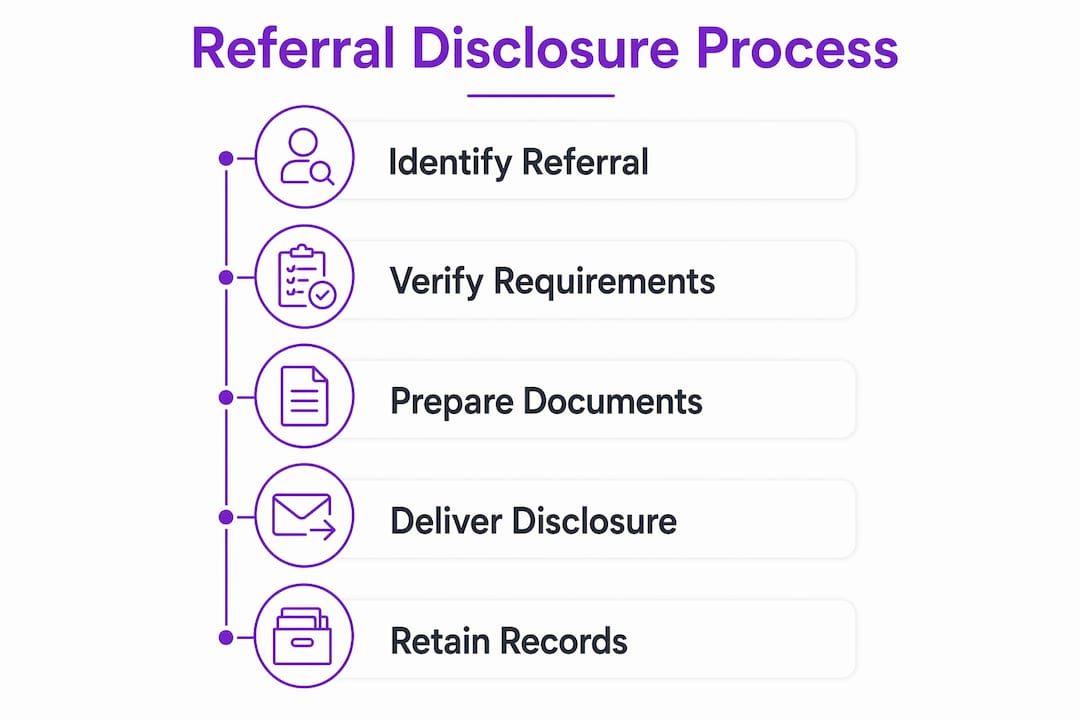
Follow these steps for every transaction involving a referral fee:
- Disclose before the client acts. Give the disclosure before the client engages with the referred agent or service provider. A disclosure after the fact does not satisfy most state statutes or AfBA rules.
- Use a written, standalone document. Do not bury the disclosure in a purchase agreement or listing contract. A separate document signals that the disclosure was intentional and clearly communicated.
- Include the fee amount or calculation method. Referral fee disclosures must include the existence of the fee, its specific amount or how it is calculated, and the timing of payment. Vague language like “a fee may be paid” does not meet the standard.
- Retain the signed disclosure in the transaction file. Keep records for at least 5 years to satisfy RESPA’s AfBA retention rules and most state commission requirements.
- Report referral fees correctly for tax purposes. As of 2026, the IRS reporting threshold for referral fee payments increased to $2,000. Fees above that threshold must be reported as income or expenses. Failure to report correctly risks audits and license scrutiny.
Manual tracking through spreadsheets or informal payment apps creates gaps. Platforms like Brokerpay are built to track referral fee payments with a documented audit trail, keeping brokerages compliant without relying on memory or paper files.
Pro Tip: Automate your disclosure workflow. When a referral fee is logged in your payment system, trigger a disclosure document at the same time. Linking the payment record to the disclosure record eliminates the most common compliance gap.
Key Takeaways
Referral fee disclosure requirements in real estate are governed by a layered framework of RESPA, state law, and professional ethics, and compliance depends on knowing which layer applies to each transaction.
| Point | Details |
|---|---|
| RESPA AfBA rules are strict | Written disclosures are required before referral; records must be kept for 5 years. |
| State rules vary significantly | California requires full compensation disclosure; Illinois does not for broker-to-broker fees. |
| Ethics fill legal gaps | NAR Code of Ethics Article 6 and brokerage policies often require disclosure where law does not. |
| Timing and format matter | Disclosures must be given before client action and on a separate, standalone document. |
| Tax reporting applies in 2026 | The IRS threshold for referral fee reporting increased to $2,000; accurate records prevent audit risk. |
Why proactive disclosure is the only defensible position
Real estate professionals often ask me whether they need to disclose a referral fee when the law does not require it. My answer is always the same: yes, and here is why.
The regulatory environment around referral fees has tightened steadily over the past decade. State commissions are paying closer attention to compensation arrangements, and consumer expectations around transparency have shifted. Clients today are more informed. They research their agents, read their contracts, and ask harder questions. An undisclosed referral fee that surfaces after closing does not just create a legal problem. It destroys the relationship and the referral network you spent years building.
I have seen brokerages operate for years without a formal disclosure policy, relying on the fact that their state did not technically require one. Then a single consumer complaint triggered a licensing audit, and the absence of documentation made everything worse. The fee was legal. The arrangement was legitimate. But without a paper trail, the brokerage had no way to demonstrate that disclosure had occurred.
The agents who come out ahead are the ones who treat disclosure as a standard operating procedure, not a legal checkbox. Write it down. Give it to the client. Keep the signed copy. That practice protects you in every jurisdiction, regardless of whether your state mandates it.
— Wes
How Brokerpay keeps your referral fee compliance audit-ready
Managing referral fee disclosures manually creates gaps that show up at the worst possible time, during an audit or a client dispute.
Brokerpay is a compliant commission payment platform built for real estate brokerages. It tracks, documents, and processes agent splits, referral fees, and co-op commissions in one place. Every payment generates a documented record, so your brokerage is always ready for a licensing review. Brokerpay also eliminates the Venmo and Zelle workarounds that create federal liability under RESPA. If your brokerage handles referral fees regularly, see how Brokerpay works and replace your manual process with one that holds up under scrutiny.
FAQ
What is a referral fee disclosure requirement?
A referral fee disclosure requirement is a legal or ethical obligation for real estate professionals to inform clients about any referral fees received in connection with a transaction. The specific rules vary by federal law, state statute, and professional ethics codes.
Does RESPA require disclosure of all referral fees?
RESPA does not require disclosure of broker-to-broker referral fees to clients, but it mandates written AfBA disclosures when a brokerage refers clients to a settlement service provider in which it holds an ownership interest.
Which states require agents to disclose referral fees to clients?
California and Texas require agents to disclose all compensation including referral fees. Illinois does not require disclosure of broker-to-broker referral fees to clients, though state rules can change and agents should verify current requirements with their state commission.
How long must referral fee disclosure records be kept?
RESPA requires AfBA disclosure records to be retained for at least 5 years. Most state real estate commissions have similar or longer retention requirements for transaction documentation.
What happens if a referral fee is not disclosed when required?
Failure to disclose a required referral fee can result in licensing sanctions, fines, and consumer complaints. In cases involving RESPA AfBA violations, federal penalties also apply. Written documentation of timely disclosure is the primary defense in any audit or dispute.