Real Estate Payment Disbursement Timeline Explained

A real estate payment disbursement timeline defines the exact sequence and timing by which sellers, agents, and brokers receive funds after a property closes. The industry term for this process is “escrow disbursement,” and understanding it separates agents who manage client expectations well from those who field angry calls at 5 p.m. on a Friday. The timeline typically runs 1–5 business days post-closing, depending on whether your state follows wet or dry funding rules, how quickly escrow clears, and how fast your brokerage processes splits. Escrow officers, lenders, and brokerages each control a distinct phase. Knowing which phase is active at any moment tells you exactly where the money is and when it moves.
What is a real estate payment disbursement timeline?
A real estate payment disbursement timeline is the ordered schedule of events that must occur before funds leave escrow and land in the accounts of sellers, agents, and brokers. The process starts the moment a lender wires funds into escrow and ends when the final commission check or wire hits your account.
The timeline is not arbitrary. Escrow disbursement only occurs after all purchase agreement conditions are met, including inspections, title clearance, and contract fulfillment. That compliance requirement is why funds do not release the second a buyer signs.
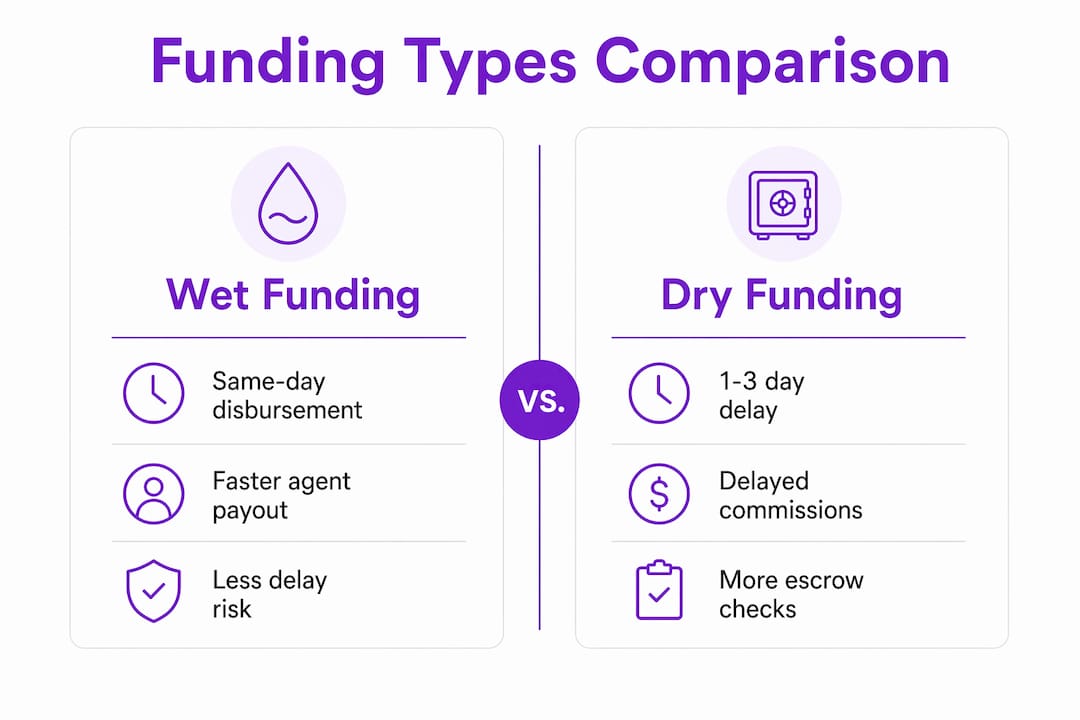
Two concepts govern how fast the timeline moves: wet funding and dry funding. Wet funding states allow disbursement on the same day as signing or within 24 hours. Dry funding states require a 1–3 business day post-closing review before any funds release. Your state’s rule sets the floor for every timeline conversation you have with a client.

Agents receive their commissions only after the brokerage processes escrow funds, meaning agent payouts lag behind seller proceeds. That lag is usually one to two additional business days on top of whatever the escrow timeline requires.
How do state funding rules affect disbursement timing?
State law is the single biggest variable in any disbursement process timeline. Wet funding states, including Texas, New Mexico, and most of the Southeast, allow escrow to release funds immediately after recording. Dry funding states, including California, Oregon, Washington, and Alaska, require lenders to review loan documents after closing before authorizing disbursement.
Wet funding enables same-day or 24-hour disbursement, while dry funding adds a 1–3 business day delay. That difference is not a flaw in the dry funding system. State funding differences protect transaction integrity, and dry funding is a safeguard, not a sign of inefficiency.
The table below shows how the two systems compare across the factors that matter most to agents and brokers.
| Factor | Wet funding states | Dry funding states |
|---|---|---|
| Disbursement timing | Same day or within 24 hours | 1–3 business days post-closing |
| Lender review | Completed before signing | Completed after signing |
| Agent commission speed | Faster overall | Slower by 1–3 days |
| Common states | Texas, Florida, Georgia | California, Oregon, Washington |
| Client expectation | Same-day proceeds possible | Multi-day wait is standard |
Pro Tip: Tell clients their state’s funding type before they sign anything. A California seller expecting same-day proceeds will be frustrated without that context. A one-sentence explanation at the listing appointment prevents a dozen calls at closing.
What happens inside escrow before funds are released?
The escrow clearance process follows a fixed sequence. Each step must complete before the next begins, which is why delays at any single point push the entire real estate closing timeline back.
- Lender funds escrow. The buyer’s lender wires the loan amount into the escrow account. This is the starting gun for disbursement.
- Escrow officer verifies conditions. The officer confirms that all purchase agreement conditions are satisfied, including title clearance, hazard insurance, and any repair credits.
- Triple-Reconciliation Audit runs. This audit verifies cleared buyer funds, confirms lien payoffs, and checks county recording confirmation before any wire transfers go out.
- Liens are paid off. The seller’s existing mortgage and any other liens are paid directly from escrow before the seller receives a single dollar.
- County recording is confirmed. The deed must record with the county before funds release in most states. Recording office outages or high-volume days can delay this step by hours.
- Final wires go out. Once recording confirms, escrow sends wires to the seller, the listing brokerage, and the buyer’s brokerage simultaneously.
Missing documents are the most common cause of delays at steps 2 and 3. A missing HOA payoff letter or an unsigned addendum can freeze the entire sequence.
Pro Tip: Ask your escrow officer for the 20-digit Output Message Accountability Data (OMAD) code if a wire has not arrived within 24 hours of the expected release. Banks can use the OMAD sequence to manually pull a wire out of an automated processing queue, which bypasses the delay without requiring a new transfer.
When do agents and brokers actually get paid?
Agents typically receive commissions 1–5 business days after closing. That range exists because two separate processes must complete: escrow must disburse to the brokerage, and then the brokerage must process and distribute the agent’s split.
The payment method affects speed as much as the brokerage’s internal process does.
- Wire transfers are the fastest option. Wire transfers typically arrive within one business day and are the most common method for escrow disbursements. Brokerages that pay agents by wire can turn around splits the same day they receive escrow funds.
- Direct deposit (ACH) takes one to two business days after the brokerage initiates the transfer. It is reliable but slower than a wire.
- Paper checks are the slowest option. Checks are subject to bank holds of one to five business days after deposit, which can push the total timeline past a week.
Brokerage processing speed varies significantly. Some firms pay agents the same day escrow funds clear. Others run weekly batch processing, which means an agent who closes on a Tuesday may not see their split until the following Monday. Knowing your brokerage’s payment cycle is as important as knowing your state’s funding rules.
Commission tracking also matters beyond just knowing when you get paid. Accurate records of each disbursement, including splits, referral fees, and co-op commissions, are critical for tax compliance and accounting. Agents who track disbursements in real time avoid scrambling at tax time.
What causes payment delays and how do you prevent them?
Disbursement delays usually stem from timing issues and document readiness rather than bank failures. That means most delays are preventable with the right preparation.
The most common causes of delayed payments include:
- Late-week closings. Closings on Fridays or after bank cutoff hours push wires to the next business day. Banks typically stop processing wires around 3–4 p.m. A 4:30 p.m. Friday signing means no funds until Monday at the earliest.
- Incomplete paperwork. Missing signatures, unsigned addenda, or absent HOA documents stop the escrow officer from completing the verification sequence.
- Title issues. An unresolved lien or a gap in the title chain delays recording, which delays disbursement.
- Recording office backlogs. High-volume periods or system outages at the county recorder’s office can delay the recording confirmation that triggers final wires.
- Lender-side delays. In dry funding states, lenders must review post-closing documents before authorizing disbursement. Any question about loan document accuracy restarts that review.
Pro Tip: Schedule closings for Tuesday through Thursday mornings whenever possible. That timing gives the escrow officer a full business day to process, gives the lender time to fund before cutoff, and keeps the entire sequence inside a single business week. Share this advice with sellers at the listing appointment so they understand why you are recommending a mid-week close.
The best prevention strategy is proactive communication. Call your escrow officer the day before closing to confirm all documents are in order. Confirm the lender’s funding timeline. Know the county recorder’s hours. Agents who treat closing day as the finish line miss the fact that disbursement is a separate race that starts the moment signing ends.
Reviewing compliant co-op payment workflows before complex transactions also reduces the chance of a documentation error that freezes escrow.
Key Takeaways
A real estate payment disbursement timeline runs 1–5 business days post-closing, controlled by state funding rules, escrow clearance steps, and brokerage processing speed.
| Point | Details |
|---|---|
| State funding rules set the floor | Wet funding states disburse same-day; dry funding states add 1–3 business days. |
| Escrow clearance follows a fixed sequence | Lender funding, lien payoffs, and county recording must all complete before wires go out. |
| Agent commissions lag seller proceeds | Brokerages process splits after escrow disburses, adding one to two days to the timeline. |
| Wire transfers are the fastest payment method | Wires typically arrive within one business day, faster than ACH or paper checks. |
| Most delays are preventable | Mid-week morning closings and complete paperwork eliminate the most common delay causes. |
Why I think most agents underestimate the disbursement process
After watching hundreds of closings play out, the pattern is clear: agents who understand the disbursement sequence manage their clients better, close with less friction, and get paid faster. The agents who treat disbursement as someone else’s problem are the ones calling escrow at 6 p.m. on a Friday wondering where the money is.
The biggest mistake I see is treating closing day and payment day as the same event. They are not. Closing is when documents sign. Payment is when the escrow officer completes a multi-step compliance process that no one can skip. Agents who explain this distinction upfront set accurate expectations and eliminate the most common source of post-closing client complaints.
The second mistake is ignoring brokerage processing speed. If your brokerage runs weekly batch payments, you are effectively lending your commission to the firm for up to seven days after every close. That is worth knowing, and it is worth asking about. Platforms built for automated commission payouts exist precisely because manual batch processing is slow and error-prone.
The future of disbursement is faster and more transparent. Brokerages that adopt compliant payment platforms will pay agents the same day escrow clears. That speed becomes a recruiting advantage. Agents choose brokerages partly on how fast they get paid.
— Wes
How Brokerpay handles commission disbursements
Real estate payment disbursement is complex enough without adding manual spreadsheets, paper checks, and Venmo workarounds into the mix. Brokerpay is a compliant commission payment platform built specifically for real estate brokerages. It tracks agent splits, referral fees, and co-op commissions in one place, processes payouts automatically, and keeps your brokerage RESPA-compliant without the federal liability that informal payment methods create.
Brokerpay eliminates the batch-processing lag that costs agents days of waiting after every close. When escrow funds clear, Brokerpay can move splits to agents immediately, with full documentation for tax and audit purposes. Brokerages that want to pay agents faster and stay compliant use Brokerpay to replace the manual processes that slow everyone down.
FAQ
What is the typical real estate disbursement timeline?
Agents typically receive commissions 1–5 business days after closing. The exact timing depends on your state’s funding rules, escrow clearance speed, and your brokerage’s payment processing cycle.
What is the difference between wet and dry funding?
Wet funding states disburse funds on the same day as signing or within 24 hours. Dry funding states require a 1–3 business day post-closing lender review before escrow can release any funds.
Why do agents get paid after sellers?
Agents receive commissions only after the brokerage processes escrow funds. Escrow wires to the brokerage first, and then the brokerage distributes agent splits, which adds one to two business days to the agent’s wait time.
What is an OMAD code and when should I use it?
An OMAD (Output Message Accountability Data) code is a 20-digit wire tracking sequence that banks use to manually locate and pull a delayed wire. Request it from your escrow officer if a wire has not arrived within 24 hours of the expected release time.
How can agents avoid payment disbursement delays?
Schedule closings for Tuesday through Thursday mornings, confirm all documents are complete the day before closing, and verify the lender’s funding timeline in advance. Late-week closings are the single most preventable cause of delayed payments.