Transaction-Based Commission Model: A Broker’s Guide

A transaction-based commission model is a compensation structure where an agent or intermediary earns a percentage or fixed fee for each completed transaction. In real estate brokerage, this is the dominant framework for paying agents, splitting co-op fees, and distributing referral income. Unlike salary-based pay, every dollar earned ties directly to a closed deal. Platforms like Airbnb, Etsy, and Fiverr use the same logic at scale. Understanding how this structure works gives brokers a clear advantage when designing compensation plans that attract top agents and protect brokerage margins.
What is a transaction-based commission model?
A transaction-based commission model is defined as a revenue framework where commissions are earned on each individual completed transaction, typically as a percentage or fixed fee tied to transaction value. The industry term for this in marketplace contexts is the take rate, which measures how much of each transaction the platform or broker retains.
The core commission structure works by collecting fees automatically before funds are settled. In real estate, this means the brokerage captures its split at closing before the agent receives their net payout. The formula is straightforward: Sale Amount × Commission Rate = Commission Earned.

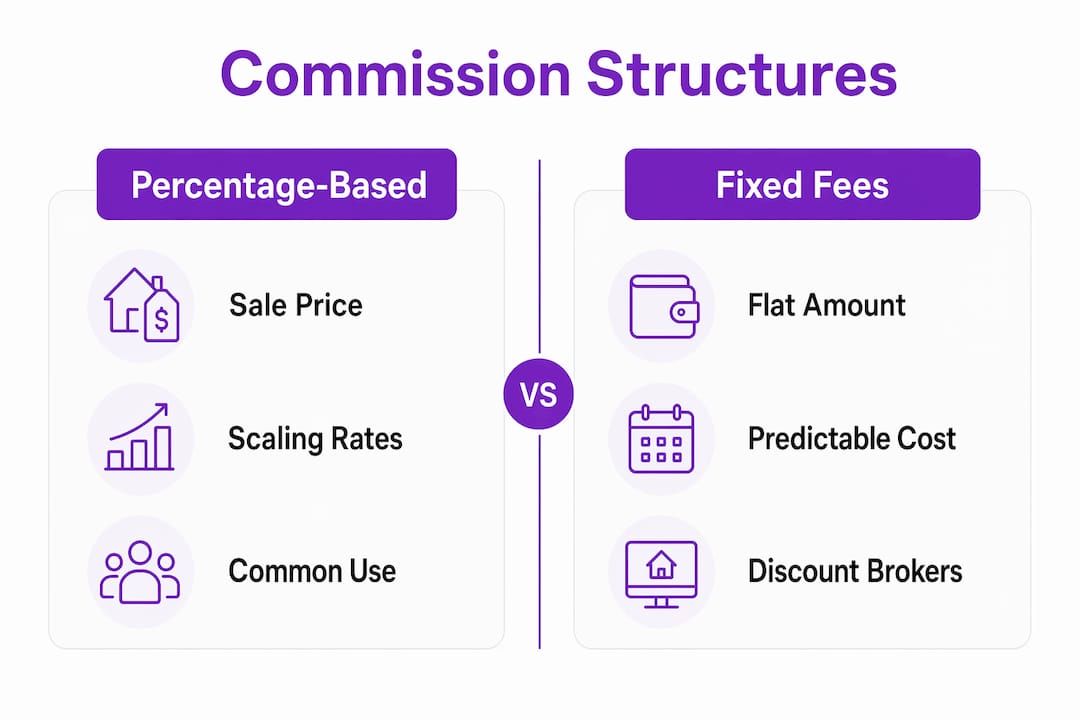
Two primary fee formats exist within this model. Percentage-based commissions scale with transaction value, which benefits brokers on high-value deals. Fixed fees per transaction provide predictability regardless of sale price. Many brokerages use a combination of both, particularly when structuring referral fees or co-op payments alongside the primary agent split.
Gross Merchandise Value (GMV) is the total transaction volume flowing through a platform before any fees are deducted. Take rate is the percentage of GMV the platform retains. These two metrics together define how efficiently a brokerage or marketplace monetizes its transaction volume.
What are the main types of transaction commission structures?
Transaction commission structures fall into several distinct categories, each with different implications for how brokers and agents share revenue.
Percentage-based commissions are the most common in real estate. The agent earns a set percentage of the sale price, and the brokerage retains a split. This scales naturally with property values, rewarding agents on premium transactions without renegotiating the rate.
Fixed per-transaction fees charge a flat dollar amount regardless of sale price. Some discount brokerages use this model to attract high-volume agents who close many lower-priced properties. The predictability appeals to agents with consistent pipelines.
Tiered commission plans adjust the rate based on production volume. An agent might earn 70% of the gross commission income (GCI) up to $50,000 in annual GCI, then 80% above that threshold. This structure rewards top producers while protecting brokerage revenue at lower volume levels.
Hybrid models combine a reduced transaction commission with a fixed monthly or transaction fee. Hybrid commission structures can boost margins by about 3.1% compared to pure commission models. That margin improvement comes from the revenue stability the fixed component provides during slow transaction periods.
Fee distribution methods compared
| Distribution Type | Who Pays | Best Used When |
|---|---|---|
| Seller-side only | Listing agent/vendor | Seller has strong incentive to close |
| Buyer-side only | Buyer’s agent/customer | Platform wants zero friction for sellers |
| Split commission | Both parties share | High-value two-sided markets like real estate |
| Tiered by volume | Agent/vendor | Rewarding high producers |
Split commissions reduce cost friction for users and are common in high-value two-sided platforms. In real estate, the listing brokerage and buyer’s brokerage each receive a portion of the total commission, typically negotiated in the listing agreement.
How does transaction commission work in real estate brokerage?
In real estate brokerage, the transaction commission structure follows a clear sequence from listing to closing. The seller agrees to a total commission rate in the listing agreement. At closing, that commission is split between the listing brokerage and the cooperating buyer’s brokerage. Each brokerage then applies its internal split formula to pay the individual agents.
Transaction commissions work best with shorter sales cycles and consistent margins where agents directly influence outcomes. Real estate fits this profile well. An agent’s effort, negotiation skill, and market knowledge directly affect whether a deal closes and at what price.
As of 2026, total real estate commission rates have shifted following the National Association of Realtors settlement. Buyer’s agent compensation is now negotiated separately rather than mandated through MLS rules. This makes understanding your internal commission structure more critical than ever, because agents are asking harder questions about how their splits are calculated and justified.
Here is how a standard commission calculation works in practice:
- Seller agrees to a 5% total commission on a $400,000 sale.
- Total commission pool equals $20,000.
- Listing brokerage and buyer’s brokerage each receive $10,000.
- Each brokerage applies its internal split, for example 70/30 in favor of the agent.
- Each agent nets $7,000. Each brokerage retains $3,000.
Income volatility is the primary risk agents face in this model. A slow quarter with few closings means little or no income. Brokerages address this through draw against commission, which advances income to agents against future earnings. Draw advances provide stability but require careful performance tracking to remain sustainable.
Pro Tip: Set a clear repayment policy for draw advances before offering them. Agents who leave mid-year with an outstanding draw balance create accounting and legal complications that are far easier to prevent than to resolve.
What are the benefits and challenges of transaction-based models?
The transaction commission structure aligns broker and agent incentives better than any salary-based alternative. When agents earn only on closed deals, their financial interest matches the brokerage’s revenue interest exactly. No closed deal means no commission expense for the brokerage and no income for the agent.
Key benefits include:
- Scalability. Commission costs scale with revenue. A brokerage with 10 agents or 100 agents pays commissions proportionally, without fixed labor cost increases.
- Incentive alignment. Agents are motivated to close deals, not just generate activity.
- Flexibility. Brokerages can adjust splits, tiers, and bonus structures without changing base payroll.
- Performance visibility. Every agent’s contribution to brokerage revenue is measurable and auditable.
The challenges are equally real. High commission rates can cause up to an 8% drop in conversion if vendors or agents perceive them as too expensive relative to alternatives. This means commission rate setting is not just an accounting decision. It is a competitive positioning decision.
“Transaction-based commissions are not inherently uncapped. Unlimited commissions create income volatility, which firms moderate using draw advances.” — Salesforce Commission Pay Strategies
Income volatility also affects agent retention. Agents who experience two or three slow months in a row may leave for a brokerage offering a lower split with a salary component. Brokerages that ignore this dynamic lose experienced agents to competitors who have thought more carefully about compensation design.
Separating commission payments from technical settlement fees is another overlooked challenge. Settlement fees such as card network charges can erode margins if not tracked separately from agent commissions. A brokerage that bundles these costs together loses visibility into its true per-transaction profitability.
Examples of commission models and take rate benchmarks
Real-world take rates across industries show how widely commission percentages vary based on transaction size, market competition, and platform value.
| Platform / Market | Commission Rate | Fee Structure |
|---|---|---|
| Airbnb | 14–16% | Split between host and guest |
| Etsy | 6.5% | Seller-side only |
| Fiverr | 20% | Seller-side only |
| U.S. Real Estate (total) | 4–6% | Split between listing and buyer brokerages |
| Financial Services Sales | ~2% | Agent-side, flat rate |
Marketplace take rates typically range from 5% to 30% depending on industry and volume. Real estate sits in the middle of this range when measured as a percentage of transaction value, but the absolute dollar amounts per transaction are far higher than most digital platforms.
Airbnb’s split commission model is instructive for real estate brokers. Airbnb charges hosts approximately 3% and guests 11–14%, spreading the cost across both parties. This reduces the friction any single party feels while maintaining a healthy total take rate. Real estate already uses a similar logic when listing and buyer commissions are negotiated separately.
Fiverr’s 20% take rate works because the platform provides significant value: payment processing, dispute resolution, marketing exposure, and trust infrastructure. This is the same argument brokers must make to justify their split. If agents can close deals without the brokerage’s systems, compliance support, or brand, the commission split becomes harder to defend.
Pro Tip: Benchmark your brokerage’s effective take rate against local competitors annually. If your split is 10% higher than the market average without a clear value difference, your best agents will notice before you do.
Best practices for implementing commission models in real estate
Structuring a transaction commission plan that retains agents and protects brokerage margins requires more than setting a split percentage. The plan must be documented, auditable, and competitive.
- Set transparent, competitive rates. Publish your split structure clearly. Agents who understand exactly how their commission is calculated trust the brokerage more and are less likely to dispute payouts.
- Layer your commission plan deliberately. Modern commission plans stack base transaction commissions with residuals and bonuses. Document each layer separately so finance audits and compliance reviews are straightforward.
- Separate commission payments from settlement fees. Card processing fees, wire transfer costs, and platform fees should never be deducted from agent commissions without explicit disclosure. Keep these line items distinct in your accounting.
- Add value to justify your split. Large transactions create strong incentives for agents to bypass brokerage systems on high-value deals. Compliance support, E&O insurance, transaction coordination, and brand credibility are the services that make your split worth paying.
- Use technology to automate tracking and payouts. Manual commission calculations create errors, disputes, and compliance risk. Automated systems generate an auditable record of every split, referral fee, and co-op payment.
Pro Tip: Review your commission tracking practices at least once per quarter. Errors caught early cost far less to fix than those discovered during a tax audit or agent dispute.
Combining a transaction commission with a small monthly desk fee is one of the most effective hybrid approaches for brokerages with experienced agents. The desk fee provides baseline revenue during slow months. The commission split rewards the brokerage proportionally when agents close high-value deals.
Key takeaways
A transaction-based commission model succeeds when rates are competitive, plans are documented, and technology handles the calculation and payout process automatically.
| Point | Details |
|---|---|
| Core definition | Agents earn a percentage or fixed fee on each completed transaction, tied directly to closed deals. |
| Fee distribution options | Seller-side, buyer-side, and split commission structures each serve different market dynamics. |
| Income volatility risk | Draw advances stabilize agent income but require performance tracking to remain financially sound. |
| Hybrid models outperform | Combining reduced transaction commissions with fixed fees improves brokerage margins by about 3.1%. |
| Technology is non-negotiable | Automated commission tracking reduces errors, supports compliance, and creates auditable payout records. |
The part most brokers get wrong about commission design
I have reviewed commission structures at brokerages ranging from five agents to five hundred. The most common mistake is treating the commission split as a fixed policy rather than a competitive tool. Brokers set a split at launch, never revisit it, and then wonder why their best agents leave for competitors offering 5% more.
The second mistake is ignoring the difference between what a commission plan says on paper and what agents actually receive at closing. Manual calculations, informal Venmo payments, and undocumented referral fees create a gap between the plan and reality. That gap is where compliance problems and agent disputes are born.
Hybrid models are underused in residential real estate. A modest desk fee combined with a competitive transaction split gives the brokerage revenue stability without punishing agents during slow markets. The brokerages I have seen hold onto top producers longest are the ones that treat compensation as a retention tool, not just a cost line.
The 2026 commission environment is more transparent than it has ever been. Buyers are asking about agent compensation. Sellers are negotiating harder. Agents are comparing splits across brokerages with more information than they had three years ago. Brokers who cannot clearly explain and justify their commission structure are at a real disadvantage.
Technology like Brokerpay removes the operational friction that makes commission management painful. When payouts are automated and documented, brokers spend less time on disputes and more time on growth.
— Wes
Stop managing commission payouts by hand
Real estate brokerages that still process agent splits through spreadsheets, Venmo, or Zelle are creating federal liability with every transaction. Brokerpay is built specifically for this problem.

Brokerpay tracks, documents, and processes agent splits, referral fees, and co-op commissions in a single compliant platform. Every payout generates an auditable record. Every split follows your documented commission plan. Brokerages using Brokerpay eliminate the manual errors and RESPA compliance risks that come with informal payment workarounds. If you are ready to move from manual to automated payouts, Brokerpay is the direct path. Visit Brokerpay to see how it works for brokerages like yours.
FAQ
What is a transaction-based commission model in real estate?
A transaction-based commission model pays agents a percentage or fixed fee for each completed property sale. The brokerage retains a split of the gross commission before distributing the agent’s share at closing.
How does transaction commission work for agent splits?
The total commission from the sale is divided between the listing brokerage and the buyer’s brokerage. Each brokerage then applies its internal split formula to calculate the individual agent’s payout.
What are typical real estate commission rates in 2026?
Total real estate commissions generally range from 4% to 6% of the sale price, split between listing and buyer brokerages. Following the NAR settlement, buyer’s agent compensation is now negotiated separately from MLS rules.
What is the difference between a commission and a settlement fee?
A commission is the agent’s or brokerage’s compensation for completing a transaction. A settlement fee is a technical processing cost such as a card network or wire transfer charge, which should be tracked separately to protect brokerage margins.
What is a hybrid commission model?
A hybrid commission model combines a reduced transaction commission percentage with a fixed fee, such as a monthly desk fee. This structure improves margin stability by about 3.1% compared to pure commission models, according to 2026 marketplace research.