Agent Payment Dispute Prevention Checklist for Brokers

An agent payment dispute prevention checklist is a structured set of practices that eliminates confusion and conflict in real estate commission payments. Commission disputes cost brokerages time, money, and agent trust. The most effective brokerages treat dispute prevention as a system, not a reaction. This checklist covers the contractual, operational, and technological steps that keep payment conflicts from reaching the point of no return. Tools like Brokerpay, digital audit trails, and mandatory mediation clauses are the foundation of that system.
1. lock down commission terms in every contract
Clear commission structures are the single most effective dispute prevention tool available to brokers. Vague split agreements and undocumented schedule changes are the leading cause of agent payment conflicts. Every contract should specify the exact percentage, the triggering event (closing date vs. funding date), and the timeline for disbursement.
- Commission split percentages: State exact figures, not ranges.
- Payment trigger: Define whether payment releases at closing, funding, or title transfer.
- Disbursement timeline: Specify the number of business days after trigger.
- Referral and co-op fees: Document separately with their own schedules.
- Change order process: Require signed written approval for any modification.
Machine-readable scope of work and signed change orders act as strong evidence to prevent client misunderstandings and disputes. Generic contracts lose disputes. Specific, enforceable documentation wins them.
Pro Tip: Add a billing descriptor clause that specifies exactly how your brokerage name appears on bank statements. Agents who do not recognize a transaction descriptor are more likely to flag it as an error, which triggers a dispute before anyone picks up the phone.

2. add a mandatory mediation clause
Litigation is slow and expensive. A 30-day mandatory mediation clause in contracts resolves disputes faster and reduces legal costs significantly. This clause requires both parties to attempt mediation before filing any legal claim, which filters out most disputes before they escalate.
The clause should name a specific mediator selection process, set a 30-day window from the date of written notice, and define what constitutes a failed mediation. Brokers who skip this step often find themselves in arbitration or court over disputes that a single structured conversation could have resolved. This is one of the most underused items in any checklist for payment conflicts.
3. respond to post-payment inquiries within 30 minutes
Speed is the most underrated factor in dispute prevention. Support tickets filed within 30 minutes of payment signal high risk of a future dispute, and quick intervention can prevent a chargeback from being filed at all. Every brokerage needs a defined response protocol for post-payment questions.
Here is a four-step response workflow that works:
- Acknowledge immediately. Send an auto-confirmation that the inquiry was received and assign it a ticket number.
- Pull the transaction record. Have the full payment chain accessible within five minutes of the inquiry.
- Contact the agent directly. A phone call resolves more disputes than three email exchanges.
- Document the resolution. Record what was communicated, what was agreed, and when the issue closed.
Provisional credits during disputes are accounting tools. Funds are removed immediately, but disputes can be won to recover them. The faster your team responds, the better your odds of resolving the issue before it becomes a formal dispute.
Pro Tip: Assign one staff member per week as the designated dispute contact. Rotating ownership without a clear handoff process is how inquiries fall through the cracks and become formal chargebacks.
4. build end-to-end payment traceability
End-to-end traceability is the gold standard for dispute defense. The ability to reconstruct the entire payment chain in under 30 minutes is critical to winning disputes. Without it, even a valid payment becomes difficult to defend.
Your traceability system should capture the following at minimum:
| Document Type | What to Capture | Storage Requirement |
|---|---|---|
| Signed commission agreement | Agent name, split %, trigger event | Permanent, searchable |
| Payment authorization | Date, amount, approving party | Linked to transaction ID |
| Disbursement record | Amount sent, method, timestamp | Exportable for audit |
| Communication log | Emails, texts, call notes | Timestamped, archived |
| Change orders | Scope changes, new amounts | Signed by all parties |
Commission tracking also supports dispute prevention and compliance in brokerages, making it a dual-purpose investment. A platform that automates this capture removes the human error that manual record-keeping introduces.
5. replace manual payouts with automated systems
Manual payout systems are the primary source of preventable payment errors in real estate brokerages. Spreadsheets, Venmo, and Zelle introduce calculation errors, missed payments, and zero audit trail. Automated systems eliminate all three problems.
The comparison is direct:
| Feature | Manual Payouts | Automated Payouts |
|---|---|---|
| Audit trail | None or incomplete | Full, timestamped record |
| Error rate | High (human calculation) | Low (formula-driven) |
| RESPA compliance | Risk of violation | Built-in compliance controls |
| Dispute evidence | Difficult to produce | Instantly retrievable |
| Multi-party approvals | Informal, undocumented | Tracked and logged |
Switching from manual to automated payouts reduces conflicts and errors in agent commissions directly. Brokerpay is built specifically for this transition. It tracks agent splits, referral fees, and co-op commissions while keeping brokerages RESPA-compliant and eliminating the Venmo workarounds that create federal liability.
When evaluating any payment platform, look for dispute automation, deadline tracking, multi-party approval workflows, and integration with your existing CRM. A real estate payment gateway built for brokerages handles these requirements out of the box.
6. train staff on common dispute triggers
Onboarding staff with training around common dispute triggers, including billing descriptor issues, refund rules, and payment authorizations, reduces human error and chargebacks. Most disputes do not start with bad intent. They start with confusion that a trained team member could have prevented.
Your training program should cover four core areas. First, billing descriptors: staff should know exactly how your brokerage name appears on statements and be able to explain it to agents on demand. Second, refund and reversal policies: every team member should know the exact steps and timelines. Third, authorization records: staff should understand what constitutes valid payment authorization and where those records live. Fourth, escalation paths: every team member should know when to escalate and to whom.
The agent productivity checklist from real estate CRM platforms reinforces these documentation and process standards at the agent level, which reduces the volume of questions that reach your office staff in the first place.
7. submit dispute evidence early
When a dispute does reach the formal stage, timing determines the outcome. Merchants have 20–45 days to respond to a dispute, but submitting evidence at least three business days before the deadline protects against processor lag. Missing a deadline by one day forfeits the case regardless of the evidence quality.
Dispute resolution is a data-retrieval process. Timely evidence collection within short deadlines is the deciding factor in most cases. Build a dispute response folder for every transaction at the time of payment, not after a dispute is filed. That folder should contain the signed agreement, payment authorization, disbursement record, and any relevant communications. When a dispute arrives, your team pulls the folder and responds, rather than scrambling to reconstruct a paper trail.
8. use reason codes to build targeted evidence packets
Dispute reason codes dictate the exact evidence needed. Code-specific responses strongly increase win rates. A response built for a “services not rendered” code looks completely different from one built for an “unauthorized transaction” code.
Every brokerage should maintain a reason code reference guide that maps each code to its required evidence type. The dispute process is network rule-driven, and the reason code assigned by the issuer is the primary key to your evidence strategy. A three-paragraph, code-specific cover letter paired with the correct documentation packet is the format that produces the highest representment success rate.
9. assign a single dispute owner
Assigning one owner per dispute to manage evidence and deadlines improves consistency and win rates significantly. Shared ownership means no ownership. When two people think the other is handling a deadline, the deadline gets missed.
The dispute owner is responsible for pulling the evidence folder, writing the cover letter, submitting before the deadline, and tracking the outcome. This role does not need to be a full-time position. It needs to be a clearly assigned responsibility with a backup named in writing. Brokerages with 10 or more agents should consider designating a transaction coordinator as the permanent dispute owner.
10. monitor dispute trends monthly
Dispute data tells you where your payment process breaks down. Track reason codes monthly to identify patterns across fraud, fulfillment, documentation, and billing descriptor categories. A single dispute is an incident. Three disputes with the same reason code in one quarter are a process failure.
Build a simple dashboard that tracks total disputes filed, win rate by reason code, average resolution time, and disputes by agent or transaction type. Review it monthly with your office manager. When a pattern emerges, trace it back to the contract language, the payment workflow, or the communication process that produced it. Compliant co-op payment workflows provide concrete examples of how structured processes reduce disputes and increase transparency across transaction types.
Key takeaways
A complete agent payment dispute prevention checklist combines clear contracts, fast communication, full documentation, and monthly trend monitoring to eliminate most commission conflicts before they escalate.
| Point | Details |
|---|---|
| Contracts prevent most disputes | Specify split percentages, payment triggers, and disbursement timelines in every agreement. |
| Speed stops escalation | Responding to post-payment inquiries within 30 minutes prevents most disputes from becoming chargebacks. |
| Traceability wins disputes | Reconstruct the full payment chain in under 30 minutes to defend any transaction effectively. |
| Automation reduces errors | Replacing Venmo and spreadsheets with a compliant platform eliminates the most common error sources. |
| Reason codes drive evidence | Match your evidence packet to the specific dispute code to maximize your win rate. |
The dispute you never see coming is the one that costs you most
I have reviewed payment workflows at brokerages of every size, and the pattern is consistent. The disputes that hurt most are not the ones involving bad actors. They are the ones that happen because a well-meaning agent did not recognize a transaction descriptor, or because a split agreement was never updated after a team restructure.
Most brokers treat dispute prevention as a reactive process. They build a response system after the first painful chargeback. The brokerages that operate cleanly treat it as infrastructure. They assign ownership, document everything at the time of transaction, and review their dispute data the same way they review their sales pipeline.
The hardest part of implementing this kind of checklist is not the technology. It is the discipline of maintaining it when things are busy. Closing season is exactly when documentation shortcuts happen, and exactly when disputes spike. The brokerages that hold the line on process during high-volume periods are the ones with the cleanest records and the lowest dispute rates.
Automation handles the consistency problem. A platform that captures every split, every approval, and every disbursement automatically removes the human variable from the equation. The personal communication piece, the phone call within 30 minutes, the direct conversation with an agent who has a question, that part still requires a person. The best dispute prevention systems combine both.
— Wes
Stop payment disputes before they start with Brokerpay
Brokerpay is built for exactly the workflows described in this checklist. It tracks agent splits, referral fees, and co-op commissions with full audit trails, multi-party approvals, and RESPA-compliant documentation built in.
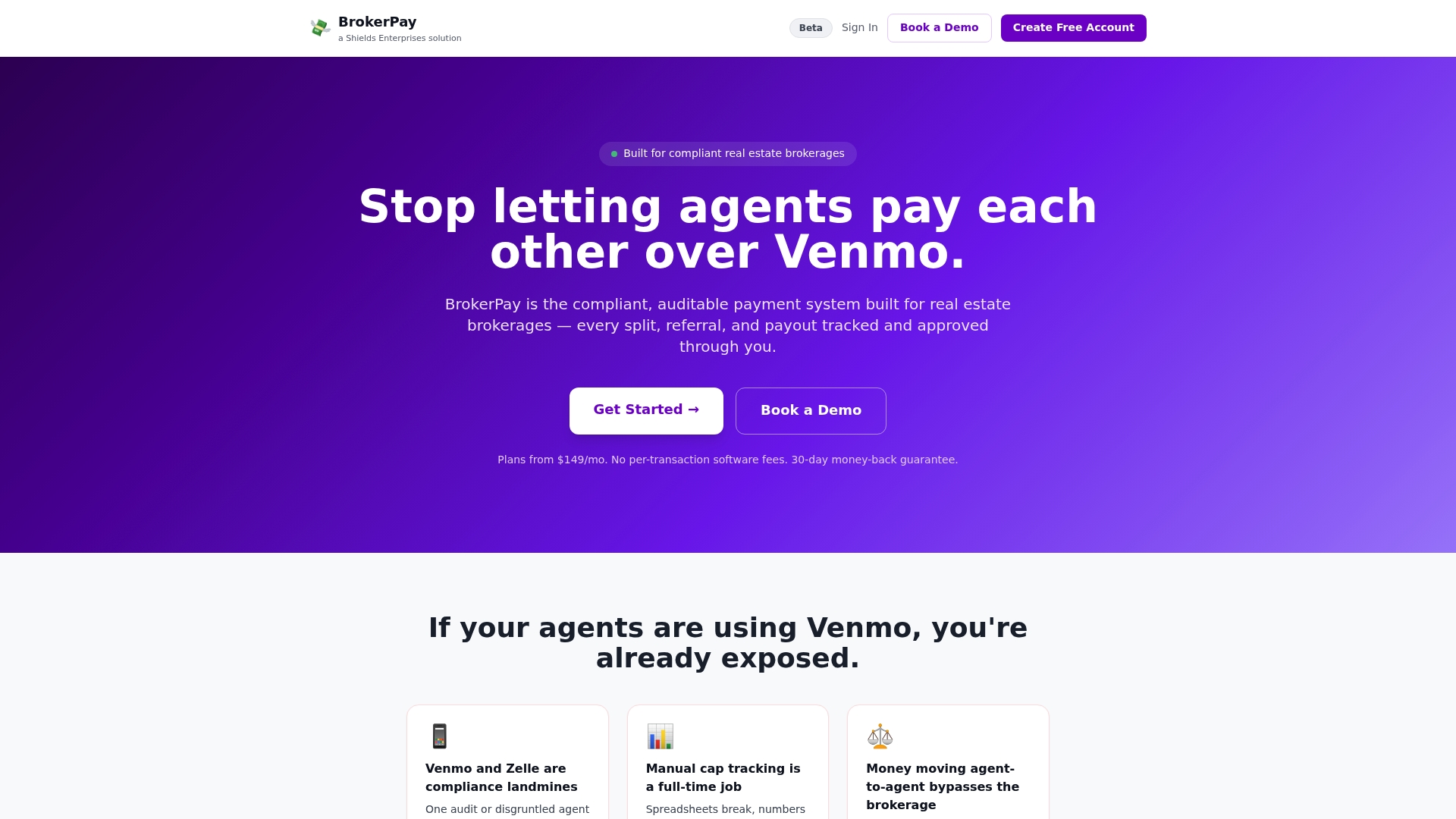
Brokerages using Brokerpay replace Venmo, Zelle, and spreadsheet-based payouts with a platform that produces dispute-ready records at every transaction. Every payment is documented, every split is traceable, and every disbursement is logged with a timestamp. If a dispute is filed, your evidence folder is already built. Visit Brokerpay to see how the platform fits your brokerage’s payment workflow and eliminates the manual processes that create liability.
FAQ
What belongs in an agent payment dispute prevention checklist?
A complete checklist includes clear commission agreements, mandatory mediation clauses, post-payment response protocols, end-to-end documentation standards, and monthly dispute trend reviews. Each item addresses a specific cause of payment conflict.
How quickly should brokers respond to payment disputes?
Respond within 30 minutes of a post-payment inquiry. Support tickets filed within that window signal high dispute risk, and fast intervention prevents most issues from becoming formal chargebacks.
What is the most common cause of agent payment disputes?
Vague or undocumented commission agreements are the leading cause. Disputes spike when split percentages, payment triggers, or disbursement timelines are not specified in writing at the time of contract.
How do reason codes affect dispute resolution steps?
Each reason code requires a specific evidence packet and cover letter. Matching your response to the assigned code is the primary factor in winning a representment case.
Why should brokers stop using venmo for agent payments?
Venmo and Zelle create no audit trail, no RESPA compliance documentation, and no dispute defense record. Platforms like Brokerpay replace these workarounds with compliant, traceable payment workflows.