How Electronic Payments Replace Paper Checks in 2026

Electronic payments are defined as digital fund transfers that move money between parties through networks like the Automated Clearing House (ACH) without any physical document changing hands. For real estate professionals and office admins, understanding how electronic payments replace paper checks is no longer optional. Executive Order 14247 directs the U.S. Treasury to stop issuing paper checks where law permits, making the shift to digital payment systems a compliance requirement in 2026. Whether you are disbursing agent commissions, paying vendors, or settling co-op fees, the paper check era is closing fast.
How do electronic payments replace paper checks?
Electronic payments replace paper checks by routing funds through secure digital networks instead of physical instruments. The ACH network is the backbone of this system. It processes transactions between bank accounts using structured data files, eliminating the need to print, sign, mail, or deposit a physical check. An eCheck, the closest digital equivalent to a paper check, captures the same routing and account information but transmits it electronically through ACH rails.
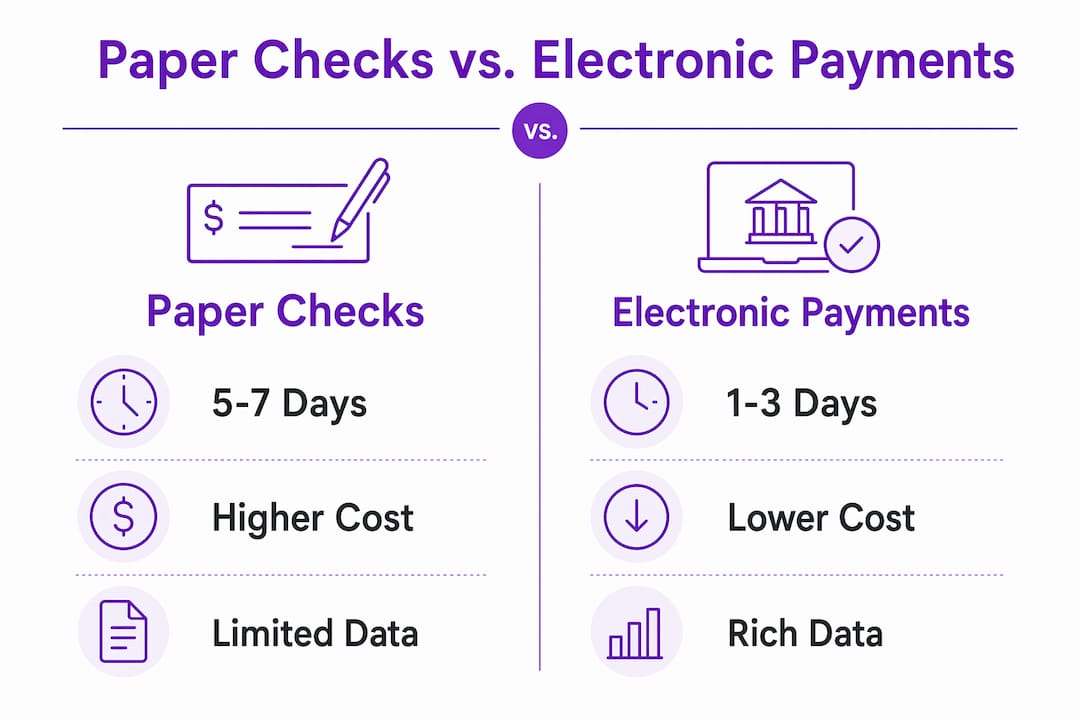
The operational difference is significant. ACH payments settle in 1–3 business days, compared to 5–7 days for paper checks. That gap matters when an agent is waiting on a commission split or a vendor needs payment to release a service. Beyond speed, the cost difference is stark. ACH transactions cost roughly $0.25–$0.50 each, while paper checks cost $4–$20 per transaction when you factor in printing, postage, and manual handling. That means a brokerage cutting 200 checks a month could save thousands of dollars annually by switching to ACH.
Digital payments also carry richer data. Every ACH transaction includes remittance fields that describe what the payment covers, which makes reconciliation far faster than matching paper stubs to ledger entries. Detailed transaction data replaces paper artifacts and manual reconciliation, giving your accounting team a clean, searchable audit trail.
| Factor | Paper Checks | ACH / Electronic Payments |
|---|---|---|
| Settlement time | 5–7 business days | 1–3 business days |
| Cost per transaction | $4–$20 | $0.25–$0.50 |
| Fraud risk | High (alterable, losable) | Lower (encrypted, monitored) |
| Audit trail | Manual, paper-based | Digital, searchable |
| Reconciliation | Manual matching | Automated remittance data |
Pro Tip: When you set up ACH payments, always include a memo or remittance reference in the payment file. This single step cuts reconciliation time dramatically because your accounting software can match payments to invoices automatically.
What are the benefits for real estate professionals?
Replacing checks with electronic payments delivers concrete advantages that go beyond speed. Real estate transactions involve multiple parties, tight timelines, and strict compliance requirements. Digital payment systems address all three.

Speed and cash flow. Agents receive commission splits faster, vendors get paid on time, and your brokerage avoids the float that paper checks create. Faster fund availability means fewer cash flow gaps between closing and disbursement.
Fraud reduction. Paper checks are one of the most fraud-prone payment methods still in use. They can be altered, intercepted, or duplicated. Electronic payments use encryption and bank-level authentication, which removes most of those attack surfaces. B2B check usage dropped from 81% in 2004 to 26% in 2024, partly because businesses recognized this fraud exposure.
Lower operating costs. Eliminating check printing, postage, and manual processing frees up staff time and reduces direct costs. For a mid-size brokerage processing dozens of transactions per month, those savings compound quickly.
Compliance and audit readiness. Electronic payment systems generate transaction-level data and status records that replace paper artifacts. When a RESPA audit or tax review requires documentation, you pull a digital report instead of hunting through file folders.
Workflow automation. Digital payment platforms integrate with accounting software like QuickBooks and property management systems like AppFolio. This means automated approval workflows can route payments through the right approvers, log every action, and post entries to your general ledger without manual data entry.
Vendor and agent adoption. Early resistance to electronic payments came largely from vendors who preferred checks. That barrier has dropped. Digital onboarding tools and automated workflows now make it straightforward for vendors and agents to provide banking details and receive payments electronically.
What compliance rules apply to electronic payments in 2026?
Compliance is now the primary driver of the shift away from paper checks, not just efficiency. Two major regulatory developments in 2026 make this clear.
-
Executive Order 14247 directs the U.S. Treasury to stop issuing paper checks for federal disbursements wherever law permits. The order cites fraud risk, processing delays, and unnecessary costs as the justification. Federal agencies are moving to direct deposit, prepaid debit cards, and digital wallets.
-
IRS paper check phase-out. The IRS phased out paper refund checks for individuals starting September 30, 2025. Exceptions exist for hardship cases and legal requirements, but the default is now electronic delivery.
-
Nacha 2026 ACH fraud rules. Nacha’s 2026 rules require organizations that originate ACH payments to maintain documented fraud-risk monitoring programs with annual reviews. Informal controls that worked for check-based workflows are no longer sufficient. You need written policies, audit logs, and a formal review process.
For real estate brokerages, these rules have direct operational implications. Your approval workflows must be documented. Every payment decision needs a digital record. And your fraud controls must be formal enough to survive an audit.
Pro Tip: Treat your ACH fraud monitoring policy as a living document. Schedule a calendar reminder each year to review and update it before your fiscal year closes. Nacha’s 2026 rules require annual reviews, and having a dated, signed policy on file protects your brokerage if questions arise.
Federal mandates in 2026 treat electronic payment adoption as a fraud-control strategy, not just a process upgrade. That framing should inform how you build your internal controls.
How can real estate offices transition from checks to digital?
A successful transition from paper checks to electronic payments requires more than changing how you send money. Replacing checks succeeds only when the full payment lifecycle is digitized, including approvals, remittance fields, and reconciliation. Here is how to approach it.
Audit your current payment volume. Count how many checks you issue monthly, to whom, and for what purpose. Separate vendor payments, commission disbursements, referral fees, and co-op payments. This inventory tells you where to start and which workflows need redesign.
Select a payment platform that fits real estate. Generic ACH processors handle basic transfers but lack the commission-tracking and RESPA-compliance features that brokerages need. Look for platforms built for real estate that handle agent splits, referral fees, and co-op commissions with built-in documentation. You can review alternatives to manual commission payments to compare your options.
Digitize your approval workflow. Every payment should pass through a documented approval chain before it is sent. This is both a compliance requirement under Nacha 2026 rules and a fraud-prevention measure. Paper-based sign-offs do not meet this standard.
Collect banking details from vendors and agents. This is the step most offices underestimate. Build a secure intake form for banking information and give vendors a clear deadline to submit details. Most resistance dissolves when you explain that electronic payments mean faster payment.
Adjust for ACH timing. ACH settlement occurs one business day after processing, but weekends and bank holidays add delays. Teams switching from checks often underestimate this. Build your payment schedule around ACH cutoff times, not check-mailing dates.
| Transition Step | Key Action | Common Pitfall |
|---|---|---|
| Payment audit | Map all check recipients and amounts | Missing recurring or irregular payments |
| Platform selection | Choose real estate-specific tools | Using generic ACH without compliance features |
| Approval workflow | Digitize and document every step | Keeping paper sign-offs alongside digital payments |
| Vendor onboarding | Collect banking info with a deadline | Leaving it open-ended and stalling adoption |
| Timing adjustment | Align schedules to ACH cutoffs | Assuming ACH timing mirrors check timing |
For commission tracking and tax compliance, digital payments also reduce errors that create problems at year-end. Proper commission tracking through a digital system means your 1099 data is accurate and ready without manual reconciliation.
Key takeaways
Electronic payments replace paper checks by transferring funds through ACH and digital networks, cutting costs, reducing fraud, and meeting 2026 federal compliance requirements that real estate brokerages cannot ignore.
| Point | Details |
|---|---|
| ACH replaces paper checks | ACH settles in 1–3 days at $0.25–$0.50 per transaction versus 5–7 days at up to $20 for checks. |
| Full workflow digitization required | Approvals, remittance data, and reconciliation must all go digital for the transition to succeed. |
| 2026 compliance is mandatory | Executive Order 14247 and Nacha rules require documented fraud controls and electronic payment adoption. |
| Vendor onboarding is the key bottleneck | Collecting banking details with a clear deadline is the step that most offices underestimate. |
| Real estate needs specialized platforms | Generic ACH tools lack commission tracking and RESPA compliance features that brokerages require. |
What i have learned after watching brokerages make this switch
Most brokerages approach this transition as a technology project. They pick a payment tool, flip a switch, and expect the checks to stop. That is where things go sideways.
The real work is in the workflow redesign. I have seen offices that moved to ACH but kept paper approval forms, manual remittance notes, and spreadsheet reconciliation. They eliminated the check but kept every inefficiency around it. The result was a digital payment rail attached to an analog process. Costs dropped slightly, but the compliance exposure and reconciliation headaches remained.
The offices that get this right treat the transition as a process audit. They ask: what happens before the payment, during the payment, and after it? Every step that involves paper, manual entry, or undocumented approval is a liability. The 2026 Nacha rules make that liability concrete. Informal controls are no longer acceptable.
I also think the industry underestimates how much agent resistance is really just unfamiliarity. Most agents have direct deposit set up for everything else in their lives. When a brokerage explains that electronic payments mean faster commission access and a digital record they can reference at tax time, resistance drops fast. The friction is usually on the brokerage side, not the agent side.
The compliance angle is the strongest argument for moving quickly. Federal mandates are not suggestions. Brokerages that build documented, auditable payment workflows now will be in a far stronger position when regulators or auditors come asking.
— Wes
How Brokerpay handles this for real estate brokerages
Real estate brokerages need more than a basic ACH processor. Commission disbursements involve agent splits, referral fees, co-op payments, and RESPA documentation requirements that generic payment tools do not address.

Brokerpay is built specifically for this. It tracks, documents, and processes every commission payment with a full audit trail, keeping your brokerage RESPA-compliant and eliminating the Venmo and Zelle workarounds that create federal liability. Every split is documented. Every payment is traceable. And your team stops chasing paper. If your brokerage is ready to move past manual checks and informal payment methods, see how Brokerpay works and get your payment workflows compliant before the next audit.
FAQ
What is an ACH payment and how does it replace a check?
An ACH payment transfers funds electronically between bank accounts through the Automated Clearing House network, using the same routing and account information as a check but without any physical document. It settles in 1–3 business days at a fraction of the cost of a paper check.
Are real estate brokerages required to use electronic payments in 2026?
Federal mandates under Executive Order 14247 apply directly to government disbursements, but Nacha’s 2026 ACH rules require any organization originating ACH payments to maintain documented fraud-monitoring programs. Brokerages using ACH must meet these compliance standards.
What is the biggest risk of staying with paper checks?
Paper checks carry high fraud exposure because they can be altered, intercepted, or duplicated. They also lack the digital audit trail that RESPA compliance and Nacha 2026 rules now require for documented payment workflows.
How long does it take to transition a brokerage to electronic payments?
Most brokerages complete the core transition in 30–60 days, with the largest time investment going to vendor and agent onboarding and approval workflow redesign. Platforms built for real estate, like Brokerpay, reduce that timeline by handling compliance documentation automatically.
Do agents need to do anything to receive electronic commission payments?
Agents need to provide their banking details through a secure intake process. Once submitted, they receive payments directly to their bank account, typically faster than a mailed check and with a digital record they can reference for tax purposes.