Why Brokerages Avoid Venmo Payments: 2026 Guide

Venmo payments are avoided by real estate brokerages because the platform’s peer-to-peer infrastructure cannot support the compliance, documentation, and security standards that professional property transactions require. Venmo was built for splitting dinner tabs and paying friends back, not for processing agent commission splits, referral fees, or co-op disbursements under RESPA oversight. The reasons brokerages reject Venmo span federal tax law, operational reliability, fraud exposure, and the absence of audit-ready records. Understanding these reasons is the first step toward choosing brokerage payment methods that protect your license, your clients, and your bottom line.
Why brokerages avoid Venmo payments: the core problem
Venmo’s design is the root cause of every problem brokerages encounter with it. The platform was built as a peer-to-peer (P2P) payment tool, and that architecture shapes every policy, limit, and feature it offers. Real estate brokerages need something fundamentally different: a payment system that documents every transaction, maps each disbursement to a specific deal, and produces records that satisfy IRS auditors and state regulators.
Venmo explicitly prohibits using personal accounts for business payments, and misuse risks account freezes or permanent suspensions. That means any brokerage routing commission payments through a personal Venmo account is already violating the platform’s terms of service. The consequences are not theoretical. Accounts get frozen mid-transaction, leaving agents without funds at exactly the wrong moment.

Venmo does offer a business account tier, but it introduces its own constraints. Business accounts cap weekly payments at $25,000 and impose rolling transfer limits that make high-volume brokerage operations unpredictable. A busy brokerage closing multiple deals in a single week can hit that ceiling before Friday. When a payment fails because of a rolling limit, the brokerage has no reliable escalation path and no guaranteed timeline for resolution.
Pro Tip: If your brokerage has ever received a “payment declined” notification from Venmo during a closing week, that is a direct symptom of its rolling limit architecture, not a one-time glitch.
Security triggers compound the problem. Venmo’s automated monitoring flags unusual payment patterns, and real estate transactions, which are large, infrequent, and often involve new payees, fit that profile precisely. Security flags and payment declines happen unpredictably, and they hit hardest during time-sensitive disbursements.
How tax compliance breaks down with Venmo
The IRS does not care that Venmo feels informal. Payments received through Venmo for goods and services are taxable income, and the platform is required to report them. Third-party platforms issue Form 1099-K and report gross payment volumes directly to the IRS and to the taxpayer. That reporting obligation creates a compliance burden that Venmo’s basic interface is not equipped to help brokerages manage.
Here is where the tax complexity compounds for real estate professionals:
- Classification errors. Venmo does not distinguish between a commission payment, a referral fee, and a personal reimbursement. Every payment looks identical in the transaction log. Brokerages must manually classify each one, and misclassification during tax filing is an audit trigger.
- Gross versus net reporting. Venmo reports gross payment volume, not net income. If an agent receives $15,000 through Venmo but $3,000 of that was a reimbursement for marketing expenses, the IRS sees $15,000 unless the agent has meticulous supporting records.
- Burden of proof shifts to the user. Tax compliance requires clear payment classification, separating personal from business and compensation from commissions. Venmo provides no automation for this. The entire record-keeping burden falls on the brokerage and the agent.
- Audit exposure multiplies. Informal payment memos like “commission” or “split” typed into a Venmo note do not constitute official documentation. Auditors and state regulators require structured records that show payment origin, purpose, deal mapping, and authorization. Screenshots of Venmo transactions do not meet that standard.
Brokerages that use commission tracking for tax compliance avoid these classification problems entirely because every payment is tied to a specific transaction record from the start.
Security, privacy, and fraud risks in brokerage transactions
Real estate transactions involve large sums, tight deadlines, and multiple parties. That combination makes security failures catastrophic rather than merely inconvenient. Venmo’s security model was not designed for this environment.
The most serious risk is irreversibility. Venmo is not FDIC insured, and fraud cases can result in permanent financial loss with limited recovery options. When a payment goes to the wrong account, whether through a typo, a spoofed contact, or deliberate fraud, there is no guaranteed mechanism to retrieve it. In a real estate context, that could mean a co-op commission disappearing with no recourse before a closing.
Privacy is a separate but equally serious concern. Venmo transactions may be publicly visible by default, and the platform’s privacy settings are frequently insufficient to protect deal-level confidentiality. A transaction memo reading “commission, 123 Main Street” is not the kind of information a brokerage should be broadcasting to anyone who checks a public feed.
Key security exposures brokerages face with Venmo include:
- Account takeover risk. P2P apps are frequent targets for credential theft, and a compromised Venmo account can drain funds before the breach is detected.
- Social engineering scams. Fraudsters impersonate agents or coordinators and request payment redirects. Venmo’s informal communication style makes these scams easier to execute.
- No dispute resolution for business payments. Unlike wire transfers or ACH payments processed through regulated financial institutions, Venmo offers no formal dispute channel designed for commercial transactions.
- Delayed reversals affecting closings. Even when Venmo does intervene in a disputed transaction, the resolution timeline is incompatible with real estate disbursement deadlines.
These risks are unacceptable in a regulated real estate environment where navigating compliance in brokering is a professional and legal obligation, not a preference.
Does Venmo support brokerage reporting and reconciliation?
The short answer is no. Venmo’s reporting tools were built for personal use, and the gap between what they provide and what a brokerage actually needs is significant.
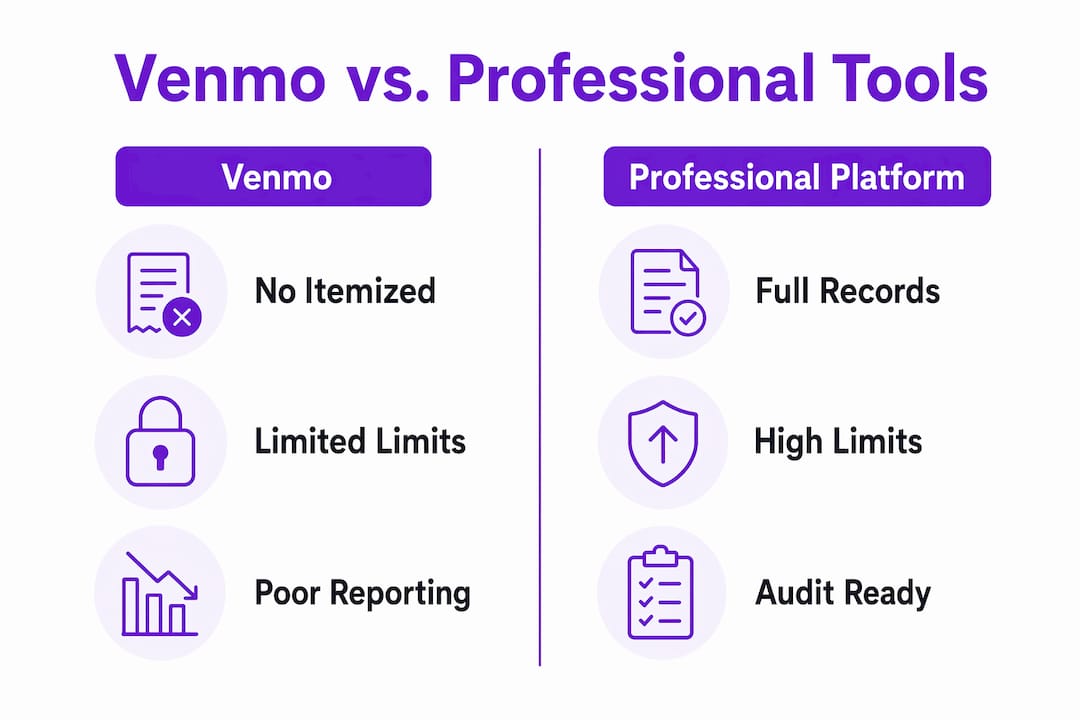
| Feature | Venmo | Professional payment platform |
|---|---|---|
| Itemized transaction records | No | Yes |
| Deal-level payment mapping | No | Yes |
| Automated commission splits | No | Yes |
| Accounting software integration | Limited | Full (QuickBooks, etc.) |
| Audit-ready documentation | No | Yes |
| 1099 generation support | No | Yes |
Manual reconciliation is required with Venmo because it produces no itemized records, no product-level transaction details, and no native integration with accounting platforms. A brokerage processing 50 commission payments per month through Venmo is generating 50 manual reconciliation tasks, each requiring someone to match a Venmo screenshot to a deal file and a ledger entry.
The documentation problem goes deeper than inconvenience. Proving payment origin, purpose, and authorization is a practical compliance requirement for brokerages. Venmo’s informal memos and screenshots are not accepted as official records by auditors, state real estate commissions, or RESPA compliance reviewers. Without formal documentation, internal controls break down and regulatory exposure grows.
Pro Tip: When evaluating any payment system for your brokerage, ask one question: “Can this produce a payment record that would satisfy a state audit?” If the answer requires screenshots and manual notes, the system is wrong for the job.
What brokerages should use instead of Venmo
Brokerages need payment infrastructure that was designed for their specific operational and regulatory context. The features that matter are not complicated, but they are non-negotiable:
- Compliance documentation. Every payment must generate a record that maps to a specific deal, identifies the parties, and documents the authorization chain.
- Automated commission splits. The system should calculate and distribute agent splits, referral fees, and co-op commissions without manual intervention.
- Accounting integration. Direct connection to platforms like QuickBooks eliminates the reconciliation burden that Venmo creates.
- RESPA alignment. Payment workflows must support the disclosure and documentation requirements that federal law imposes on real estate transactions.
- Reliable settlement timing. Disbursements must execute predictably, without the rolling limits or security flags that make Venmo unreliable at closing.
Automated payouts for brokers replace the entire manual workflow that Venmo forces on brokerage staff. Dedicated real estate payment platforms also produce the structured records that protect brokerages during audits and state reviews. For a practical look at how compliant workflows function in real brokerage environments, the co-op payment workflow examples from Brokerpay illustrate what structured disbursement looks like at scale.
Key takeaways
Brokerages avoid Venmo payments because its P2P design, transaction limits, tax reporting gaps, security vulnerabilities, and absent reconciliation tools create compounding legal and operational risk for every real estate transaction it touches.
| Point | Details |
|---|---|
| P2P design is the root cause | Venmo’s architecture conflicts with brokerage compliance and documentation requirements. |
| Tax exposure is real and immediate | IRS Form 1099-K reporting and manual classification burdens create direct audit risk. |
| Security failures are irreversible | Venmo offers no FDIC insurance and limited fraud recovery, making losses permanent. |
| Reconciliation requires manual labor | No deal mapping, no accounting integration, and no itemized records increase error risk. |
| Professional platforms solve all four problems | Purpose-built brokerage payment tools provide compliance, automation, and audit-ready records. |
The uncomfortable truth about “good enough” payment tools
I have seen brokerages defend Venmo with the same argument every time: “It works fine for us.” What they mean is it has not visibly failed yet. That is a different thing entirely.
The compliance exposure from using Venmo does not announce itself. It accumulates quietly in the form of misclassified 1099-K income, undocumented commission splits, and transaction records that would not survive a state audit. By the time a brokerage discovers the problem, it is usually because a regulator or an IRS notice has surfaced it.
The operational risk is more visible but equally underestimated. I have watched a brokerage scramble to reprocess a co-op commission payment on a Friday afternoon because Venmo’s security system flagged the transaction and held it. The other agent’s brokerage was threatening to delay the closing. That is not a hypothetical. It is a predictable outcome of using a consumer app for a professional financial process.
The real estate industry has a habit of adopting consumer technology and then being surprised when it fails under professional conditions. Venmo is fast and familiar, which is exactly why it feels like a reasonable shortcut. It is not. The combination of RESPA requirements, IRS reporting obligations, and the irreversible nature of P2P payments makes Venmo a liability, not a convenience. Moving to a purpose-built real estate payment gateway is not an upgrade. It is a basic professional standard.
— Wes
Stop using Venmo before it costs you a closing
Brokerpay is a compliant commission payment platform built specifically for real estate brokerages. It tracks, documents, and processes agent splits, referral fees, and co-op commissions with full audit trails, automated reconciliation, and RESPA-aligned workflows. Every payment maps to a deal. Every record is audit-ready. There are no rolling limits, no security flags at closing, and no manual reconciliation tasks piling up on your staff. If your brokerage is still routing payments through Venmo or Zelle, you are carrying federal liability that a purpose-built platform eliminates on day one. Visit Brokerpay to see how brokerages replace informal payment workarounds with a system that actually protects them.
FAQ
Why do brokerages reject Venmo for commission payments?
Brokerages reject Venmo because it lacks audit-ready documentation, imposes transaction limits that disrupt closings, and exposes the brokerage to IRS reporting complications and RESPA compliance risk. Personal Venmo accounts are also explicitly prohibited for business use under Venmo’s own terms of service.
Is Venmo legal for real estate transactions?
Using a personal Venmo account for business payments violates Venmo’s terms of service and can result in account suspension. Beyond platform policy, the absence of formal documentation makes Venmo payments legally insufficient for RESPA-compliant real estate disbursements.
What are the tax risks of using Venmo in a brokerage?
Venmo reports gross payment volumes to the IRS via Form 1099-K, and the platform provides no automated classification between commissions, referral fees, and personal payments. This forces manual record-keeping and creates direct audit exposure for both the brokerage and individual agents.
Can Venmo payments be reversed if sent to the wrong person?
Venmo payments are generally irreversible once sent, and the platform is not FDIC insured. Fraud cases involving misdirected payments can result in permanent financial loss with limited recovery options, making it unsuitable for large real estate disbursements.
What payment methods should brokerages use instead of Venmo?
Brokerages should use purpose-built platforms that provide deal-level payment mapping, automated commission splits, accounting software integration, and RESPA-compliant documentation. These systems eliminate the manual reconciliation burden and audit exposure that Venmo creates.