Why Cash Payments Violate RESPA: A Compliance Guide

Cash payments violate the Real Estate Settlement Procedures Act (RESPA) when they function as unlawful referral fees or kickbacks tied to federally related mortgage transactions. RESPA’s Section 8(a) prohibits any person from giving or receiving a “thing of value” in exchange for the referral of settlement service business, and cash is the most direct form that prohibition covers. The Consumer Financial Protection Bureau (CFPB) and state regulators actively enforce these rules, with penalties reaching into the millions. Real estate professionals and investors who rely on informal cash arrangements, even small ones, face federal liability that written agreements and digital payment tools can prevent.
Why cash payments violate RESPA: the core prohibition
RESPA Section 8 is violated when a party gives or receives a “thing of value” in exchange for referrals of settlement service business tied to a federally related mortgage loan. That definition is deliberately broad. It covers cash, but it also covers gifts, meals, event tickets, marketing services, and any other benefit exchanged with the expectation of steering business.
The statute applies to federally related mortgage loans, which includes most residential purchase loans backed by FHA, VA, Fannie Mae, or Freddie Mac. Cash-only purchases without any financing component generally fall outside RESPA’s scope, but that exemption is narrower than many investors assume. Any transaction involving a federally backed loan triggers full RESPA coverage, regardless of how the referral compensation is structured or labeled.

The prohibition has two distinct parts under Section 8. Section 8(a) targets referral kickbacks: paying or receiving anything of value specifically because someone directed a client to a settlement service provider. Section 8(b) targets fee-splitting and unearned fees: dividing settlement service fees with a party that performed no actual service. Both violations can involve cash, and both carry the same federal penalties.
How RESPA defines “thing of value” and which transactions it covers
RESPA’s definition of “thing of value” is one of the broadest in federal real estate law. It includes:
- Cash payments of any amount, including small bonuses or “thank you” payments
- Gift cards and prepaid debit cards tied to referral expectations
- Free or discounted services, such as marketing support or administrative help
- Event access, meals, or entertainment provided in exchange for steering clients
- Equity interests or profit-sharing in joint ventures structured around referrals
Even small incentives linked to referrals can trigger violations, with no minimum value threshold. A $50 gift card given to an agent for sending a client to a specific title company carries the same legal exposure as a $5,000 cash payment. The amount affects the severity of penalties, but not whether a violation occurred.
The transaction scope matters equally. RESPA applies to the settlement of federally related mortgage loans on one-to-four-family residential properties. Commercial transactions, cash purchases, and certain business-purpose loans fall outside this scope. However, real estate professionals should verify scope before assuming an exemption applies. Many investors incorrectly assume that because a buyer is paying cash, no RESPA rules apply to any part of the deal, including referral arrangements with lenders or title companies who may be involved in related transactions.
What separates a legal service fee from an illegal referral payment
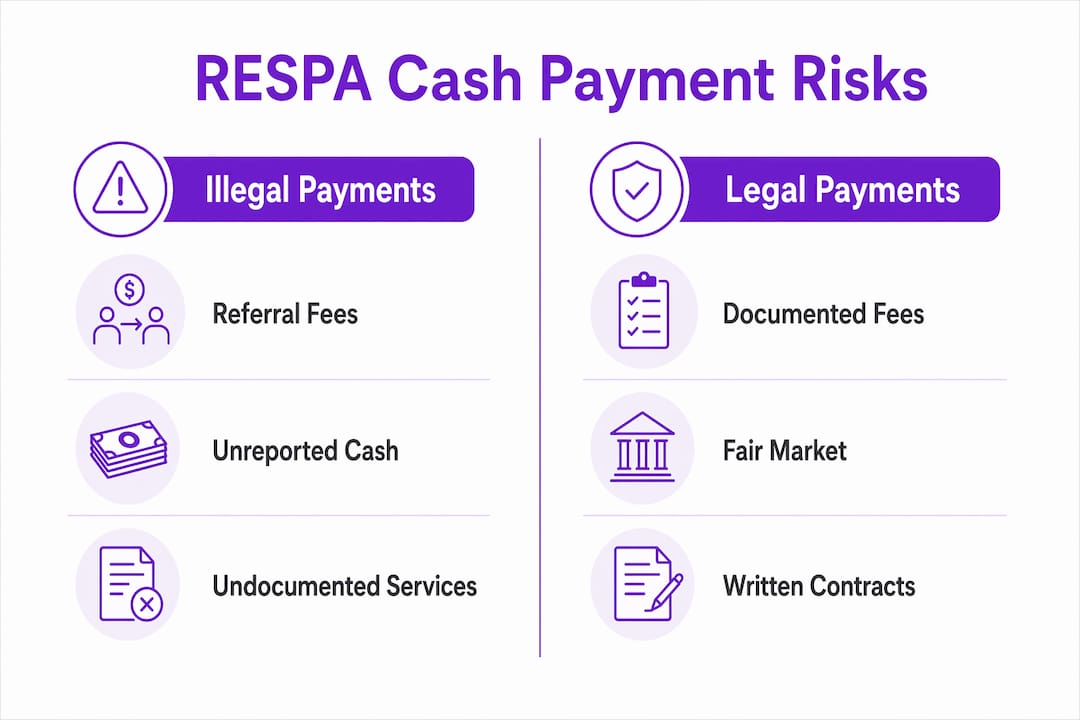
The compliance distinction that determines whether a cash payment is lawful or a kickback comes down to one question: was the payment made for a bona fide service actually performed at fair market value? NAR’s compliance guidance frames this as a function-based test. Being paid for a referral risks a violation. Being paid for a real service at fair market value is compliant.
The practical steps to establish a lawful payment arrangement follow a clear sequence:
- Define the service in writing. A signed agreement must describe exactly what work is being performed, by whom, and at what rate.
- Establish fair market value. The payment must reflect what the service would cost from any qualified provider in the open market, not an inflated rate designed to disguise a referral fee.
- Document delivery of the service. Invoices, work logs, emails, or deliverables must show the service was actually performed.
- Separate the payment from any referral expectation. The agreement cannot condition payment on the volume or value of referrals sent.
If payment cannot be clearly linked to documented services at fair market value, regulators treat it as unearned or referral-based. This is where many real estate professionals get into trouble. A title company that pays a real estate agent $500 per month for “marketing services” but receives no deliverables and sees a corresponding increase in referrals has created a textbook RESPA violation, regardless of the contract language.
Pro Tip: Document every service arrangement with a written contract, a description of deliverables, and evidence of completion. If you cannot produce that documentation during a regulatory audit, the payment will be treated as a kickback.
Fee-splitting under Section 8(b) follows the same logic. Splitting a settlement service fee with a party that performed no actual service is prohibited even when no explicit referral agreement exists. The payment itself, if unearned, is the violation.
Common scenarios where cash payments trigger RESPA violations
Understanding abstract rules matters less than recognizing the specific arrangements that create real exposure. The following scenarios represent the most common RESPA cash payment issues encountered in practice:
- Referral bonuses paid outside the transaction. A mortgage broker pays a real estate agent $300 cash after closing for every buyer the agent sends. No service is documented. This is a direct Section 8(a) violation.
- Joint ventures structured around referral flow. A title company and a brokerage form a joint venture where the brokerage receives profit distributions tied to the volume of transactions it refers. Regulators treat these arrangements as disguised kickback schemes when the profit share correlates with referrals rather than genuine capital investment.
- Informal cash payments between agents. An agent pays a colleague $200 cash for introducing a buyer. No written agreement exists. Informal or unwritten agreements linked to referrals carry the same risk as formal ones.
- Gift cards for preferred vendor referrals. A settlement service provider distributes $100 gift cards to agents who consistently recommend their services. No minimum value threshold protects this arrangement.
- Fee splits with unlicensed parties. A brokerage splits a commission with an unlicensed referral source using a cash payment outside the HUD-1 or Closing Disclosure. This violates both Section 8(b) and state licensing laws.
| Arrangement | RESPA risk |
|---|---|
| Cash bonus for client referral, no service | Section 8(a) violation: direct kickback |
| Joint venture profit tied to referral volume | Section 8(a) violation: disguised kickback |
| Fee split with party performing no service | Section 8(b) violation: unearned fee |
| Gift card for preferred vendor steering | Section 8(a) violation: no value threshold |
| Documented service at fair market value | Compliant: lawful compensation |
What are the legal and financial consequences of RESPA violations?
The penalties for RESPA violations involving cash payments are severe and extend beyond fines. A Maryland title company paid $1,050,000 to settle RESPA claims tied to joint venture referral payments, illustrating that enforcement actions reach into seven figures. That settlement also required operational changes and ongoing compliance monitoring, costs that exceeded the fine itself.
“RESPA violations are often uncovered through the substance of payment arrangements over the form. Regulators look for evidence that payments steer business regardless of paperwork.” — NAR compliance guidance
Federal penalties under RESPA include criminal fines up to $10,000 per violation and imprisonment up to one year for knowing violations. Civil liability allows borrowers to sue for three times the amount of any charge paid for the settlement service involved. The CFPB can also impose civil money penalties and require restitution to affected consumers.
Beyond federal exposure, state regulators independently investigate and sanction real estate professionals. License suspension or revocation is a real outcome for agents and brokers found to have participated in kickback arrangements. Reputational damage compounds the financial impact. Clients, lenders, and title companies that discover an agent has been sanctioned for RESPA violations typically terminate business relationships immediately.
Informal or undisclosed cash payments amplify every one of these risks. A payment made through Venmo, Zelle, or physical cash leaves no compliant paper trail, which makes it nearly impossible to demonstrate that the payment was for a legitimate service rather than a referral kickback.
Best practices to stay RESPA-compliant on cash and referral payments
Avoiding RESPA violations requires deliberate process design, not just good intentions. The following practices protect real estate professionals and investors from the most common RESPA cash payment issues:
- Conduct fair market value assessments before any payment. Research what comparable services cost in your market and document that research. Payments above market rate are a red flag for regulators.
- Use written service agreements for every payment arrangement. Verbal agreements offer no protection. Every payment to a co-operating party must be supported by a signed contract describing the services, the rate, and the deliverables.
- Avoid cash, Venmo, Zelle, and other untraceable payment methods. These channels create no audit trail and signal to regulators that the arrangement was designed to avoid scrutiny. Use compliant payment processing tools that document every transaction.
- Train staff and partners on RESPA rules annually. Florida Realtors emphasize that RESPA is triggered in everyday marketing arrangements when a “thing of value” and referral expectations coexist, even for perks or event access. Staff who do not understand this create liability without realizing it.
- Review joint venture and co-marketing agreements with legal counsel. Arrangements that look like legitimate business partnerships can still violate RESPA if profit distributions correlate with referral volume rather than capital contribution.
Pro Tip: Build a compliance checklist for every new payment arrangement: written agreement, fair market value documentation, service delivery evidence, and no referral condition. If any item is missing, do not make the payment.
Proper commission tracking also reduces RESPA exposure by creating a documented record of every split, referral fee, and co-op payment. When regulators request records, brokerages with organized documentation resolve inquiries faster and with less legal cost.
Key takeaways
Cash payments violate RESPA when they function as referral kickbacks rather than compensation for documented services at fair market value, and no payment amount is too small to trigger federal liability.
| Point | Details |
|---|---|
| RESPA’s “thing of value” is broad | Cash, gift cards, meals, and perks all qualify with no minimum threshold. |
| Transaction scope determines coverage | RESPA applies to federally related mortgage loans; cash-only purchases are generally exempt. |
| Documentation is the compliance defense | Every payment must link to a written agreement, fair market value, and proof of service delivery. |
| Informal payments increase risk | Cash, Venmo, and Zelle transactions leave no audit trail and signal concealment to regulators. |
| Penalties reach seven figures | Enforcement actions include fines, restitution, license loss, and criminal liability for knowing violations. |
The compliance test most professionals apply too late
I have reviewed enough referral arrangements to know that the most common mistake is not greed. It is assumption. Experienced agents assume that because a payment is small, or because “everyone does it,” the risk is negligible. That assumption is wrong, and it is expensive.
The compliance test that actually matters is not “how much did I pay?” It is “what was the payment for?” South Carolina REALTORS put it plainly: fees must be for actual services and properly documented. If you cannot answer that question with a signed contract and a paper trail, you have a problem regardless of the dollar amount.
What I find most underappreciated is that regulators do not need to prove intent. They need to prove that a payment was made in connection with a referral and that no documented service justified it. Informal cash payments, Venmo transfers, and gift cards handed over at closing are practically self-incriminating because they leave no service documentation by design.
The professionals who stay clean are the ones who treat every payment as if it will be audited. They use written agreements, they document deliverables, and they process payments through systems that create a record. That discipline is not bureaucratic overhead. It is the only reliable defense against a federal enforcement action.
Adopting transparent payment technology is not just about compliance. It changes the culture of how a brokerage handles money. When every split and referral fee runs through a documented system, the informal cash workarounds stop feeling normal. That cultural shift is worth more than any single compliance training session.
— Wes
How Brokerpay keeps your referral payments RESPA-compliant
Real estate brokerages that still rely on cash, Venmo, or Zelle to pay agent splits and referral fees are creating federal liability with every transaction. Brokerpay replaces those informal channels with a compliant, fully documented payment platform built specifically for real estate.
Brokerpay tracks and processes agent splits, referral fees, and co-op commissions with a complete audit trail on every payment. Every transaction is tied to a documented service, making it straightforward to demonstrate fair market value and service delivery during a regulatory review. Brokerages using Brokerpay eliminate the Venmo and Zelle workarounds that regulators treat as red flags. If RESPA compliance on commission and referral payments is a priority for your brokerage, Brokerpay is the purpose-built solution.
FAQ
What makes a cash payment a RESPA violation?
A cash payment violates RESPA when it is given or received in exchange for a referral of settlement service business tied to a federally related mortgage loan, rather than as compensation for a documented service at fair market value. The payment amount does not determine whether a violation occurred.
Does RESPA apply to cash real estate purchases?
RESPA generally does not apply to cash purchases without any mortgage financing, since the law covers federally related mortgage loans. However, professionals should confirm that no related transaction involves a covered loan before assuming the exemption applies.
Can a small gift card trigger a RESPA violation?
Yes. RESPA bans all “things of value” tied to referrals with no minimum threshold, so even a $25 gift card given in connection with a referral expectation constitutes a violation under Section 8(a).
What documentation protects against a RESPA cash payment claim?
A written service agreement describing the work, evidence that the service was performed, and documentation that the payment reflects fair market value are the three elements regulators require to treat a payment as lawful compensation rather than a kickback.
What penalties apply to RESPA violations involving cash payments?
Federal penalties include criminal fines up to $10,000 per violation, up to one year of imprisonment for knowing violations, and civil liability equal to three times the settlement service charge. State regulators can also suspend or revoke professional licenses.