Why Bank Transfers Are Safer Than P2P Apps

Bank transfers are safer than P2P apps because they operate under federal consumer protection laws, structured dispute timelines, and institutional oversight that peer-to-peer payment platforms largely do not provide. Apps like Zelle and Venmo have made sending money fast and frictionless, but that speed comes at a cost: once you authorize a payment, getting that money back is often impossible. Regulation E, the Electronic Fund Transfer Act, and NACHA operating rules create a legal framework around bank transfers that gives consumers and businesses real recourse when something goes wrong. P2P platforms offer no equivalent guarantee.
Why bank transfers safer than P2P apps: the regulatory foundation
The core reason bank transfers carry stronger safety guarantees is governance. Federal law, specifically Regulation E, caps consumer liability at $50 for unauthorized electronic fund transfers reported within two business days. That protection applies to ACH transfers, wire transfers, and debit-linked transactions processed through regulated banking networks. It does not automatically extend to P2P apps unless those apps are directly tied to a bank account and the transaction qualifies as unauthorized under the law’s narrow definitions.
Regulation E also requires financial institutions to investigate disputed transactions within defined timeframes, typically 10 business days, and to provisionally credit the consumer’s account during the investigation. That structure shifts the burden of proof onto the institution, not the consumer. For individuals and businesses handling high-value payments, that distinction is significant.
Beyond liability caps, bank transfers benefit from NACHA operating rules that govern ACH transactions across the U.S. banking network. These rules define exactly which parties are responsible at each step of a transaction, creating accountability that no P2P app replicates. The formal governance and liability structures of bank transfers explain their safety advantage over P2P apps far more than encryption alone.
Pro Tip: If you report an unauthorized bank transfer within two business days, your maximum liability under Regulation E is $50. Wait longer than 60 days after your statement is sent, and you could lose all protection. Set up account alerts to catch suspicious activity immediately.
Key protections built into bank transfer infrastructure include:
- Defined investigation timelines under Regulation E requiring institutions to act within 10 business days
- Provisional credits issued to consumers during dispute investigations
- NACHA return codes that categorize errors and unauthorized debits with specific remediation paths
- Strong Customer Authentication (SCA) requirements in open banking environments, where customers approve payments via biometrics or passcode inside their bank app
- Audit trails maintained by regulated financial institutions for compliance and dispute purposes
What are the biggest security risks with P2P payment apps?
P2P apps are frequently targeted by social engineering and impersonation scams, and consumers face higher loss risk due to less guaranteed reimbursement compared to bank transfers. The Better Business Bureau has specifically warned about this pattern in 2026, noting that scam tactics on platforms like Zelle and Venmo have grown more sophisticated.

The most common attack vectors follow predictable patterns. A scammer poses as a landlord collecting a security deposit. A fake seller on Facebook Marketplace requests payment via Zelle before shipping. A romance scam builds trust over weeks before requesting an “emergency” transfer. In each case, the victim authorizes the payment willingly, which is the critical detail. Once you authorize a P2P transfer, the legal definition of “unauthorized” no longer applies, and your path to reimbursement narrows dramatically.
Zelle and Venmo differ significantly in the protections they offer. Venmo provides buyer protection for goods and services payments when you select the correct payment type. Zelle treats authorized payments like cash: once sent, they cannot be reversed. That distinction matters enormously for anyone using these apps for anything beyond splitting a dinner bill with a trusted friend.
“Scams on P2P apps are common and consumers face higher risk of financial loss due to less guaranteed reimbursement.” — Better Business Bureau, 2026
A compounding risk is payment mode misuse. Using the wrong payment mode on Venmo, specifically selecting friends-and-family instead of goods-and-services, eliminates buyer protections entirely. Many users make this mistake without realizing it, turning what they believed was a protected transaction into an irrevocable cash transfer.
Common P2P scam scenarios to recognize:
- Marketplace fraud: Fake sellers or buyers requesting P2P payment before delivering goods
- Impersonation scams: Fraudsters posing as banks, utilities, or government agencies demanding immediate transfer
- Romance scams: Long-term trust-building followed by urgent financial requests
- Overpayment scams: Sending excess funds and requesting a partial refund before the original check bounces
How do reversibility and finality differ between the two?
Transaction reversibility is where the gap between bank transfers and P2P apps becomes most concrete. Most P2P push payments cannot be canceled after sending unless the transaction qualifies as unauthorized or falls under specific impersonation scam exceptions. That is not a bug in the system. It is a deliberate design choice that prioritizes speed over recourse.
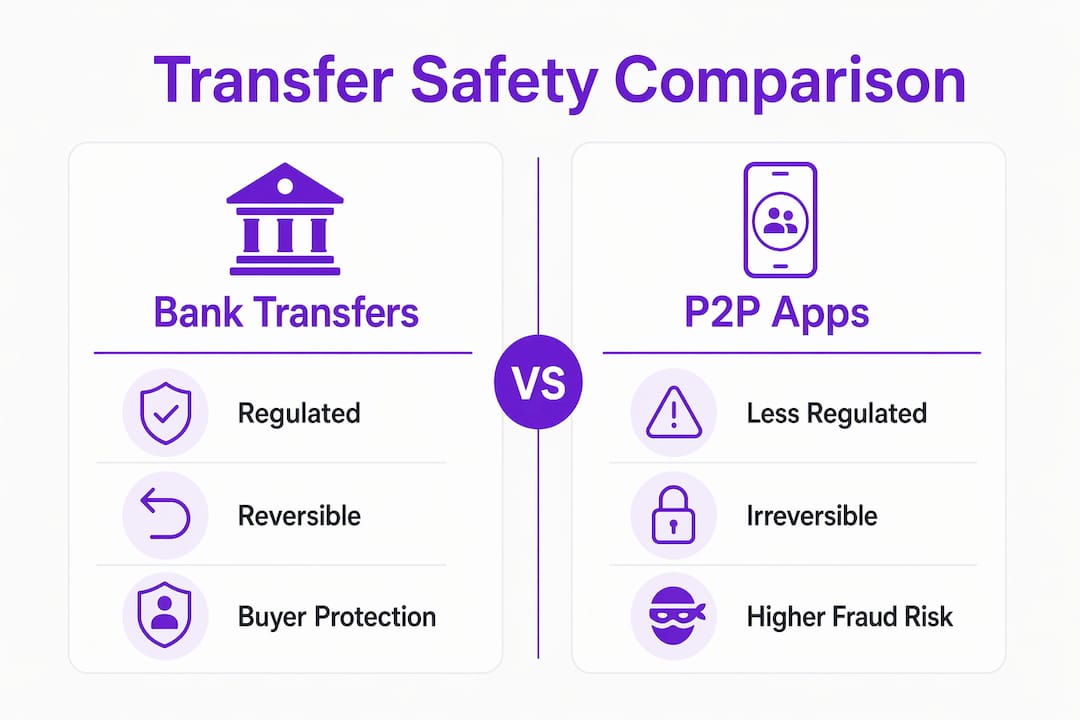
Bank transfers, by contrast, operate under NACHA rules that permit reversals within defined windows and for specific reasons. NACHA reversal windows can be as short as 24 hours or as long as 5 banking days depending on the return reason code. Missing those windows eliminates your automatic right to reversal, which is why daily monitoring matters for businesses processing ACH payments.
Pro Tip: Businesses processing ACH payments should monitor transactions daily, not weekly. NACHA return windows for some categories close within 24 hours of settlement. A missed window means a missed reversal.
The table below compares how reversibility works across payment types:
| Payment type | Reversal possible? | Timeframe | Who initiates |
|---|---|---|---|
| ACH bank transfer | Yes, under specific conditions | 24 hours to 5 banking days | Originating bank |
| Wire transfer | Rarely, requires receiving bank cooperation | Same day only | Sending institution |
| Zelle payment | No, except unauthorized activity | Not applicable | Platform discretion |
| Venmo (friends/family) | No | Not applicable | Not available |
| Venmo (goods/services) | Limited buyer protection | Case-by-case | Venmo review team |
NACHA operating rules restrict ACH reversals to four narrow categories: duplicate payments, wrong dollar amount, wrong receiver, and wrong timing. Outside those categories, reversals are not available. That sounds restrictive, but it is still four more categories than Zelle offers. For businesses, this structured framework means errors have a defined remediation path rather than a dead end.
What modern bank transfer security features P2P apps cannot match
Modern bank transfer infrastructure has added security layers that go well beyond basic encryption. Open banking’s Pay by Bank model is the clearest example. Customers approve payments via biometric or passcode inside their bank’s own app, which then sends funds directly using bank infrastructure. No card numbers are shared. No third-party app stores credentials. The entire authentication chain stays within the regulated banking ecosystem.
This architecture eliminates several fraud surfaces that P2P apps expose. When you pay through a P2P app, your credentials, linked account details, and transaction history sit on that app’s servers. A breach of that app compromises your data. Pay by Bank flows, by contrast, keep authentication inside the bank’s security perimeter, where regulatory requirements for data protection are far stricter.
Stripe notes that bank transfers reduce fraud risk and provide payment certainty for businesses compared to chargeback-prone card payments. For real estate brokerages, law firms, and any business handling large disbursements, that certainty has direct operational value. A commission payment processed via ACH carries no chargeback risk. The same payment sent via Venmo or Zelle carries no institutional protection at all.
The comparison between payment rails becomes clearer when you look at what each system was designed to do. Bank transfer rails were built for regulated financial institutions moving money under federal oversight. P2P apps were built for consumer convenience. Those design priorities produce very different security outcomes, particularly for automated broker payouts where compliance and traceability are non-negotiable.
Real-time P2P transfers limit fraud detection windows, shifting the entire security burden toward prevention rather than remediation. Bank transfer systems, even faster payment rails, retain monitoring checkpoints that P2P apps bypass in the name of speed.
Key takeaways
Bank transfers are safer than P2P apps because federal regulation, structured dispute timelines, and institutional accountability create recourse mechanisms that P2P platforms cannot replicate.
| Point | Details |
|---|---|
| Regulation E liability caps | Consumers face a $50 maximum liability for unauthorized transfers reported within two business days. |
| NACHA reversal windows | ACH reversals are available for four specific error categories within 24 hours to 5 banking days. |
| P2P authorized payments are final | Once you authorize a Zelle or Venmo transfer, reversal is nearly impossible regardless of fraud. |
| Pay by Bank reduces fraud surfaces | Biometric authentication inside the bank app eliminates card number sharing and third-party credential storage. |
| Businesses benefit from no chargebacks | Bank transfer finality gives businesses payment certainty that card and P2P payments cannot provide. |
The uncomfortable truth about P2P apps in professional payments
I have watched real estate brokerages defend Venmo and Zelle as “good enough” for commission splits right up until the moment they weren’t. A co-op commission sent to the wrong agent. A referral fee disputed with no paper trail. A Zelle transfer to a fraudster posing as a cooperating broker. In each case, the brokerage had no institutional recourse, no dispute timeline, and no federal protection to invoke.
The honest assessment is this: P2P apps are excellent tools for low-stakes, high-trust transactions between people who know each other well. They were not designed for professional financial workflows, and using them as such creates liability that most brokerages do not fully understand until something goes wrong.
What I find most underappreciated is the documentation gap. Bank transfers processed through compliant platforms generate audit trails, timestamps, and transaction records that satisfy RESPA documentation requirements. A Venmo screenshot does not. For brokerages navigating co-op payment compliance, that difference is the difference between a clean audit and a federal inquiry.
The regulatory environment around P2P apps is also tightening. The Consumer Financial Protection Bureau has increased scrutiny of P2P platforms, and the gap between what bank transfers offer and what P2P apps provide in terms of consumer protection is unlikely to narrow quickly. Businesses that build payment workflows around bank transfer infrastructure now are positioning themselves ahead of that regulatory curve, not just protecting against today’s fraud patterns.
My recommendation is straightforward: use bank transfers for any payment where the amount, the counterparty, or the compliance requirement makes the transaction consequential. Reserve P2P apps for what they were built for.
— Wes
How Brokerpay keeps commission payments off Venmo
Real estate brokerages that process agent splits, referral fees, and co-op commissions through Venmo or Zelle are creating federal liability with every transaction. Brokerpay eliminates that exposure by processing all commission payments through bank-level infrastructure with full documentation, RESPA-compliant audit trails, and no chargeback risk.
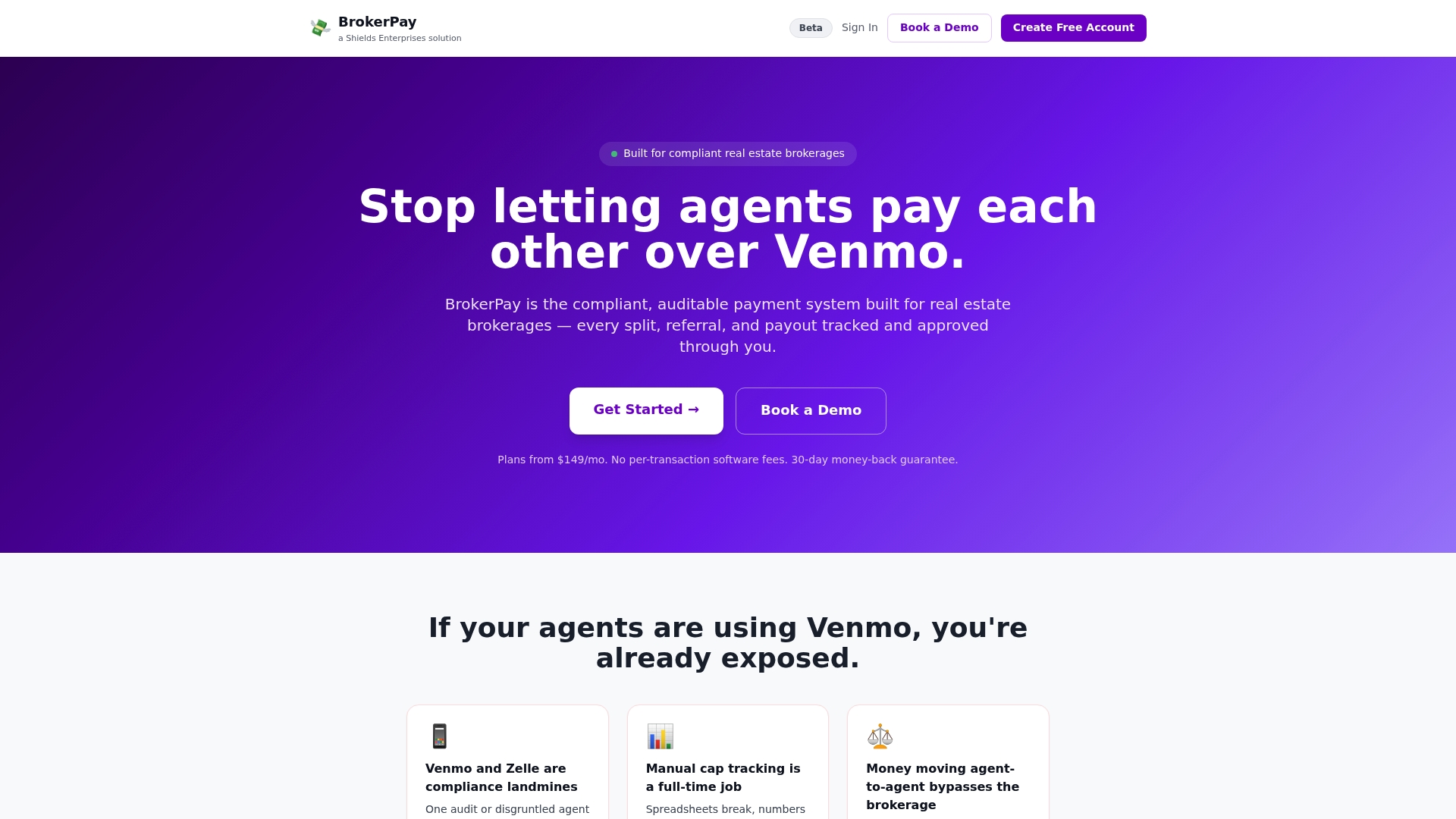
Brokerpay uses open banking and strong authentication to move funds the way regulated financial institutions move funds, not the way a consumer app does. Every transaction is tracked, documented, and processed with the traceability that federal compliance requires. If your brokerage is still using informal P2P workarounds for commissions, the question is not whether something will go wrong. It is when. Brokerpay gives you the infrastructure to stop that risk before it starts.
FAQ
Are bank transfers always safer than P2P apps?
Bank transfers are generally safer because they operate under Regulation E and NACHA rules that provide defined dispute timelines and liability limits. P2P apps offer fewer protections, particularly for authorized payments that turn out to be scams.
Can you reverse a Zelle payment if you were scammed?
Zelle payments are treated as authorized once sent, and reversal is not available except in narrow cases of true unauthorized activity. If you were tricked into sending the payment yourself, Zelle typically does not reimburse the loss.
What is Regulation E and how does it protect bank transfer users?
Regulation E is a federal law that caps consumer liability at $50 for unauthorized electronic fund transfers reported within two business days and requires financial institutions to investigate disputes within 10 business days.
What are the main P2P app vulnerabilities businesses should know?
The primary risks are payment irreversibility, social engineering scams, and the absence of buyer protection for authorized transfers. Businesses also face documentation gaps that create compliance exposure when using P2P apps for professional payments.
How does Pay by Bank improve security over P2P apps?
Pay by Bank keeps the entire authentication process inside the customer’s bank app using biometrics or a passcode, which means no card numbers or credentials are shared with third-party platforms, cutting fraud exposure significantly.