How to Create Compliant Payment Records for Brokers

Compliant payment records are the documented proof that every financial transaction in a real estate brokerage was authorized, accurately classified, and retained in a format regulators can verify. Real estate brokers face federal and state-level scrutiny on escrow handling, commission splits, and co-op payments, making the ability to create compliant payment records a core operational requirement, not an administrative afterthought. Florida Realtors mandates monthly trust account reconciliation under Section 61J2-14.012(2), F.A.C., and California requires trust records retained for at least three years from closing. Platforms like Oracle NetSuite ERP and Brokerpay demonstrate that audit-ready payment documentation is achievable through structured data schemas and automated workflows.
What are the core components of compliant payment records?
A compliant payment record, known in accounting practice as a transaction payment record, is only as strong as the data fields it captures. Payment receipts must include the date, amount, payment method, invoice reference, supplier information, and a unique receipt number to meet audit standards. Each of these fields serves a distinct function: the date establishes the timeline of funds movement, the unique receipt number prevents duplication, and the invoice reference ties the payment to a specific obligation.
Beyond the standard fields, brokers must classify every payment by type. The three categories regulators look for are advance payments, part payments, and final payments. Misclassifying a partial commission disbursement as a final payment, for example, creates a discrepancy that triggers audit flags and can result in license discipline.

Escrow and trust fund transactions require additional specificity. The record must identify the beneficiary, the trust account number, and the purpose of the deposit or disbursement. Oracle NetSuite ERP handles this by generating separate payment records for each tender when a transaction involves multiple payment methods, ensuring every financial event has its own traceable record.
Split payments and partial disbursements are where many brokerages fall short. When a co-op commission is split between two agents using different payment methods, each tender must produce its own record. Separate tenders require separate records to accurately represent the flow of funds, a principle that applies equally whether you use an ERP or a purpose-built brokerage platform.
Pro Tip: Set up a standardized payment record template that includes all required fields before the first transaction of the month. Filling in a complete template is faster than reconstructing missing data during an audit.
Key fields to include in every payment record:
- Transaction date and time
- Gross amount and net amount after splits
- Payment method (wire, check, ACH, platform transfer)
- Invoice or contract reference number
- Unique receipt or transaction ID
- Payer and payee legal names and trading addresses
- Payment classification (advance, partial, or final)
- Trust account or escrow account identifier where applicable
How to prepare monthly trust account reconciliation packages
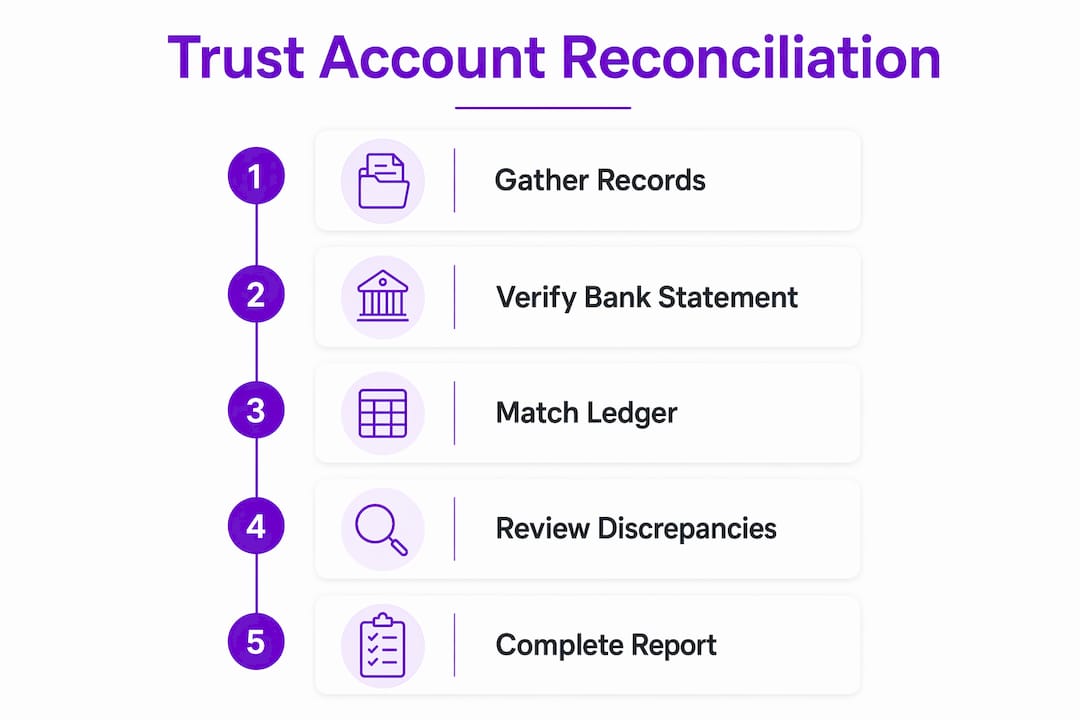
The three-way reconciliation is the gold standard for trust account compliance in real estate brokerage. State commissions require a monthly three-way match of the bank statement balance, the trust ledger balance, and the sum of all client sub-ledgers. If these three figures do not agree, the broker must document the variance and explain its disposition before signing the reconciliation worksheet.
Follow these steps to build a complete monthly reconciliation package:
- Pull the bank statement for the trust account as of the last business day of the month. This is the external reference point that all internal records must reconcile against.
- Compile the trust ledger showing all deposits and disbursements during the month, with running balances. The ending balance must match the bank statement after adjusting for outstanding checks and deposits in transit.
- Aggregate client sub-ledgers for every beneficiary whose funds are held in the trust account. The sum of all sub-ledger balances must equal the trust ledger balance.
- Document any variances with a written explanation and the corrective action taken. Regulators treat unexplained variances as evidence of mismanagement.
- Attach supporting documents including deposit receipts, disbursement authorizations, wire confirmations, and any escrow instructions relevant to the period.
- Obtain the designated broker’s signature on the reconciliation worksheet. An unsigned worksheet is treated as a missing worksheet during a state commission audit.
- Package everything into one retrievable file. Regulators expect one retrievable file containing the signed worksheet, bank statement, trust ledger, sub-ledger trial balance, and variance notes.
Florida Realtors provides the MSR-5 form specifically for this purpose, giving brokers a standardized reconciliation format that satisfies state requirements. Using a state-approved form removes ambiguity about what regulators expect to see.
| Reconciliation component | Purpose |
|---|---|
| Bank statement | External verification of actual cash position |
| Trust ledger | Internal record of all trust account activity |
| Client sub-ledgers | Beneficiary-level breakdown of funds held |
| Variance explanation | Documents and resolves any discrepancies |
| Signed worksheet | Broker attestation of accuracy and completeness |
Pro Tip: Complete the reconciliation within five business days of month-end. Waiting until the last minute before an audit forces you to reconstruct transactions from memory, which introduces errors and raises regulator suspicion.
What best practices ensure secure payment record retention and retrieval?
Retention is not just about keeping records. It is about keeping them in a format that proves their integrity when a regulator, auditor, or opposing counsel requests them. Records must be retrievable within 24 hours and stored in searchable, machine-readable formats. A folder of scanned PDFs with no indexing fails this standard because it cannot be searched by transaction ID, date range, or beneficiary name.
Retention periods vary by state but follow a consistent pattern. California mandates three years from closing for trust-related documents. Most other states require five to seven years for the same category of records. Brokers operating across multiple states must apply the longest applicable retention period to avoid gaps in compliance.
Secure payment record management requires more than a shared drive. The following practices define a defensible retention system:
- Store records in a centralized digital repository with role-based access controls. Not every staff member needs access to trust account records.
- Apply encryption to all stored payment data, particularly records containing bank account numbers, wire instructions, or personal financial information.
- Build automated deletion schedules that remove records only after the applicable retention period expires, with a logged confirmation of deletion for data protection compliance.
- Maintain an immutable audit trail for every record, capturing who created it, who accessed it, and any modifications made. Append-only logs with exportable audit packets satisfy the tamper-evidence standard regulators require.
- Assign clear ownership for each stage of the record lifecycle: creation, review, storage, and deletion.
| Retention category | Minimum period | Format requirement |
|---|---|---|
| Trust account transactions | 3 years (California); 5-7 years (most states) | Machine-readable, searchable |
| Commission disbursement records | Match trust account period | Linked to contract and invoice |
| Reconciliation worksheets | Same as trust account period | Signed originals or certified copies |
| Audit trail logs | Concurrent with underlying record | Append-only, exportable |
Automation and centralized data management reduce the manual work of reassembling payment records at audit time from hours to minutes. Brokerages that rely on spreadsheets and email threads consistently struggle to produce complete packages on demand.
Which tools support compliant payment record creation?
The right technology does not just store records. It generates them in a compliant format at the moment of the transaction. Oracle NetSuite ERP creates payment records per tender automatically, linking each record to the originating invoice and supporting multi-tender transactions with separate traceable entries. DocuWare provides document management with indexed storage and retrieval, making it practical for brokerages that need to attach signed escrow instructions to specific payment records.
Brokerpay is purpose-built for real estate brokerages, handling agent splits, referral fees, and co-op commissions within a RESPA-compliant framework. Unlike generic accounting platforms, Brokerpay eliminates the Venmo and Zelle workarounds that create federal liability by processing every disbursement through a documented, auditable channel. Brokers using Brokerpay can automate broker payouts and generate audit-ready reports without manual assembly.
When evaluating any platform for payment record management, look for these capabilities:
- Automated reconciliation that matches payments to invoices without manual intervention
- Linked document storage that attaches escrow instructions, wire confirmations, and signed agreements to each transaction record
- Immutable audit trail functionality with exportable logs
- Integration with your CRM and payment gateway to capture transaction data at the source
- Role-based access controls and encryption at rest
Pro Tip: Before selecting a platform, ask the vendor to demonstrate how it handles a split-tender co-op commission with two agents on different splits. If the system cannot produce two separate, linked payment records from one transaction, it will create compliance gaps in your most common transaction type.
Understanding payment gateway options for real estate is a useful starting point when assessing how payment data flows from transaction to record.
What mistakes should brokers avoid when creating payment records?
The most common compliance failure in real estate brokerage payment records is not fraud. It is incompleteness. Missing a signature on a reconciliation worksheet, failing to issue a receipt at the moment of payment, or storing documents in separate systems that cannot be linked at audit time each carry the same regulatory consequence as a deliberate omission.
Receipts must be issued immediately when payment is received. Issuing a receipt two days after a deposit creates a timestamp discrepancy that auditors flag as a potential misappropriation indicator. The same principle applies to disbursements: the payment record must be created at the time of the transaction, not reconstructed afterward.
Partial and split payments deserve particular attention. A co-op commission paid in two installments requires two separate records, each classified correctly as a part payment or final payment. Combining them into a single record misrepresents the transaction timeline and obscures the flow of funds.
“Compliance in payment records is embedded into operating models involving authorization, monitoring, and dispute management, not just documentation checklists.” Ecrypt
Non-compliance consequences for brokers include audit findings, mandatory corrective action plans, fines, and license suspension. State real estate commissions treat trust account violations as among the most serious offenses a broker can commit. The commission tracking practices that protect agents from tax problems also protect brokers from regulatory exposure.
Key takeaways
Compliant payment records in real estate brokerage require standardized data fields, monthly three-way reconciliation, and machine-readable retention systems to satisfy state and federal regulatory requirements.
| Point | Details |
|---|---|
| Standardize every record | Include date, amount, method, invoice reference, and unique ID in every payment record. |
| Complete three-way reconciliation monthly | Match bank statement, trust ledger, and client sub-ledgers with a signed worksheet each month. |
| Retain records in searchable formats | Store records in machine-readable systems with retrieval possible within 24 hours. |
| Use immutable audit trails | Append-only logs with exportable packets satisfy tamper-evidence standards during audits. |
| Automate to reduce risk | Platforms like Brokerpay eliminate manual gaps and generate audit-ready records at the point of transaction. |
Why compliance is a system, not a task
I have worked with enough brokerage finance teams to know that the ones who struggle at audit time share one trait: they treat compliance as something they do before an audit rather than something built into every transaction. The brokers who sail through state commission reviews are not doing more work. They are doing the same work inside a system that captures compliant records automatically.
The insight from Ecrypt’s operating model framework resonates with what I see in practice. Compliance embedded into authorization workflows, payment processing, and reconciliation cycles means there is nothing to reconstruct when a regulator calls. The record exists because the transaction could not be completed without creating it.
The practical implication for brokers is this: stop auditing your records and start auditing your processes. If your current workflow allows a disbursement to occur without generating a timestamped, classified payment record linked to the originating contract, the process is broken regardless of how diligent your staff is. Fix the system, and the records take care of themselves. Train your team on the why behind each documentation step, not just the how, and you will see fewer exceptions and faster month-end closes.
— Wes
How Brokerpay simplifies compliant payment record management
Real estate brokers who want to generate accurate payment records without building a compliance infrastructure from scratch have a direct path forward with Brokerpay.
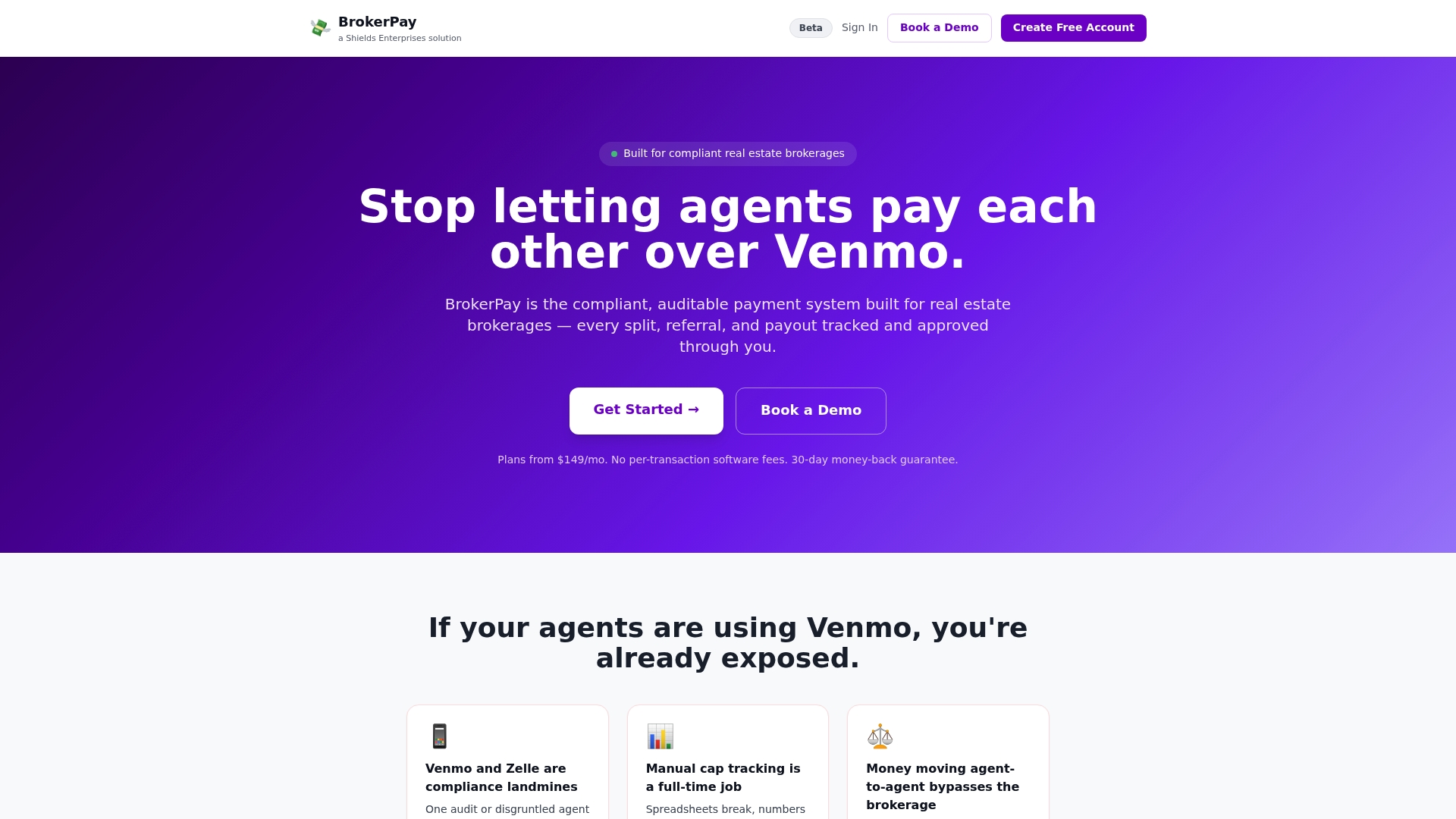
Brokerpay processes agent splits, referral fees, and co-op commissions through a RESPA-compliant platform that documents every transaction at the moment it occurs. Every disbursement produces a linked, audit-ready record with full transaction history, eliminating the Venmo and Zelle workarounds that expose brokerages to federal liability. Automated reconciliation and exportable audit reports mean your monthly trust account package is ready in minutes, not hours. Brokers looking to ensure compliant financial records and reduce regulatory risk can explore Brokerpay’s platform to see how purpose-built automation replaces manual documentation gaps.
FAQ
What fields must every compliant payment record include?
Every payment record must include the transaction date, amount, payment method, invoice reference, unique receipt number, and payer and payee information. Records should also classify the payment as advance, partial, or final to satisfy audit requirements.
How often must real estate brokers reconcile trust accounts?
Brokers who hold escrow funds must perform monthly trust account reconciliation, retaining the signed worksheet, bank statement, and trust ledger as a single retrievable package. Florida mandates this under Section 61J2-14.012(2), F.A.C., and most other states have equivalent requirements.
How long must brokers retain payment records?
California requires trust-related payment records to be retained for at least three years from closing, while most other states require five to seven years. Brokers operating in multiple states must apply the longest applicable retention period across all records.
What is a three-way reconciliation in real estate?
A three-way reconciliation matches the bank statement balance, the trust ledger balance, and the sum of all client sub-ledger balances to confirm they agree. Any variance must be documented with an explanation and signed off by the designated broker.
Why are Venmo and Zelle a compliance risk for brokers?
Venmo and Zelle do not generate the classified, audit-ready payment records that state commissions and RESPA require. Using consumer payment apps for commission disbursements creates undocumented fund flows that regulators treat as trust account violations, exposing brokers to fines and license discipline.