The Role of Automation in Brokerage Payments

Automation in brokerage payments is defined as the systematic replacement of manual commission disbursements, tax form collection, and payment reconciliation with software-driven workflows that execute faster, with fewer errors, and with compliance built in. Real estate brokerages processing dozens of agent splits per week face a compounding problem: manual payment processes create federal liability, delay closings, and generate audit exposure that grows with every transaction. Platforms like Routable and Brokerpay address this directly by embedding validation, tax automation, and multi-rail payment execution into a single workflow. The role of automation in brokerage payments is not a convenience upgrade. It is the operational foundation that separates compliant, scalable brokerages from those managing payments over Venmo and Zelle.
How does automation prevent payment errors and ensure compliance?
Payment errors in brokerage operations are not random. They follow predictable failure points: wrong bank accounts, missing tax forms, and unverified payees. Automation eliminates each of these at the source rather than catching them after funds have moved.
The most effective control is embedding bank account ownership verification during payee onboarding. Routable integrates ownership verification at the onboarding stage, blocking misdirected payments before they occur. This matters because ACH reversals are costly, slow, and create a paper trail that regulators notice. Shifting verification to the front of the workflow converts a reactive problem into a preventive gate.

Tax compliance follows the same logic. Automated W-8/W-9 collection and 1099-NEC and 1099-MISC generation at year-end removes the manual reconciliation that most brokerage accounting teams dread. Payment data feeds directly into tax form generation with no separate data entry required. For brokerages paying dozens of independent contractors and co-op agents, this alone justifies the switch.
Fraud prevention adds a third layer. Risk-based ACH fraud controls require real-time, independent account ownership verification at both vendor onboarding and any bank-detail change, with audit trails maintained throughout. This aligns with Nacha’s 2026 implementation standards and creates a defensible compliance record if a transaction is ever disputed.
Key controls that automation embeds into brokerage payment workflows:
- Pre-flight validation: Verifies payee bank account ownership before any funds move
- Tax form automation: Collects W-8/W-9 at onboarding and generates 1099s from payment data
- Audit trails: Logs every verification event and payment action for regulatory review
- Bank-detail change controls: Re-verifies account ownership whenever routing or account numbers are updated
Pro Tip: Set your platform to trigger a re-verification workflow automatically whenever an agent updates their banking details. This single rule eliminates the most common vector for payment fraud in brokerage operations.
What operational efficiencies does automation bring to high-volume workflows?
Volume is where manual payment processes break down completely. A brokerage closing 50 transactions per month might process 150 or more individual payment lines once splits, referral fees, and co-op commissions are counted. At 200 closings per month, that number becomes unmanageable without automation.
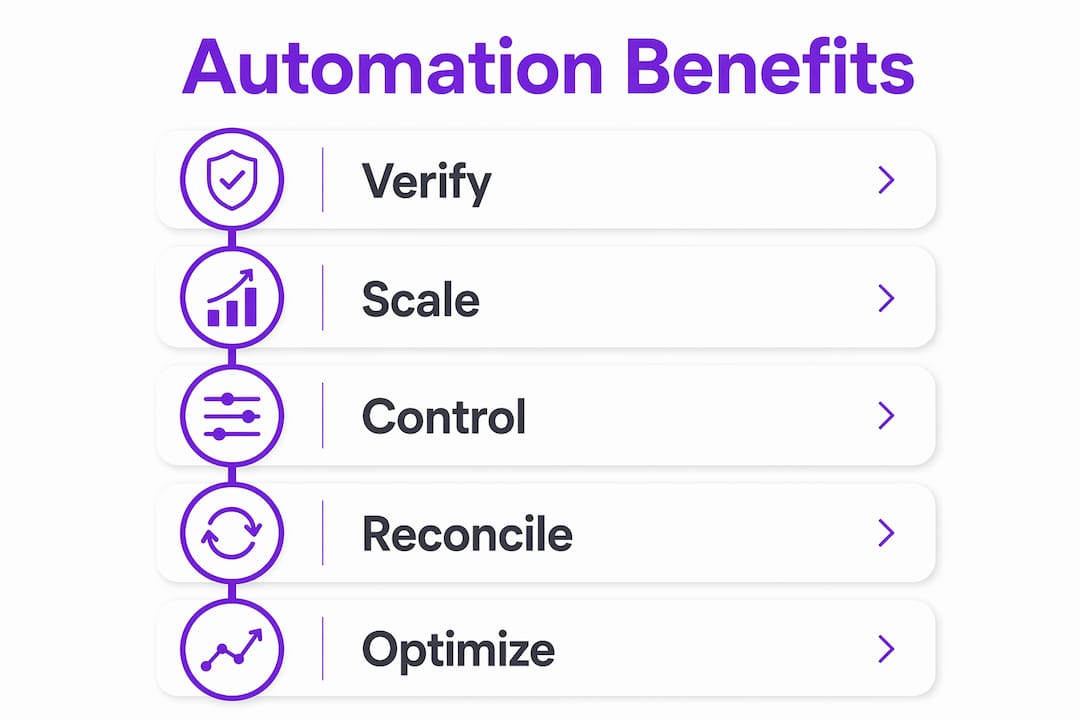
API-first mass payment platforms support 10,000 or more monthly payments without adding headcount. The platform handles validation, batching, and reconciliation automatically. Finance staff shift from processing payments to reviewing exceptions, which is a fundamentally different and more productive use of their time.
The operational gains compound across four specific areas:
- Payment initiation: API triggers fire payments automatically on system events like deal closes or scheduled distribution dates, removing manual batch initiation entirely.
- Approval workflows: Separating initiation, approval, and execution stages reduces bottlenecks and aligns with regulatory expectations for segregation of duties.
- Reconciliation: Automated bank-account reconciliation reduces manual effort by over 75% and speeds month-end close by 4.2 days, with matching rates reaching 97 to 99% within months of implementation. That speed improvement directly affects how quickly agents get paid after closing.
- Exception handling: Pre-populated audit context in exception workflows reduces analyst research time by approximately 20 minutes per case. Exceptions route with transaction history and verification data already attached, so the analyst makes a decision rather than hunting for information.
Pro Tip: Treat reconciliation as a daily workflow, not a month-end task. Platforms that run automated matching continuously catch discrepancies within hours instead of weeks, which makes corrections far less disruptive.
How does automation handle complex commission structures and payment types?
Real estate brokerage payments are not uniform. A single closing might generate a commission split between two agents, a referral fee to an outside broker, a co-op payment to a buyer’s agent, and a contractor payment to a transaction coordinator. Each line has different tax treatment, different payee verification requirements, and potentially different payment timing.
Automation handles this complexity through structured flexibility. The comparison below shows how different payment types map to automation capabilities:
| Payment type | Automation capability |
|---|---|
| Agent commission splits | Rule-based calculation with version control and audit trails for plan changes |
| Referral fees | Automated payee onboarding with W-9 collection and 1099-NEC generation |
| Co-op commissions | Multi-rail payment execution with same-day ACH, wire, or RTP/FedNow options |
| Escrow deposits | 80 to 95% automated condition verification with governed fund release workflows |
| Contractor payments | Batch processing with independent account verification at each payment |
Commission plan changes mid-cycle are a particular risk. Version control and audit trails for commission rules prevent payout errors caused by plan adjustments that take effect before all prior transactions are settled. Without rollback capability, a rule change can silently miscalculate payouts for every transaction processed after the update. Governed payout operations with rollback features eliminate this exposure entirely.
The payment rail question also matters more than most brokerages realize. Same-day ACH works for most agent splits. Wire transfers suit large investor distributions. RTP and FedNow support real-time disbursements when agents need funds immediately after closing. An automated platform that supports all three rails lets the brokerage match the payment method to the transaction type without manual intervention.
What are the practical steps to implement payment automation in a brokerage?
Implementation succeeds or fails based on how well the operating model is designed, not just which platform is selected. Technology is the enabler. The workflow design is the actual work.
A practical implementation follows this sequence:
- Embed account validation at onboarding. Every new agent, contractor, or co-op partner should complete bank account verification before their first payment. Build this into your onboarding checklist as a non-negotiable step.
- Choose an API-first platform with real-time status tracking. Platforms that expose payment status via API let your transaction management system confirm disbursement without manual checking. This is the foundation for switching from manual to automated payouts without creating new blind spots.
- Standardize workflows with clear ownership. Every payment type needs a defined owner, an approval chain, and an escalation path for exceptions. Ridley & Co’s operating model framework prescribes this separation as the core of scalable payment operations.
- Re-verify bank details on every change. Set a policy that any update to routing or account numbers triggers a new verification event. Log the verification with a timestamp and the identity of who initiated the change.
- Continuously refine matching rules. Automated reconciliation improves over time as matching rules are tuned to your transaction patterns. Review unmatched items weekly for the first three months and update rules based on what you find.
The brokerages that get the most from automation are the ones that treat implementation as a process redesign, not a software installation. The platform handles execution. The brokerage defines the rules, the ownership, and the escalation logic. Both sides have to be right for the system to work.
For brokerages managing co-op payment workflows specifically, the compliance stakes are higher because RESPA governs how co-op fees are documented and disbursed. Automation that tracks and timestamps every step of the co-op payment process creates the documentation trail that RESPA compliance requires.
Key takeaways
Automation in brokerage payments works because it embeds compliance controls, scales payment volume without adding headcount, and eliminates the manual errors that create federal liability for real estate brokerages.
| Point | Details |
|---|---|
| Pre-flight validation is the highest-leverage control | Verify bank account ownership at onboarding to block misdirected payments before funds move. |
| Tax automation removes year-end reconciliation | Automated W-9 collection and 1099 generation feeds directly from payment data with no separate entry. |
| Reconciliation should run daily, not monthly | Automated matching at 97 to 99% accuracy speeds month-end close by 4.2 days and catches errors early. |
| Commission version control prevents silent errors | Rollback and audit trail features stop mid-cycle plan changes from miscalculating settled payouts. |
| Operating model design drives automation success | Clear workflow ownership and segregation of duties matter as much as the platform itself. |
Why most brokerages underestimate the operating model side
Most brokerage owners I talk to approach payment automation as a technology purchase. They evaluate platforms, compare features, and sign a contract. Then they discover that the platform works exactly as advertised and the payments are still a mess. The problem was never the software.
What actually determines whether automation delivers results is the operating model underneath it. Who owns each payment type? Who approves exceptions? What happens when an agent’s bank account fails verification two hours before a scheduled closing disbursement? If those questions don’t have written answers before the platform goes live, the automation just moves the chaos faster.
The other thing I’ve seen consistently is that brokerages underinvest in the onboarding stage. They set up the platform, configure the payment rules, and then let agents submit bank details through whatever channel is convenient. That’s where the exposure lives. Commission tracking and tax compliance both depend on clean payee data from the start. If the foundation is bad, the automation amplifies the problem rather than fixing it.
The brokerages that get this right treat the first 90 days of implementation as a process audit. They map every payment type, assign ownership, and document the exception paths before processing a single live payment. That discipline is what separates the brokerages that say automation didn’t work from the ones that closed 300 transactions last month without a single payment dispute.
— Wes
How Brokerpay automates compliant commission payments
Brokerpay is built specifically for the payment complexity real estate brokerages face every day. The platform automates agent splits, referral fees, and co-op commissions while keeping every transaction RESPA-compliant and fully documented. Brokerages using Brokerpay eliminate the Venmo and Zelle workarounds that create federal liability, replacing them with a tracked, auditable payment workflow that handles tax form collection and 1099 generation automatically.
Integration is straightforward through API or CSV upload, and the platform supports multiple payment rails including ACH and wire. If your brokerage is ready to replace manual disbursements with a system that scales, Brokerpay’s compliant payment platform is the place to start.
FAQ
What is the role of automation in brokerage payments?
Automation in brokerage payments handles commission disbursements, tax form collection, payee verification, and reconciliation through software-driven workflows. It replaces manual processes that create payment errors, compliance gaps, and federal liability for real estate brokerages.
How does automation improve compliance for real estate brokerages?
Automated platforms embed bank account ownership verification, collect W-8/W-9 forms at onboarding, generate 1099s from payment data, and maintain audit trails that satisfy Nacha and RESPA requirements. These controls convert reactive compliance fixes into preventive gates.
Can automation handle high payment volumes without adding staff?
API-first platforms like Routable support 10,000 or more monthly payments through automated validation, batching, and reconciliation without requiring additional headcount. Finance teams shift from processing payments to reviewing the small percentage of exceptions the system flags.
Why do large brokerages need payment automation specifically?
Large brokerages process multiple payment types per transaction, including splits, referral fees, co-op commissions, and contractor payments, each with different tax and compliance requirements. Manual processes cannot maintain accuracy or audit readiness at that volume without significant error risk.
What should brokerages prioritize when implementing payment automation?
Embed bank account verification at payee onboarding, choose a platform with real-time status tracking, and define clear workflow ownership before going live. The operating model design matters as much as the platform itself for achieving accurate, compliant payment execution.