Avoid Venmo Real Estate Payments: 2026 Agent Guide

Using Venmo for real estate payments is a compliance violation that exposes brokerages to federal liability, frozen funds, and IRS audit risk. Real estate professionals who rely on peer-to-peer (P2P) apps for commission splits, co-op payments, or referral fees are operating outside the boundaries of both Venmo’s Terms of Service and RESPA guidelines. This guide explains the specific legal, financial, and operational risks of Venmo in real estate transactions, and walks you through the compliant alternatives that purpose-built platforms like Brokerpay provide.
Why you should avoid Venmo real estate payments
Venmo is a consumer P2P application built for splitting dinner tabs and paying friends. It is not a licensed payment processor for commercial real estate transactions. When a brokerage uses personal Venmo accounts to collect rent or distribute agent commissions, it violates Venmo’s Terms of Service, which prohibits using personal accounts for commercial purposes. The consequence is not a warning. Venmo can suspend the account and withhold funds for up to 30 days, leaving your brokerage unable to cover payroll or mortgage obligations.
The industry term for what Venmo lacks is “merchant payment infrastructure.” Merchant-grade platforms carry FDIC-insured accounts, transaction audit trails, and IRS reporting integrations. Venmo carries none of these for standard users. The gap between what a real estate transaction legally requires and what Venmo actually provides is the core reason to avoid Venmo real estate payments entirely.

Pro Tip: If your brokerage currently uses Venmo or Zelle for any agent split or referral fee, document every transaction immediately. You will need that paper trail if the IRS or a state licensing board requests records.
What legal and compliance issues arise from using Venmo
The compliance risks of Venmo for real estate payments go beyond a suspended account. They touch RESPA, state landlord-tenant law, and IRS reporting requirements simultaneously.
Account suspension and fund freezing are the most immediate threats. Venmo’s risk algorithms flag high-volume or high-dollar transactions on personal accounts. A single flagged transaction can freeze all funds in the account, not just the disputed amount. For a brokerage processing multiple commission splits in a closing week, that freeze can delay payments to agents by weeks.
Tax documentation failures compound the problem. Venmo does not generate 1099 forms for personal account transactions below the IRS threshold, and even its business account reporting is limited compared to dedicated platforms. Real estate professionals who commingle personal and business funds through Venmo face heightened audit risk and difficulty proving deductible expenses.
Eviction and partial payment traps are a specific risk for landlords and property managers. Tenants can send partial payments on Venmo to disrupt eviction timelines. Many states treat accepted partial payments as a waiver of the eviction notice. Venmo does not allow you to decline or block incoming payments, so you have no legal defense once the funds land in your account.
- Personal Venmo accounts are not authorized for commercial rent collection or commission distribution
- Account freezes can withhold funds for up to 30 days with no guaranteed resolution timeline
- No 1099 generation means manual tax reporting and elevated audit exposure
- Partial payment acceptance on Venmo can legally invalidate an eviction filing
- Venmo’s Purchase Protection rarely covers real estate disputes, leaving chargebacks uncontested
Legal experts advocate for separating business transactions into dedicated accounts and business entities rather than relying on consumer P2P apps. This is not optional advice. It is the standard that state licensing boards and federal regulators expect from licensed brokerages.
How fees and accounting costs add up for real estate professionals
The perceived convenience of Venmo disappears quickly when you calculate its true cost. Venmo Business accounts charge 2 to 3 percent on transactions, compared to the flat subscription pricing or sub-one-percent per-transaction fees that dedicated real estate payment platforms offer. On a $2,000 commission payment, that fee reaches $40 to $60 per transaction. Multiply that across a brokerage processing 50 transactions per month and the fee drag becomes material.
| Cost category | Venmo Business | Purpose-built platform |
|---|---|---|
| Transaction fee | 2–3% per payment | Flat subscription or under 1% |
| 1099 generation | Manual or absent | Automated |
| Instant transfer fee | 1.75% additional | Included or waived |
| Bookkeeping labor | Manual reconciliation | Automated ledger sync |
| Annual admin cost increase | $800–$2,400 extra | Minimal with automation |
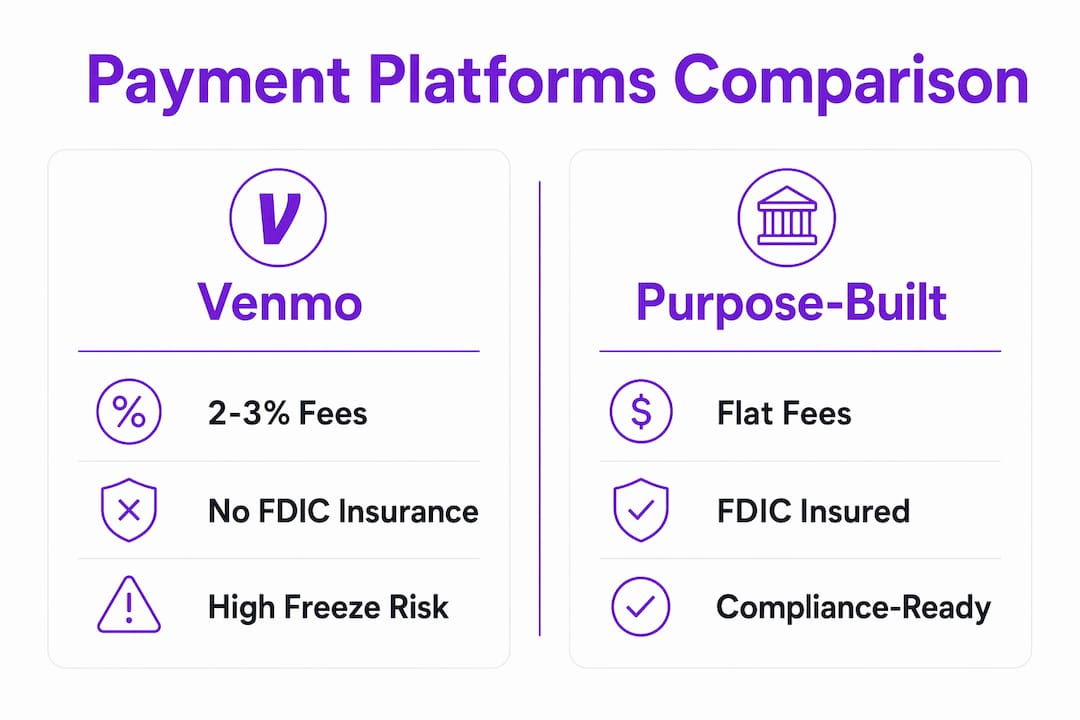
Manual rent and commission collection via Venmo increases accounting costs by $800 to $2,400 annually compared to integrated software that automates bookkeeping and tax reporting. That figure does not include CPA time spent reconstructing transaction histories from Venmo screenshots. It also excludes the liquidity risk created when a frozen account forces you to cover mortgage or payroll obligations from personal funds.
Pro Tip: Ask your CPA to calculate the fully loaded cost of your current payment method, including their time spent on reconciliation. Most brokerages are shocked to find Venmo costs more than a dedicated platform subscription.
What operational gaps make Venmo unsuitable for real estate
Beyond compliance and cost, Venmo simply lacks the features that real estate payment workflows require. P2P apps lack purpose-built infrastructure for tracking partial payments, security deposits, and late fees. This creates recordkeeping gaps that become serious problems during audits, disputes, or licensing reviews.
The operational shortfalls are specific and consequential:
- No automated late fee calculation or application
- No rent receipt generation for tenant records
- No lease integration to match payments against specific obligations
- No tenant credit reporting, which removes a key incentive for on-time payment
- No ability to block or decline partial payments that could compromise eviction filings
- No audit trail formatted for legal or regulatory review
Payment errors on Venmo are also difficult to reverse. If an agent receives the wrong split amount, correcting it requires a new manual transaction, which creates a second entry in your books and complicates reconciliation. A real estate payment gateway built for brokerage workflows handles corrections within the same transaction record, preserving the audit trail.
Industry experts confirm that the shift away from P2P apps toward specialized integrated payment platforms is accelerating. The reason is straightforward: API-first payment infrastructure automates validation, batching, and reconciliation while supporting complex commission splits, 1099 filing, and multiple payment rails. Venmo supports none of these functions.
How to select and implement compliant real estate payment alternatives
Replacing Venmo requires a structured evaluation, not just picking a new app. Follow these steps to select and implement a compliant payment solution for your brokerage.
-
Define your requirements. List every payment type your brokerage processes: agent commission splits, referral fees, co-op commissions, security deposits, and rent collection. Each type may carry different compliance requirements under RESPA, state law, or IRS reporting rules.
-
Evaluate platforms against compliance criteria. The platform must generate 1099 forms automatically, maintain a transaction audit trail, support FDIC-insured holding accounts, and allow you to decline or reverse payments. Generic P2P apps fail every one of these criteria.
-
Compare total cost of ownership. Include transaction fees, subscription costs, CPA time, and the cost of potential compliance failures. A platform charging a flat monthly fee almost always costs less than Venmo’s percentage-based fees at brokerage transaction volumes.
-
Set up dedicated business accounts. Never process real estate payments through a personal account. Create a business entity, open a dedicated business bank account, and connect your payment platform to that account exclusively. This separation is the foundation of compliant real estate financial management.
-
Migrate existing payees systematically. Export your current agent and vendor payment records. Import them into the new platform and verify account ownership before processing the first payment. Automated payouts for brokers eliminate the manual verification step that creates errors in Venmo-based workflows.
-
Communicate the change to agents and tenants. Send a written notice at least 30 days before switching platforms. Explain the new payment method, provide enrollment instructions, and document that the notice was sent. This protects you if a payment dispute arises during the transition.
-
Audit your first three months on the new platform. Reconcile every transaction against your lease agreements or commission schedules. Confirm that 1099 data is accumulating correctly. Address any discrepancies immediately rather than letting them compound.
For brokerages managing compliant co-op payment workflows, the transition to a purpose-built platform also eliminates the manual tracking that creates RESPA exposure. The compliance benefit alone justifies the switch before you factor in fee savings.
Key takeaways
Real estate professionals who avoid Venmo real estate payments and adopt purpose-built platforms eliminate federal liability, reduce transaction costs, and gain the audit documentation that regulators require.
| Point | Details |
|---|---|
| Venmo violates ToS for commercial use | Personal accounts used for commissions or rent risk suspension and fund freezes up to 30 days. |
| Fee drag is measurable and significant | Venmo Business charges 2–3% per transaction versus flat-rate pricing on dedicated platforms. |
| Accounting costs rise without automation | Manual Venmo reconciliation adds $800–$2,400 in annual admin costs compared to integrated software. |
| Partial payments create legal traps | Venmo cannot block partial payments, which can invalidate eviction filings under many state laws. |
| Purpose-built platforms solve all gaps | Platforms with 1099 automation, audit trails, and commission split tracking replace every Venmo workaround. |
The real cost of convenience in real estate payments
I have reviewed brokerage payment workflows where agents were splitting commissions over Venmo for years without incident. Then one transaction triggered a fraud flag, the account froze, and the brokerage spent three weeks explaining to agents why their checks were delayed. The brokerage had no documentation, no audit trail, and no recourse with Venmo’s support team.
The uncomfortable truth is that Venmo’s convenience is real but short-lived. It works until it doesn’t, and when it fails in a real estate context, the failure is expensive and public. Agents talk. Clients notice delayed closings. State licensing boards do not accept “Venmo froze our account” as a compliance explanation.
What I have found actually works is separating payment infrastructure from personal finance tools entirely. P2P networks carry approximately five times higher scam losses per dollar compared to traditional card networks. That statistic alone should end the conversation about whether Venmo belongs in a professional brokerage workflow.
The brokerages that adopt compliant platforms proactively are not just reducing risk. They are building a financial infrastructure that scales. When your transaction volume doubles, your payment system should handle it automatically, not require you to manually Venmo 40 agents on a Friday afternoon.
— Wes
Stop processing real estate payments through Venmo
Brokerpay is built specifically for real estate brokerages that need to process agent splits, referral fees, and co-op commissions without the compliance exposure that Venmo creates. The platform automates 1099 generation, maintains a full transaction audit trail, and keeps your brokerage RESPA-compliant on every payment. You also get account ownership verification before any funds move, which eliminates the payment errors that Venmo workflows routinely produce. If your brokerage is ready to replace P2P workarounds with a payment system that meets federal and state requirements, visit Brokerpay to see how compliant commission processing works in practice.
FAQ
Is Venmo legal for real estate agent payments?
Using personal Venmo accounts for commercial real estate payments violates Venmo’s Terms of Service and creates IRS reporting gaps. Licensed brokerages are expected to use merchant-grade payment infrastructure that generates proper documentation.
What are the best alternatives to Venmo for real estate payments?
Purpose-built platforms that automate commission splits, generate 1099 forms, and maintain audit trails are the standard alternative. Brokerpay is designed specifically for brokerage commission workflows, including agent splits, referral fees, and co-op payments.
Can Venmo freeze funds from real estate transactions?
Yes. Venmo’s risk systems flag high-volume or high-dollar transactions on personal accounts and can withhold funds for up to 30 days with no guaranteed resolution, disrupting agent payroll and closing timelines.
How much does Venmo cost compared to dedicated real estate payment platforms?
Venmo Business charges 2 to 3 percent per transaction. Dedicated platforms typically offer flat monthly subscriptions or sub-one-percent per-transaction fees, saving brokerages thousands annually at typical transaction volumes.
Does using Venmo create RESPA compliance risks for brokerages?
Yes. RESPA requires accurate documentation of all settlement-related payments. Venmo does not produce the transaction records or 1099 data that RESPA compliance demands, exposing brokerages to federal audit and penalty risk.