Why Commission Payment Platforms Reduce Risk for Brokers

Commission payment platforms are systems that automate, document, and secure commission calculations and payouts, directly reducing financial and legal risk for real estate brokerages. Independent brokers handling agent splits, referral fees, and co-op commissions face compounding exposure every time a transaction runs through a spreadsheet, a text message, or a Venmo transfer. 85% of commissionable employees manually recalculate their own payouts, creating a verification gap that costs brokerages real money and real legal exposure. Platforms like Brokerpay close that gap by replacing fragmented manual workflows with a single, auditable system built for RESPA compliance.
Why commission payment platforms reduce risk in real estate
The core reason commission payment platforms reduce risk is automation. Every manual step in a commission workflow is a potential error, a potential dispute, and a potential compliance violation. When a broker calculates splits in Excel and pays agents through personal payment apps, there is no audit trail, no compliance layer, and no anomaly detection. Businesses lost 7.7% of revenue to fraud in 2024 and 2025. For a brokerage closing $10 million in annual commissions, that figure represents $770,000 in preventable losses.
Automated platforms replace this exposure with machine learning and rules-based logic that flag irregularities before a payout clears. Integrated systems move commission processes from a bottleneck into a competitive advantage by enabling rapid anomaly detection across every transaction. The practical result is fewer errors, fewer disputes, and a defensible paper trail if a regulatory question ever arises.

How automation prevents financial leakage and errors
Manual commission calculations fail in predictable ways. Brokers miscalculate tiered splits. Agents dispute referral fee deductions. Finance teams spend hours reconciling payouts against closed transaction records. These are not edge cases. They are the standard operating cost of running commissions without a dedicated platform.
Automated commission platforms address this through several specific mechanisms:
- Automated split calculation: Rules for agent tiers, referral percentages, and co-op splits are configured once and applied consistently to every transaction, removing human recalculation from the equation.
- Anomaly detection: Machine learning flags payouts that deviate from established patterns, such as a split percentage that does not match the agent’s current agreement.
- Reconciliation workflows: Platforms match commission disbursements against closed transaction records automatically, surfacing discrepancies before they become disputes.
- Audit-ready records: Every calculation, approval, and payment is logged with timestamps, creating documentation that satisfies both internal review and external regulatory inquiry.
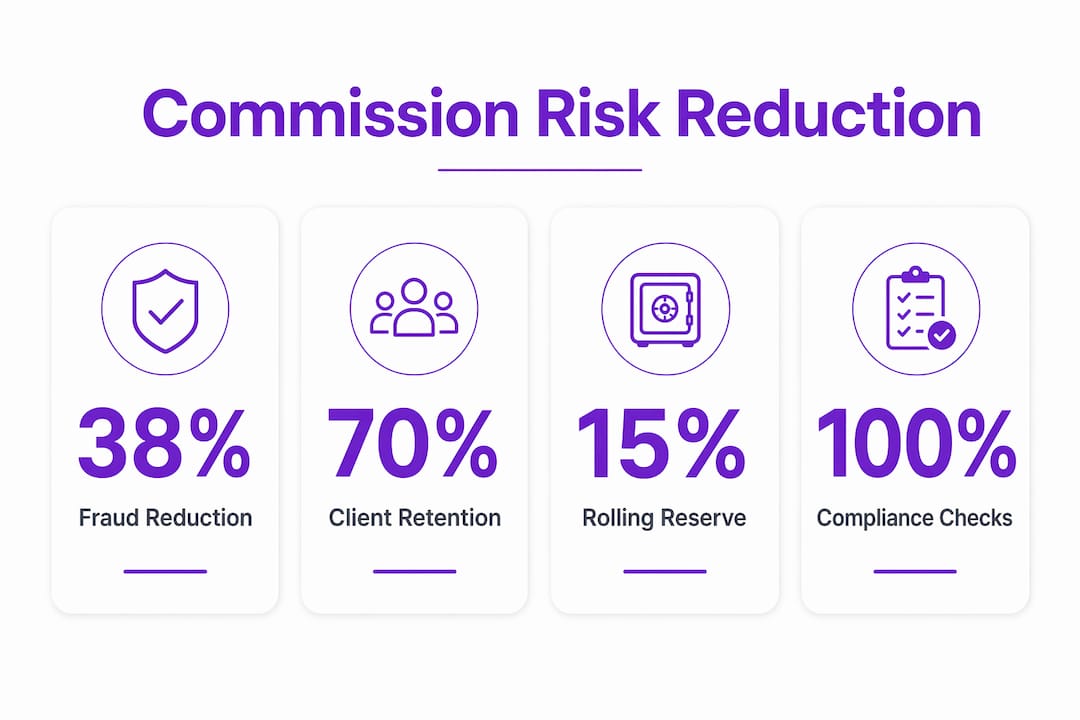
AI fraud detection in commission platforms reduces fraud-related losses by 38%, a figure that reflects both direct theft prevention and the elimination of costly manual errors. That reduction compounds over time as the platform learns the brokerage’s specific transaction patterns.
Pro Tip: The most common source of manual commission errors is not bad math. It is outdated split agreements applied to new transactions. A platform that ties split rules directly to agent contracts eliminates this category of error entirely.
What compliance features in payment platforms mitigate legal risk
Real estate brokerages handle large sums of money under strict federal oversight. RESPA, FinCEN reporting requirements, and state licensing rules create a compliance environment where a single undocumented referral fee payment can generate significant liability. Payment platforms with embedded compliance tools address this directly.
Embedded KYC and AML in commission platforms reduce brokerage exposure to regulatory risk by verifying the identity of every payee before a disbursement clears. This matters most during agent onboarding and when processing co-op commissions to outside brokerages. The compliance checks that would otherwise require manual documentation are handled automatically within the payment workflow.
Key compliance protections built into purpose-built platforms include:
- KYC verification: Identity checks on agents and co-op recipients confirm that payouts go to licensed, verified parties.
- AML screening: Automated screening against watchlists catches flagged entities before funds are released.
- RESPA documentation: Platforms like Brokerpay generate compliant records for referral fees and co-op commissions, replacing the informal arrangements that create federal liability.
- Audit trail generation: Every compliance check is logged, creating documentation that satisfies regulatory review without additional administrative work.
70% of financial firms lost clients due to inefficient onboarding in 2025. For brokerages, the equivalent risk is agent attrition caused by slow, opaque payout processes. Platforms that handle compliance automatically remove friction from onboarding without sacrificing the verification standards that protect the brokerage. You can see how compliant co-op payment workflows work in practice across eight real transaction types.
Pro Tip: When evaluating a commission payment platform, ask specifically whether KYC and AML checks are embedded in the payout workflow or handled separately. Separate processes create gaps. Embedded compliance is the standard that protects you.
How transparency and audit trails reduce disputes
Commission disputes are expensive in two ways. They consume broker and agent time, and they erode the trust that keeps productive agents at a brokerage. The root cause of most disputes is not dishonesty. It is opacity. Agents cannot see how their split was calculated, so they recalculate it themselves and arrive at a different number.
Commission transparency is a primary risk-reduction tool that prevents disputes and motivates agents by giving them real-time visibility into their earnings. Platforms that provide agents with a dashboard showing the exact calculation behind every payout eliminate the information gap that generates disputes in the first place.
The operational benefits of this transparency follow a clear sequence:
- Agent receives a payout notification with a line-item breakdown of gross commission, splits, referral deductions, and net amount.
- Agent can verify the calculation against their agreement without contacting the broker.
- Disputes that would have required broker intervention resolve themselves or never arise.
- Finance teams spend less time fielding payout questions and more time on closed transactions.
- The broker retains a timestamped record of every calculation and agent acknowledgment.
Automated commission systems eliminate shadow accounting, saving thousands of hours per year for sales teams and finance departments. Teams with 1,000 sellers save $576,000 annually from reduced shadow accounting at typical rates. For a mid-size brokerage, the proportional savings are still material, and the reduction in operational friction is immediate.
“Preventative controls embedded in payment workflows empower brokerages to stop fraud before it happens, avoiding reactive crisis management.” — Kyriba and Eftsure
Manual processes vs. integrated payment platforms
The practical difference between running commissions manually and using an integrated platform is not just efficiency. It is risk exposure at every stage of the transaction lifecycle.
| Risk factor | Manual process | Integrated platform |
|---|---|---|
| Split calculation accuracy | Prone to human error and version conflicts | Rules-based automation applied consistently |
| Compliance documentation | Generated manually, often incomplete | Auto-generated and audit-ready |
| Fraud detection | Reactive, identified after payout | Proactive anomaly detection before disbursement |
| Cash flow impact | Rolling reserves hold 5 to 15% of funds for 6 to 12 months | Instant settlement eliminates reserve requirements |
| Dispute resolution | Requires broker intervention and manual reconciliation | Self-service agent dashboards resolve most disputes |
| Regulatory exposure | High, especially for referral fees and co-op payments | Reduced through embedded KYC, AML, and RESPA documentation |
Rolling reserves hold 5 to 15% of funds for 6 to 12 months, locking brokerage revenue that should be working capital. Platforms that settle instantly remove this constraint entirely, improving the cash position of the brokerage without any change in transaction volume. Understanding what a real estate payment gateway actually does clarifies why this integration matters beyond simple payment processing.
Fragmentation of commission, payment, and receivable processing is the primary enemy of risk management in brokerages. When these functions live in separate systems, exception workflows break down and errors accumulate undetected. Integration is not a convenience feature. It is the structural condition that makes risk management possible.
Pro Tip: If your brokerage is still using Venmo, Zelle, or personal checks for agent payouts, you are not just accepting operational risk. You are creating federal liability. RESPA requires documented, compliant payment records for referral fees and co-op commissions. Personal payment apps produce neither.
Key takeaways
Commission payment platforms reduce risk by replacing every manual, undocumented step in a commission workflow with automated, auditable, and compliance-ready processes.
| Point | Details |
|---|---|
| Automation eliminates financial leakage | AI-driven anomaly detection reduces fraud-related losses by 38% and removes manual recalculation errors. |
| Embedded compliance protects brokerages | KYC, AML, and RESPA documentation built into the payout workflow reduce regulatory exposure without added administrative work. |
| Transparency prevents disputes | Real-time agent dashboards with line-item payout breakdowns eliminate the information gap that generates commission disputes. |
| Integration beats fragmentation | Unified commission and payment platforms create exception workflows that catch errors before they become liabilities. |
| Cash flow improves with instant settlement | Eliminating rolling reserves unlocks 5 to 15% of brokerage funds previously held for 6 to 12 months. |
Why I think most brokerages are underestimating their commission risk
Most independent brokers I talk to frame commission risk as an accounting problem. They think the solution is a better spreadsheet or a more careful bookkeeper. That framing misses the actual exposure.
The legal risk in commission handling is not primarily about math errors. It is about documentation. RESPA does not care whether your referral fee calculation was correct. It cares whether you can prove it was compliant. A Venmo payment to a referring agent, even at the right amount, is an undocumented transaction that creates federal liability. No spreadsheet fixes that.
The second thing brokerages underestimate is the compounding cost of agent disputes. A single payout dispute that consumes three hours of broker time, one hour of agent time, and one hour of finance review costs more than most brokerages spend on a month of platform fees. Multiply that by the number of disputes a manual system generates, and the economics of staying manual become indefensible.
What I have seen work is treating the platform decision as a risk management decision, not a technology decision. The question is not “what does this software do?” It is “what liability does my current process create, and does this platform eliminate it?” Brokerpay was built specifically to answer that question for real estate brokerages, which is why it handles RESPA documentation, agent verification, and co-op payment records as core functions rather than add-ons.
The brokerages that adopt purpose-built platforms in 2026 will not just operate more efficiently. They will be structurally protected against the regulatory and financial risks that are already catching up with brokerages still running on informal payment workflows.
— Wes
See how Brokerpay eliminates commission risk for real estate brokerages
Brokerpay is built specifically for independent brokers and brokerage owners who need more than a generic payment processor. It tracks agent splits, referral fees, and co-op commissions in a single auditable system, generates RESPA-compliant documentation automatically, and eliminates the Venmo and Zelle workarounds that create federal liability. Every payout is verified, documented, and defensible. If your brokerage is still handling commissions manually or through personal payment apps, stop the liability exposure and see what a compliant commission payment platform actually looks like in practice. You can also explore how to switch from manual to automated payouts with a step-by-step breakdown built for brokers.
FAQ
Why do commission payment platforms reduce financial risk?
Commission payment platforms reduce financial risk by replacing manual calculations with automated, rules-based systems that apply split agreements consistently and flag anomalies before payouts clear. AI fraud detection in these platforms reduces fraud-related losses by 38% compared to manual processes.
What legal risks do real estate brokerages face with manual commission payments?
Real estate brokerages using personal payment apps or informal processes for referral fees and co-op commissions risk RESPA violations because these methods produce no compliant documentation. Embedded KYC and AML verification in purpose-built platforms generate the records required to demonstrate regulatory compliance.
How do payment platforms prevent commission disputes with agents?
Platforms prevent disputes by giving agents real-time dashboards with line-item breakdowns of every payout calculation, eliminating the information gap that causes agents to manually recalculate and challenge their splits. Automated commission systems also eliminate shadow accounting, which is the primary driver of payout disagreements.
What is shadow accounting in real estate commission management?
Shadow accounting is the practice of agents independently tracking and recalculating their expected commissions in parallel with the brokerage’s records. Automated platforms eliminate this by providing a single, transparent source of truth that both the broker and agent can access in real time.
How do rolling reserves affect brokerage cash flow?
Rolling reserves hold 5 to 15% of brokerage funds for 6 to 12 months, locking working capital that could otherwise be deployed in the business. Commission payment platforms with instant settlement capabilities remove this constraint entirely, improving cash flow without changing transaction volume.